

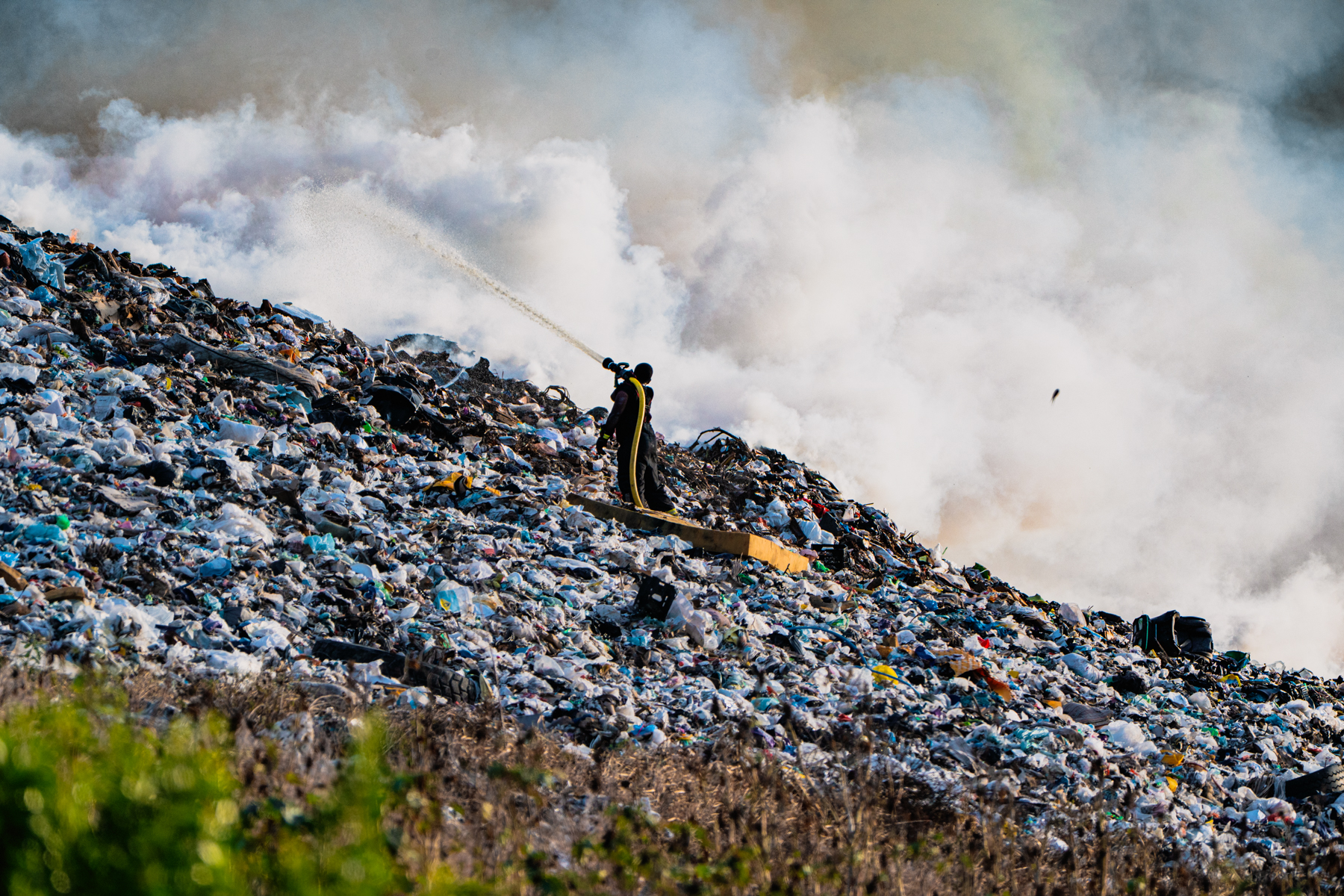
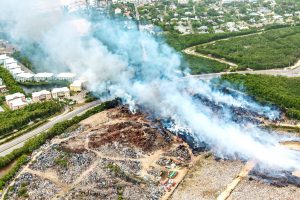
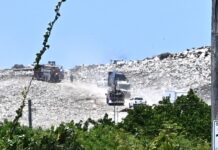
Fire ripped through the George Town landfill site Thursday, causing traffic chaos and the closure of several schools Friday morning.
By 5.30 early Friday evening, fire crews remained actively engaged in fighting the fire. Although the fire continued to emit light to moderate amounts of smoke, there was no longer any visible flames at the top of the landfill mound.
It is the third blaze at the dump in recent weeks, and there appears to still be no government plan in place for a long-term solution to address what residents call ‘Mount Trashmore’.
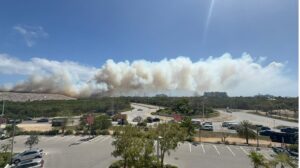
Fire chiefs declared a critical incident after the blaze broke out just before 1pm, sending thick black smoke billowing across the highway. A substantial portion of the site was still burning into the night as crews worked to douse the flames while police drones hovered overhead.
Education Minister Rolston Anglin announced the closure of five schools on Friday due to the ongoing fire and smoke: Bloom Learning Centre, Cayman International School, Footsteps School, Marie Martin Primary School and St. George’s Anglican Preschool.
Police closed the Esterley Tibbetts Highway between the AL Thompson roundabout and Jay Bodden Highway early Thursday afternoon.
Traffic was diverted to West Bay Road and through Industrial Park, and motorists were stuck in bumper-to-bumper jams along West Bay Road, North Sound Way and other streets in George Town. The road was still closed at press-time on Thursday night.
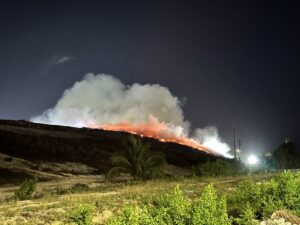
Bright orange flames were visible on the main uncovered mound close to the Esterley Tibbetts Highway.
Opposition leader Joey Hew, speaking to the Compass from the dyke roads by the dump in his George Town North constituency, said he could feel the heat of the fire and saw a projectile shooting from the blaze “like a rocket”.
“This is dangerous,” he said. “The difference between this one and the last one is how close to the road this one is and how close it is to residential areas.”
In a statement issued Thursday night Chief Fire Officer Dwight “Randy” Rankin said the blaze presented a complex firefighting challenge.
“A landfill fire is particularly complex, not only because of the wide variety of materials present, but also due to deep-seated burning, possible methane gas pockets, and intense internal heat that can persist even after visible flames have been extinguished.”
Multiple resources were being deployed including Tanker 1, Tanker 1-2 and a trailer pump. RCIPS drones were monitoring containment efforts and EMS crews were on site to treat firefighters rotating through smoke exposure.
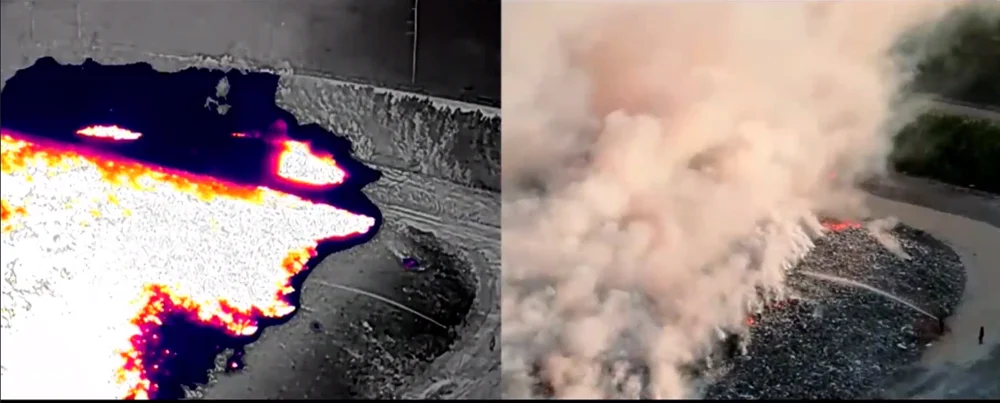
The Fire Services advised members of the public in neighbouring communities in George Town, especially those with respiratory conditions, to be mindful of potential smoke drift.
The Department of Environmental Health was conducting air quality tests in the area to monitor threats to public health, officials confirmed.
Cayman International School alerted parents to the blaze Thursday afternoon, but an evacuation was not required because northeasterly winds were pushing smoke away from the school and across the highway. Minister Anglin later announced that the school would be among five closed on Friday.
At the Lakeside condominium complex, across the Esterley Tibbetts Highway from the landfill, residents were advised to close their windows and doors and run their air conditioners to help expel air inside their apartments but were told that police had said no evacuation was immediately required.
The Red Cross opened its shelter for anyone unable to get home or otherwise impacted by the blaze.
No plan in sight for landfill fix
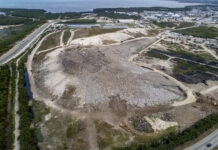
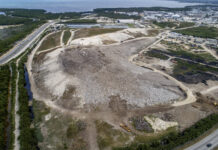
The George Town landfill has been operational since the 1970s. It is unlined, uncapped in its active section, and has no confirmed replacement.
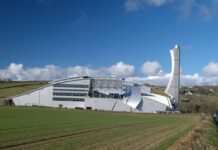
The ReGen project, a deal between government and a Dart-led consortium to build a waste-to-energy facility, recycling centre and smaller lined landfill to replace it, was cancelled in July 2024 after seven years of negotiations.
The landfill, nicknamed ‘Mount Trashmore’ and is one of the highest points on Grand Cayman, has been the scene of some major fires over the years, though the seriousness of the blazes diminished temporarily after the site was capped in preparation for the ReGen project.

Hew told the Compass Thursday, as the landfill continued to burn, that government had scrapped previous plans to replace the dump with a waste-to-energy facility as too expensive without coming up with an alternative solution.
“We simply cannot go with the status quo,” he said, adding that the current government hasn’t proposed any new solutions to the landfill problem.
“There’s no money in the budget, no future plans,” Hew said. “We haven’t heard any further statements as to how we intend to deal with it in the long term. This is pretty serious.”
The Compass reached out to Health and Environment Minister Katherine Ebanks-Wilks and Premier André Ebanks for comment but had not received a response by press time.
This major fire event is a developing story and will be followed with additional coverage on the George Town landfill and the need for a long-term solution.
Related Videos








The head-in-the-sand approach isn’t working
Past time for this to be dealt with. Shame on those involved in previous attempts for not resolving this, instead of thinking of profit, try ‘for the good of the people’. We have lots of bright minds in Cayman, surely there’s some in big business who want to up their ESG by assisting CIG with a solution. DART clearly isn’t in it for anything other than more profit.
If anyone was injured by a fire at the dump at this point, they would certainly have a case for criminal negligence against the government.
I’ve seen enough! Raise the taxes higher on electric scooters and e-bikes that reduce traffic and are green.
The dump probably puts off more pollution in a few days than all cars on the island for a year.
The current government is incompetent. Where do I file a class action for my lung damage breathing in this smoke. Meanwhile I’ll I want is to not register and insure and electric scooter. Makes no sense.
Yet our Gov’t and Civil Service use the term “world class”! in regard to performance!.
No $$$$$$$$$$ in the budget for this but you can spend 500,000 to cull the iguanas. Sand for SMB ???????????? no … only money to kill iguanas. The Govt. has to get some brains.
This is a national emergency for which Hazard Management Cayman Islands (HMCI) exists. Yet, life goes on as usual, and I bet schools will reopen the next day once the fire is extinguished, because it will be declared “safe.”
LANDFILL FIRES ARE DANGEROUS BECAUSE THEY EMIT TOXINS LIKE CARBON MONOXIDE, HYDROGEN SULPHIDE, VOLATILE ORGANICS, DIOXINS, AND FURANS.
Yet, no formal charges of criminal disregard for health and safety have been successfully brought against officials regarding the landfill management, though the situation has been described as “gross negligence”.
I am reposting my 28 March 2026 comment.
I hope my concerns are taken into consideration and the comment is published.
Because too many lives are at stake, the school’s current air quality monitors should be regarded with deep concern, UNLESS HIGH-ACCURACY, REGULATORY-GRADE MONITORING EQUIPMENT is employed to ensure data accuracy.
MONITORS.
I assume the school is using consumer air quality sensors that are MORE SOPHISTICATED THAN those purchased on Amazon for $50-200.
Indoor Air quality monitors only measures specific pollutants: air monitoring systems are designed to detect A LIMITED RANGE of pollutants, usually focusing on PM2.5 (fine particulate matter), but they often MISS the complex, toxic “cocktail” of dioxins, heavy metals, and VOCs (volatile organic compounds) generated by burning plastics and household refuse.
Outdoor air quality monitors often miss precise, regulated measurements of specific gases like nitrogen dioxide, sulfur dioxide, and ozone.
Landfill fires are unpredictable, and pollution is localized; a sensor at one school/location or home may not represent the exposure levels just a block away, or how the pollutant profile changes throughout the day.
Indoor monitoring CANNOT account for soot deposited on roofs, windows, and outdoor surfaces, which can be re-suspended into the air and brought inside by wind, pets, or foot traffic.
Low-cost sensors provide general trends but lack the precision of regulatory monitors, while environmental factors and lack of, or improper, maintenance lead to data inaccuracies.
THE SOOT.
Schools, hospitals, residences, and offices located near the dump fires face another unique air quality challenge—the highly toxic soot.
Measuring indoor air quality in schools, hospitals, and homes near the Dump fires is often inadequate because it fails to capture the full spectrum of pollutants, and misses the hazardous, long-term exposure risks from settled soot. Outdoor structures, soil, and ground surface coverings act as massive collection surfaces for toxic soot, which can re-enter the air, yet they are rarely monitored.
When the wind blows this settled soot becomes airborne again. Soot can be brought inside by wind, pets, or foot traffic. It can settle on outdoor furniture, soil, and play areas, allowing for skin absorption or ingestion (especially in children). This means people are breathing in contaminated dust long after the official air quality report says “good” or “moderate.”
Soot from landfill fires contains carcinogens, such as arsenic, cadmium, chromium, and PCBs (Polychlorinated Biphenyls are synthetic, highly toxic chlorinated aromatic hydrocarbon chemicals).
Unlike gases that dissipate, soot and ash are persistent and can continue to release toxic substances into the surrounding air over weeks following the fire.
Yet, the focus is almost always only on immediate inhalation hazards during the fire, ignoring the long-term, chronic health impacts of residing, working, studying in an area covered in hazardous ash, dust, and soot.
Rain often fails to effectively wash away soot accumulation on outdoor structures, often spreading or embedding the fine, greasy particles rather than removing them.
Cleaning requires mechanical intervention, such as power washing or scrubbing using specialized cleaning solutions.
Lastly, outdoor surface cleaning after landfill fires is typically handled by specialized environmental remediation contractors or emergency response teams. Cleaning is heavily regulated in the US and in other developed countries.
When it comes to children’s health, there should be absolutely no oversights or shortcuts. Soil and surfaces and play equipment on school grounds should be tested and likely remediated—including replacing topsoil. Site-specific testing by LICENSED ENVIRONMENTAL PROFESSIONALS is crucial to assess the extent of the damage and determine the appropriate corrective actions.
Recurring dump fires in Grand Cayman pose significant risks to a developing fetus, primarily causing increased rates of low birth weight, small-for-gestational-age infants, and preterm births. Toxic smoke exposure (particularly PM2.5) during pregnancy, especially in the first trimester, can trigger maternal inflammation, reduce placental oxygen flow, and cause lasting developmental issues.