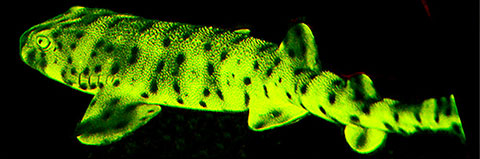
Study began with chance discovery in Little Cayman
Fish may be communicating with each other in a spectacular underwater light show invisible to the human eye, a ground breaking research project that originated in Little Cayman has revealed.
Scientists have identified 180 species of marine fish that glow in different colors and patterns. They believe the discovery could provide new insight into how certain species hunt and find mates.
It could also lead to the discovery of new fluorescent proteins, useful in cancer, brain and other biomedical research.
The study began with the chance discovery of a fluorescing eel, glowing bright green, in the background of a photograph taken on Little Cayman’s Bloody Bay Wall.
It was already widely known that some marine organisms, including corals and jellyfish, fluoresce. But the new study provides the first in-depth look at wide distribution of biofluorescence across fish and even some shark species.
Carrie Manfrino, president of the Central Caribbean Marine Institute and one of the investigators on the study, said researchers at the field station were photographing the reef around Little Cayman in 2009 for an exhibit explaining the science behind fluorescence on coral reefs.
What was going on in the foreground of those images provided part of an illuminating and spectacular exhibit at the American Museum of Natural History in New York called Creatures of Light.
But it was what was going on in the background that really got the scientists interested. The sight of an eel, glowing bright green, prompted a full-scale research project in the Bahamas and the Solomon Islands.
Researchers, wearing green visors over their masks and using special “long-pass” filters on their cameras, were able to document evidence of an underwater light show, invisible to the human eye, occurring on a far greater scale than previously imagined. They found 180 species of fluorescing fish.
“By designing scientific lighting that mimics the ocean’s light along with cameras that can capture the animals’ fluorescent light, we can now catch a glimpse of this hidden biofluorescent universe,” said co-lead author David Gruber, a research associate at the museum.
“Many shallow reef inhabitants and fish have the capabilities to detect fluorescent light and may be using biofluorescence in similar fashions to how animals use bioluminescence, such as to find mates and to camouflage.”
The discovery of a whole new spectrum of fluorescing fish is likely to lead to further research, not just into the evolutionary function of the phenomenon, but also into the future potential for biomedical research.
“The discovery of green fluorescent protein in a hydrozoan jellyfish in the 1960’s has provided a revolutionary tool for modern biologists, transforming our study of everything from the AIDS virus to the workings of the brain,” Dr. Gruber said.
“This study suggests that fish biofluorescence might be another rich reservoir of new fluorescent proteins,’ he added.

Related Videos