

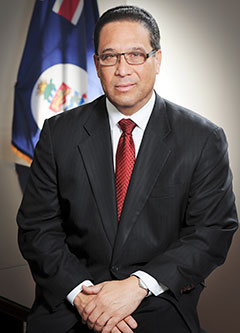
Premier, deputy governor say legislative changes afoot
They were supposed to save money and help government manage the size of the public sector.
However, statutory authorities and government companies often lack clearly defined goals and don’t say if or how they reached those goals and often lack acceptable governance rules. They also have some board members with clear conflicts of interest or no experience in the relevant field.
These revelations were set out in a report released Wednesday by the Cayman Islands Auditor General’s Office.
The report concluded that specific audits of various statutory authorities and government-owned companies would be needed in the future to determine “the extent to which poor government practices have led to poor performance and lack of due diligence” in spending public money.
The problems identified in management, financing and politics of the entities do not apply equally across the 25 statutory authorities and government-owned companies auditors reviewed between 2011 and 2012. However, many problems existed in a number of agencies, Auditor General Alastair Swarbrick said.
Moreover, the ineffective management of these quasi-government agencies has led to confusion with the elected arm of government that oversees these agencies and which has ultimate responsibility for them, Mr. Swarbrick said, leading to serious questions about what the public is getting for its money.
“The linkages aren’t very clear between what government is trying to achieve and what the statutory authorities and government companies are doing,” Mr. Swarbrick said. “They should be looking at what results they’re trying to achieve.
“When you muddy the waters, when the policies and practices aren’t clearly defined, it creates the opportunity for the abuse of public funds.”
Mr. Swarbrick has made similar statements in the past three years.
Premier Alden McLaughlin said Wednesday, “There are those who will say otherwise, but my view of [the creation of the statutory authorities and government companies] is that, by and large, that has not saved the government money.
“If you look at the salaries paid to statutory authorities and government companies compared to those in central government … you would be astounded. There are those in statutory authorities that earn more than the governor, let alone me or the deputy governor.
“We do not believe the statutory authorities and government companies can operate completely outside what obtains in the country and in the [central] government particularly,” the premier continued. “I think there is the mind-set in some of those who control these entities that they are a completely independent entity doing whatever they want. That’s not the case at all.”
Proposal for more oversight
Mr. McLaughlin said it is his administration’s intention to bring forward a Public Authorities Bill that would, to some extent, give the central elected government more direct control over the operations of those agencies.
Deputy Governor Franz Manderson noted, as an example, that when government reduced civil servants’ pay by 3.2 per cent to save money a few years ago, there was some dispute over whether employees within the authorities had to take the same pay cut.
“There shouldn’t be a question about that,” Mr. Manderson said, indicating that the statutory authorities and government company employees should have taken the same pay cut immediately.
Mr. Swarbrick, while not commenting on specific salaries or expenditures, noted that while Cabinet members or the governor appoint boards of directors to oversee the agencies managed outside central government, the internal operations of those agencies are by no means uniform or can be ineffective or risky.
For instance, of the 17 statutory authorities and government companies that responded to a survey from the auditor general’s office, seven stated they did not know the “skill sets, experience or knowledge levels” as far as requirements for individuals appointed to their board of directors. Eight entities did not respond to the survey.
None of the 17 entities make public the registers of interests for the board members and senior managers unless an open records request is filed specifically seeking that information.
Both Mr. Swarbrick and Mr. Manderson said the public release of board members’ and senior managers’ interests should already have been done. Mr. McLaughlin said such public disclosures will be required when the Public Standards Bill is approved by lawmakers, which could happen by the end of this month.
Growing number of authorities
According to figures reported last year by the Caymanian Compass, the core government service has steadily decreased over the past five years, from more than 3,800 employees at its height in 2008 to just over 3,500 in late 2013.
However, employment in the related statutory authorities and government-owned companies has steadily increased, according to a government human resources report.
In January 2001, the civil service consisted of 4,034 employees. It was at that point the government decided to split off the Cayman Islands Health Services Authority from its central government operations, dropping the central service to 3,097 workers. More than two dozen statutory authorities and government-owned companies have been formed since then.
By June 30, 2012, the central government service has increased 17.5 percent from 2001.
The non-central government entities employed 2,262 people by June 30, 2012 from 937 workers initially spun off from the central government service, or a 141 percent increase since 2001.
Mr. Swarbrick spoke to the need, in his view, to “simplify” some of government’s practices. He said one way might be to reduce the number of boards and commissions – of which there are more than 100 – in the Cayman Islands. The auditor general did not give his own views about reducing the overall size of the civil service or those employed by its ancillary authorities.
Mr. Manderson has said that his office planned to reduce about 360 jobs from the civil service by the 2016/17 budget year, but that would largely be done through eliminating vacant positions. The deputy governor does not exert any direct control over the statutory authorities and government-owned companies.
Mr. McLaughlin said reducing the size of the overall government service is a more difficult matter.
“We have to remember this … the majority of the public service is made up of Caymanians,” he said. “Government cannot simply decide the optimum size of the public service ought to be 2,500 or 2,600 people and go about a process to ruthlessly trim the size of the service.
“Government cannot act as a private sector employer.”
A total of 25 statutory authorities and government-owned companies were listed in the auditor general’s report.
Eight did not respond to the survey: Cayman Airways, Cayman Islands Development Bank, Children and Youth Services Foundation, Civil Aviation Authority, National Drug Council, National Housing Development Trust, Sister Islands Affordable Housing Initiative and University College of the Cayman Islands.
The 17 agencies that responded were: Cayman Islands Airports Authority, Cayman Islands Monetary Authority, Cayman Islands National Museum, Cayman Islands Stock Exchange, Cayman National Cultural Foundation, Cayman Turtle Farm, Cayman Islands National Insurance Company, Electricity Regulatory Authority, Health Services Authority, Information and Communications Technology Authority, Maritime Authority, National Gallery of the Cayman Islands, National Roads Authority, Port Authority, Public Service Pensions Board, Tourism Attraction Board and Wate
r Authority.

Related Videos













Not before time! This should have been dealt with thirty years ago. Every MLA during that time has been aware of this state of affairs, so let’s hope this is not just another false start.
When you can see the head of one statutory authority driving around in a new 4×4 for his personal use purchased with authority funds (public money) while government are struggling with garbage trucks and other vehicles, something is very very wrong.