Wednesday marked a special day in education for Cayman with the launch of Our Ocean Planet, a teaching aid produced by the Central Caribbean Marine Institute which will be providing a way for Cayman’s Year 6 teachers to cover a treasure trove of ocean knowledge.

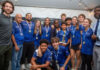
Programme Developers with Our Ocean Planet Tim Courtis, Greenlight Re; Clive Baker, curriculum development for Department of Education; Bart Hedges, CCMI education chair; and Valentino Lee, author of Our Ocean Planet. |
Bart Hedges, chairman of the Central Caribbean Marine Institute’s Education and Outreach Committee was joined by author and dedicated CCMI volunteer Tino Lee, along with the Department of Education’s Chief Education Officer Shirley Wahler and Head of Curriculum Services Clive Baker, as well as Peter Beckford from the Ministry of Education to launch the manual.
‘This project started some time ago when Ms Carrie Manfrino, the founder of CCMI, asked a student to develop an outline for an activity manual to promote ocean literacy,’ said Mr. Hedges.
An ocean-literate person understands how the ocean functions, can communicate about the ocean in a meaningful way; and is able to make informed and responsible decisions regarding the ocean and its resources.
‘Since then, with Carrie’s guidance, we’ve advanced the concept considerably. CCMI’s stated goal is for every child in the Cayman Islands to be ocean literate by the time they are 12 years old. This is an ambitious goal but with the partnership of the Cayman Islands government and the effort of local educators we’re confident it can be achieved.’
Mr. Hedges’ firm, Greenlight Re, has been actively supporting CCMI’s education initiatives for several years.
Now KPMG, Caribbean Utilities Company and PriceWaterhouseCoopers have joined Greenlight Re in funding a three year programme, which will support training for primary school teachers on the manual, set to be implemented in the second half of the current school year.
The aim is to further develop the manual to include more advanced teaching tools for middle and senior school students.
‘Although our focus is on educating the decision makers of tomorrow, we are also planning a public outreach program targeted at all Cayman residents and in particular the parents of our students,’ said Mr. Hedges.
‘After all, we Cayman residents are all closely linked to our ocean surroundings and our collective actions will determine how well we can preserve our environment.’
Mr. Hedges noted the impetus behind the teachers’ manual was that ocean and aquatic sciences are among the most underrepresented disciplines in the K-12 educational curriculum.
‘The ocean covers 70 per cent of our planet. It is the source of most life on Earth. It regulates our weather and climate. It provides most of our oxygen and feeds much of the human population. Yet concepts about the ocean and the coasts infrequently appear in K-12 curriculum materials, textbooks, assessments or standards, and are rarely taught at any level.’
Recognising this, the National Oceanographic & Atmospheric Administration and National Geographic Society along with many scientists and science educators collaborated to define ocean literacy and produce a set of essential principles and fundamental concepts.
‘Ocean literacy is an understanding of the ocean’s influence on you and your influence on the ocean,’ said Mr. Hedges.
‘Given the importance that the ocean plays on pretty much all aspects of our lives as Cayman residents, we believe it is especially important for all of us to be ocean literate.’
Our Ocean Planet was written to illustrate seven essential principles that are explored through the materials.
‘The principles are applicable to middle school and high school as well as primary school,’ said Mr. Hedges.
‘This is why CCMI has now developed a three year project, which will include the development of teaching materials for middle and high school students in support of Ocean Literacy. We now view Ocean Literacy as the umbrella programme for all of CCMI’s local education initiatives including our field study programs – Eco Weekends and Caribbean Sea Camp.’
Shirley Wahler said she was pleased with the outcome of the project.
‘It’s a fantastic resource for teachers, in offering an emphasis on Cayman while also presenting a global perspective on the importance of oceans,’ said Mrs. Wahler.
‘This resource does a terrific job of bringing relevance to what our oceans mean and considerably surpasses traditional science resources.’
She was particularly impressed with the fact that the resource includes a whole section on Cayman, which is unprecedented in contemporary science textbooks.
‘This underscores to students that place that you live is important, and that what’s relevant here is also relevant out in the world,’ she said.
‘What it says to students is that Cayman is important. The more you know, the more value you understand about the place you live, the more invested you are in preserving it.
Mrs. Wahler also underscores the importance this resource has in context of Cayman’s ocean heritage.
‘It gives legitimacy and value to the knowledge about the ocean that Cayman students and their parents already have, which we hope will inspire students to learn even more.’
The seven essential Ocean principles
1. The Earth has one big ocean with many features
2. The ocean and life in the ocean shape the features of the Earth
3. The ocean is a major influence on weather and climate
4. The ocean makes Earth habitable
5. The ocean supports a great diversity of life and ecosystems
6. The ocean and humans are inextricably interconnected
7. The ocean is largely unexplored
Related Videos