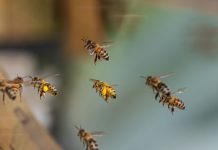
Bee expert Otto Watler said there is absolutely no need for residents in Grand Cayman to panic about Africanised honey bees, also known as killer bees, in the Cayman Islands.
Mr. Watler’s comments came on the heels of a highly publicised incident in West Bay last month in which a woman, who was bathing her dog outside after a day at the beach, was attacked by a swarm of bees, killing the dog and leaving the owner with multiple stings all
over her body.
Other high-profile incidents include the 2008 death of the father of boxing champion Charles “Killa” Whittaker, 78-year-old Shirley Whittaker.
“Usually when bees attack, there is usually a high degree of human error that needs to account for. The bee dies after it stings and therefore it is in its best interest not to do so, and bees know this,” said Mr. Watler.
The honey farmer said a lot of people don’t know very much about bees and blamed this lack of knowledge as a major factor in attacks.
“For one, bees don’t like pungent smells, and if you go near their hive with cologne on or if you have a foreign scent like garlic of something distinct like that, the bees will move in. The scent created when the woman in West Bay was washing her dog could have been enough to aggravate the bees,” he explained.
Mr. Watler added that like humans, some bees have more get up and go than others and may be more inclined to sting than others. However, once the stinging starts the stingers leave behind a scent trail that incites the other bees and this is what can start a frenzied
attack.
“If you see a hive of bees, stay away from them,” warned the bee keeper, who pointed out that one thing that concerned him was how most children tend to throw rocks at bee hives, almost instinctively. He said this was something that was extremely dangerous and urged all parents to make sure their children knew enough about the creatures in their environment to avoid getting into serious trouble.
When bees are swarming they are also particularly aggressive and if anyone should see a swarm on a tree limb, preparing to move from one hive to another, they should report the occurrence to the Department of Environment or Agriculture and Mr. Watler’s team will come out to extract the bees.
The cost for this service can range from $100 up to $300.
The only bee other than honey bees that inhabits the Cayman Islands is the black bee, which you will often see around cherry trees, according to Mr. Watler, who added that swarms of these bees are almost never seen.
Mr. Watler declared however that there are no Africanised honey bees in Cayman, as it would be impossible for them to get here unless someone brought them. He added that this was highly unlikely and there was simply “too much sea for them to cross.”
Related Videos