With menacing Tomas still making a
beeline toward an already quake-battered Haiti, President René Préval travelled
by helicopter and road to the southern and western coasts Monday to assess
hurricane preparedness and ramp up evacuation plans.
“Since 2004, we have been getting
hit by hurricanes,’’ Préval told The Miami Herald by phone Monday as he left
the south-western city of Les Cayes and headed to Jeremie on Haiti’s western
tip.
“This is why we started early, to
make sure there are no deaths. We are doing everything we can to make sure
there are none.’’
At 5am Tuesday, the National
Hurricane Center said Tomas had slowly intensified overnight, with sustained
winds at 50 mph, and remained on a track that will begin curving north late
Wednesday or early Thursday toward Haiti’s southern coast. The updated forecast
slows Tomas a bit, with Haitians likely to begin feeling its effects in the
early morning hours of Friday.
John Cangialosi, a hurricane specialist
at the National Hurricane Center in West Miami-Dade, said the powerful centre
of the storm could shift significantly to the east or west before the storm
makes landfall. The latest track showed it striking near Les Cayes on a path
that could also take it close to the heavily populated capital city of
Port-Au-Prince.
“The overall trend here is they
will be affected,’’ he said. “How strong the winds will be is a question mark
and exactly where the track will be is a question mark.’’
With wind shear and dry air taking
a toll on Tomas, the centres lowered its predicted power from a major storm to
a Category 1 hurricane or perhaps even a strong tropical storm but forecasters
acknowledge that pinpointing intensity is difficult.
Flooding fear
In Haiti, however, wind speeds
won’t be as critical as rainfall totals.
Flooding from Hurricanes Hanna and
Ike in 2008 killed more than 800 people and the four hurricanes that hit Haiti
that year left $1 billion in damage. A tropical deluge also could overwhelm
efforts to contain an outbreak of cholera, caused by drinking contaminated
water that already has killed more than 300 people.
Meeting with authorities from the
surrounding vulnerable regions around Les Cayes in south-western Haiti, Préval
asked for an inventory of needs, announced that a fleet of government vehicles
including evacuation buses and heavy earth-moving equipment were already on
site and that shelters had been identified. The health ministry was evaluating
the possibility of evacuating patients at the government-run hospital, which is
prone to flooding.
“We are trying to get everyone to
work together,’’ Préval said. “We began with the South, but we are not certain
that is where it will do the most damage.’’
Still, the southern coast’s largest
city – and Haiti’s fourth largest, Les Cayes – is vulnerable to floods even
with normal rainfall.
“Once a hurricane hits us, we are
in a mess,’’ said Pierre Leger, a Les Cayes businessman, recalling how twice in
two years mud buried the city of Gonaives after hurricanes.
“We have two canals – one on the
left, one on the right. They are blocked with trash, there are houses built on
them. What happened to Gonaives could happen to us.’’
On Monday, US officials announced
that the USS Iwo Jima was on its way to Haiti. The ship, which can support
helicopters, is scheduled to arrive later this week.
Prime Minister Jean-Max Bellerive
said the government was calling on people in the South to evacuate if the storm
poses a dangerous threat. But even as officials planned for potential disaster,
concerns remained.
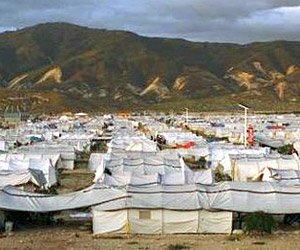
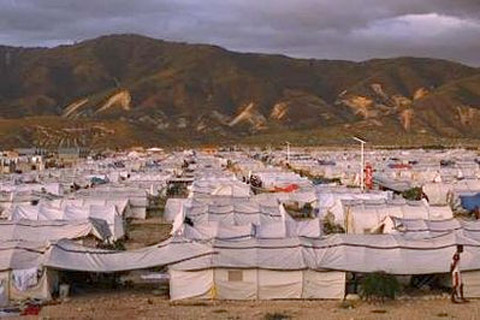
A recent survey of hundreds of tent
cities in Port-au-Prince revealed that only 30 per cent of the displaced had a
place to move into, and officials were still trying to identify potential
buildings that can shelter people.
“We are making buses available to
evacuate people in the camps, like children. But when we say evacuate, the
question is where do we take them,’’ Mr. Bellerive told The Miami Herald.
The Cayman Islands Immigration
Department will make the determination of whether to accept any Haitian
refugees.
As officials plan for the storm,
they continue to deal with the cholera epidemic. On Monday, a government
official confirmed a US Centers for Disease Control and Prevention report that
the cholera strain found in Haiti matched strains commonly seen in South Asia.
The UN has denied that Nepalese soldiers at a base in the city of Mirebalais,
in Central Haiti, are responsible for the outbreak.
Since the epidemic began in Haiti’s
lower Artibonite Valley two weeks ago, Haitian officials have been fighting to
keep it from spreading. Humanitarian aid officials say rain and floods make for
a “toxic combination’’ for the spread of the waterborne infection.
“This storm could not have come at
a more difficult time,’’ Humanitarian Coordinator Nigel Fisher said. “Although
we have made extensive preparations and pre-positioned stocks across the
country, some crucial supplies have been badly depleted by ongoing needs,
particularly the response to the ongoing cholera epidemic.’’
The UN has appealed to donors
seeking emergency shelter, including tarps, water, sanitation supplies and oral
rehydration salts for cholera treatment.
Meanwhile, Haiti’s neighbours were
also preparing for Tomas. The Dominican Republic closed beaches along its
southern and eastern coasts as the Emergency Operation Center warned residents
to brace for 9- to 12-foot waves within the next 24-72 hours. The country’s
Ministry of Health also issued an infectious disease warning, saying that swollen
rivers and lakes could lead to a rise in illnesses.
In Jamaica
Jamaica’s Prime Minister Bruce
Golding held an emergency meeting with his cabinet Monday. The Meteorological
Service said the country could feel the outer bands of the storm on Thursday or
Friday, with periods of heavy rain and strong winds as it passes east of the
island.
The government also advised fishing
fleets to return to the mainland.
The storm has already been blamed
for anywhere from three to 12 deaths in the eastern Caribbean, where Tomas
raked across Barbados before gaining strength to hit St. Lucia and St. Vincent
and the Grenadines as a Category 1 hurricane.
The Caribbean Disaster Management
Agency said the storm killed at least three people in St. Lucia, injured two in
St. Vincent and the Grenadines, and damaged hundreds of homes and dozens of government
buildings throughout the region.
St. Lucia Tourism Minister Allan
Chastanet, however, said there were at least 12 confirmed dead, the Caribbean
Media Corporation reported.
Related Videos