Any day now it should be determined where Cayman’s foster crocodile comes from so that the reptile can be sent home to its wild population of origin.

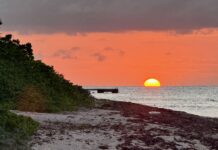
This Crocodile was captured in the sea near Old Man Bay 30 December. |
The 7.5- to eight-foot American Crocodile has been housed in a tank, screened from public view, at Boatswain’s Beach adventure park since 30 December, after being captured at Old Man Bay.
Director of the Department of Environment Gina Ebanks-Petrie said that information is expected back from the Smithsonian Tropical Research Institute in Panama in the form of preliminary results, indicating whether the animal comes from Cuba, Central America or South America.
The process to get the animal back to its population can then begin.
Blood and tissue samples from the animal were sent to the Smithsonian Institute, where genetic analysis is being done on the DNA to help determine the population of origin of the animal.
Department of Agriculture Marketing Co-ordinator Brian Crichlow explained that blood samples that had originally been taken immediately after the animal’s capture had to be taken again about a month ago because those samples had become unusable due to storage conditions. Information gathered through research led to this conclusion, he said.
Ms Ebanks-Petrie said at a press conference in January that they believed it to be in the animal’s best interests to repatriate it to its native population.
Mr. Crichlow confirmed that the reptile has fully recovered from a spear gun wound it received during capture.
The animal’s housing facilities at Boatswain’s Beach have improved greatly from what they were shortly after its capture, he added.
Now that its wound has healed, the crocodile has much more room to move around, with full access to a water tank to swim in and an area to bask in the sun out of the water, he noted. The area is set up in order to minimise the reptile’s exposure to human beings, so it can be returned to the wild.
The animal is fed every three days, as is suitable for such a reptile.
Mr. Crichlow added that no microchip was found in the crocodile as any indication that he may have belonged to a captive facility.
A microchip has now been placed in the croc in order for identification purposes.
The health of the reptile is still being monitored by the Department of Agriculture, while under the day to day care of Boatswain’s Beach staff.
Crocodiles have been occasional visitors to Grand Cayman and the Sister Islands in the past, with the last sighting in the 1950s.
Related Videos