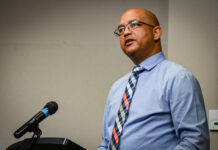
A year ago today, on 12 March, a solemn-faced Premier Alden McLaughlin announced at a press briefing that Cayman had its first COVID-19 case.
Of six samples from suspected cases that had been sent to an overseas lab, there was one positive result – from a 68-year-old Italian man who had been a passenger on board the Costa Luminosa cruise ship, that had arrived in Cayman on 29 Feb. The man had suffered two heart attacks while on board, and had been transported from the ship by ambulance to Health City Cayman Islands.
The next day, Health City announced it was temporarily closing its doors after a number of its staff appeared to have coronavirus symptoms. The Italian patient died the following day. Ultimately, it was confirmed that two staff members at the hospital had been infected.
At the time, Cayman had no ability to carry out COVID-19 testing on island, and samples had to be sent to a Caribbean Public Health Agency laboratory in Trinidad and Tobago, which took between five and 10 days. By the following week, the Health Services Authority had begun testing any patients who presented with typical COVID-19 symptoms, but widespread testing did not begin locally until 8 April when a shipment of 165,000 PCR test kits arrived from South Korea.
Asked at a recent press conference about those days after the first case was reported, McLaughlin described them as the “scariest period” of his life “because we didn’t know what we didn’t know because we had no ability to test and we had no idea how widespread or not the disease was in the community”.
Once the first case was discovered, COVID-19-suppression restrictions were quickly introduced with each daily press briefing bringing a new announcement regarding what local residents could and could not do, beginning on 14 March with the closure of all schools and a 50-person cap on public gatherings, as well as a ban on cruise ships.
Following soon after was the shutting down of Cayman’s two international airports for all but emergency or repatriation flights. After two more cases were reported, the first nighttime curfew was introduced on 24 March and gatherings were restricted to a maximum of 10 people, which was soon reduced to two people.
Then, on 25 March, the government placed Cayman under a 24-hour-a-day curfew, until 5am on 28 March because, the premier said, it had been unable to get cooperation from the business community for an order to shut down non-essential businesses, after there had been more than 850 requests for exemptions, totalling more than 20,000 workers.
By the end of the month, residents were being allocated grocery shopping days according to the letter their surnames began with.
McLaughlin said, “That was an incredibly challenging time. We were making a lot of decisions in the dark, just made on the basis of judgment and common sense, without any clear evidence to support them. A lot of those decisions initially were challenged, because who wants to go into lockdown, who wants to have restraints placed on their ability to move around?
“I know that the decisions we took – even though some thought, and many did say, we were over-reacting – they were absolutely the right decisions. Our strategy from the start was to seek to eliminate the virus in the Cayman Islands because we knew and understood, by seeing what was happening in other places, that to do otherwise meant that you were going to keep having these surges, and then implement measures and you reduce the spread, and then you reopen, and then the surge starts again.
“Until we could get to the point where we are now, where there are vaccinations available, we understood that our best hope for something approaching normalcy in terms of the life we can lead in Cayman required that we eliminate the virus in the community so we could then lift other restrictions and people could behave quite normally.”
For someone arriving in Cayman, it may seem as though life has returned to normal here, as there has been no community transmission since September, but a glance at Seven Mile Beach or the waterfront in George Town tells a different story, as the island is devoid of stayover and cruise ship tourists.
International tourism is non-existent, with flights into Cayman remaining restricted and all incoming travellers requiring to be quarantined for at least 14 days, effectively preventing US visitors, who typically have 10 days of vacation a year, from coming here.
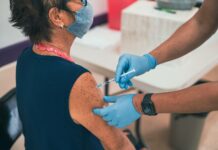
Visit any hospital or doctor’s office, and you’ll spot patients wearing masks, as is still required by law, while hand sanitiser is available at the entrance of almost every store on island. Perhaps the most telling sign that COVID is still among us is the scores of people who show up daily at the Owen Roberts International Airport’s check-in hall, which has been converted into a vaccination clinic.
By 11 March, Cayman had received 58,000 doses of the Pfizer-BioNTech vaccine from the United Kingdom. Another 43,000 doses are scheduled to arrive in two batches by 7 April, meaning that there will be enough vaccines to inoculate the entire adult population of the islands.
McLaughlin is urging anyone who is able to take the vaccination to do so, “so that we get to the point where we can safely open the borders and our people can move around the world without grave concern about becoming really ill, or worse, as a result of COVID-19”.
He added that he was overwhelmed by “the success of what we’ve done and I think we all have a lot of people to thank, and God to thank, for having delivered us this far”.
Related Videos