Staff and guests at Pirates Point and the Department of Environment this morning rescued a huge green sea turtle that had become trapped in bushes on the grounds of the resort on Little Cayman.
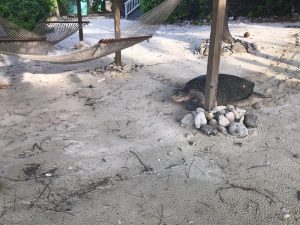
It comes as observers around the world mark World Sea Turtle Day.
Guest Liz Wyatt spotted the turtle as it made its way across the grounds, heading in the opposite direction from the sea. The turtle became trapped in bushes and could not extricate itself, so Wyatt called staff, who alerted DoE officer Mike Guderian.
The group managed to free the turtle and direct her back towards the ocean and the animal slowly made her way back to the sea.
Wyatt told the Compass she had seen turtle tracks on the beach earlier and had just figured a turtle had nested and gone back into the sea. But a few minutes later, she said, she heard a noise near the resort’s laundry building.
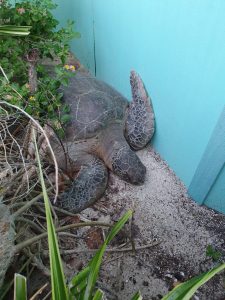
“Then I saw this huge turtle under the trees, near the bushes. She looked really tired and I could see her tracks looping around. She started to make her way away from the sea, towards the road. I tried to stand in front of her to block her path, but she was having none of it.
“She got completely stuck between a building and bushes and couldn’t get out of there.”
Wyatt phoned Pirates Point staffer Michelle Davis who contacted Guderian. Joined by another staff member Richard Trevaskis, the small group hosed down the turtle with water, which Wyatt said seemed to revive the animal a little.
Between them, they managed to get the turtle out of the bushes.
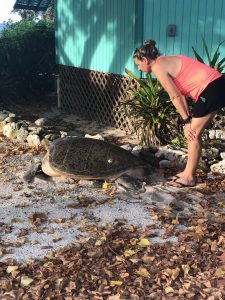
“She started heading for the water,” Wyatt said. “She made her way over the patio. She seemed to smell or hear the ocean…
“It was a very happy moment when she pushed her way into the sea. It was just lucky that I was up early and happened to see her.”
Turtle nesting season is currently under way, when the females climb ashore, dig nests on beaches and lay their eggs.
The number of nests found in the Cayman Islands has increased significantly in the past 20 years, according to a recent report in a study carried out by the DoE and the University of Exeter in the UK.
Related Videos