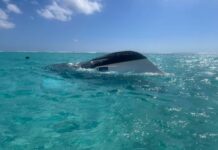
A court hearing is under way that will decide if the director of the Department of Environment can act on behalf of the National Conservation Council to direct the Central Planning Authority to reject applications for proposed developments that may have detrimental impacts on the environment.
A Grand Court judicial review, brought by the National Conservation Council against the Central Planning Authority, began on Tuesday, 14 June.
The case before Acting Justice Alistair Walters revolves around a direction given by Director of Environment Gina Ebanks-Petrie to the CPA last year to reject an application by property developer Cayman Property Investments Ltd to rebuild a seawall and cabana on Boggy Sand Road in West Bay, which abuts a protected marine reserve. The CPA instead granted planning permission for the work.
The first day of the two-day hearing kicked off with Chris Buttler, the attorney acting for the National Conservation Council, arguing what he said were the three salient points in the case. These were whether the CPA had discharged its duty to determine if the development was likely to cause an adverse effect on the marine reserve; whether it had a legal obligation to give its reasons for rejecting the director of environment’s direction; and whether the NCC had the statutory power to delegate its functions to the director of environment.
Buttler told the judge, “The marine reserve is the sea off Seven Mile Beach. Given the sea laps against the site, it is right on the boundary. When the sea comes underneath the existing seawall, as it does from time to time, on those occasions, the site is within the marine reserve.”
He contended that the CPA had ignored Ebanks-Petrie’s assessment of the likely adverse impact on the environment, and then, despite having what he described as a “heightened duty” to do so considering it had disregarded her expert opinion on the matter, the board had failed to give reasons on why it had made that decision.
Cayman Property Investments, in September last year, was granted permission by the CPA to demolish the existing seawall, which is disintegrating, and replace it with a new wall, and a new cabana. An earlier application to replace the cabana with a three-storey residential home had been rejected by the planning board.
In October last year, the court granted the NCC leave to bring a judicial review, and placed a stay on beginning the construction work on the cabana and seawall until the matter was decided by the Grand Court.
‘Delegated authority’
Ebanks-Petrie, in her response to the planning application last year, under “delegated authority” from the National Conservation Council, had directed the planning board to turn down the application, citing the impact suspended and dissolved particles and sediment displacement from the construction of the site would have on the protected coral and sponge species in the marine reserve.
Ian Paget-Brown, QC, the attorney representing the CPA and Cayman Property Investments, argued that there is no authorised or signed documentation that indicates that the NCC can delegate to the director of environment its power to order the CPA to reject an application – an issue which he said had also arisen at an earlier hearing by the Planning Appeals Tribunal in an unrelated case.
He told Justice Walters that if the court determines that there is no legal basis for the director of environment’s claim that she was acting on delegated authority from the NCC, that would negate the rest of Buttler’s arguments regarding whether the CPA had taken into account Ebanks-Petrie’s input on the likely adverse environmental effects or the board’s failure to provide reasons why it had not abided by her order.
The Department of Environment’s submission on the application reads, “In the exercise of powers which have been conferred through express delegation by the National Conservation Council… the Director of DoE respectfully directs that you refuse the planning permission under section 41 (5) (b) of the National Conservation Act, on the basis that the proposed development will result in the detrimental alteration of a Marine Protected Area and the environment generally…”
Paget-Brown contended that Ebanks-Petrie did not have the legal power to direct the CPA to turn down the application, noting that the National Conservation Act’s section 13 states, “The [National Conservation] Council may delegate any of its functions, other than the making of orders and the issuing of directives, to the Director or to any committee or sub-committee of its members.”
According to the minutes of the meeting at which the CPA made its decision, the board had stated that it was “satisfied that it was not in possession of a lawful directive issued under Section 41 (3) of the National Conservation Act, by the National Conservation Council directing the Authority to refuse planning permission”.
Buttler pointed out to Justice Walters that, in all instances when the word ‘directive’ appears in the National Conservation Act, it relates to the making of rules, rather than individual decisions.
He stated that clearly the intention of Section 41 (3) of the Act was for the council to delegate its powers on individual decisions, as it would be “impractical” for the entire National Conservation Council board to meet every time any public body is making a decision on a matter relating to potential adverse effects on the environment.
Paget-Brown said Buttler’s argument that the use of the word ‘directive’ in the context of the National Conservation Act referred to broader rules rather than individual applications, was moot, stating that the director of environment effectively had “ordered” the CPA to turn down the application, and that the National Conservation Law specifically excludes the director from the making of orders.
‘Adverse effect’
In his argument, Buttler stated that, under the National Conservation Act, Parliament prohibits the CPA from granting planning permission unless it gets approval from the National Conservation Council in situations where there may be an adverse impact on a protected area or species.
“The Central Planning Authority has a statutory duty to decide whether there will be a relevant adverse effect,” he said.
And, in cases where the planning authority decides there will be no adverse effect, if that is contrary to the opinion of the director of the environment who has been chosen by Parliament to be the expert in this field, then clear and rational reasons must be provided to explain why the board made that decision, he said.
Buttler told the judge that, according to the minutes of the meeting at which the proposed development was considered, the CPA had “strikingly” failed to address Ebanks-Petrie’s assessment relating to the adverse effects the construction of the site would have on the marine environment. He said this indicated that the CPA, therefore, had not done its statutory duty to consider the potential adverse effects of a development on the environment.
Under Section 41 of the National Conservation Law, 2014, all government entities are required to comply with the provisions of the Law, and section 41 (3) states that “every entity shall, in accordance with any guidance notes issued by the Council, consult with the Council and take into account any views of the Council before taking any action including the grant of any permit or licence and the making of any decision or the giving of any undertaking or approval that would or would be likely to have an adverse effect on the environment generally or on any natural resource”.
The issue of guidance notes came under scrutiny by both lawyers in Tuesday’s hearing.
Paget-Brown argued that while a guidance note appeared to be the only documentation that implies the director of environment may have delegated powers from the NCC to order the planning board to make a specific decision, guidance notes cannot be considered to be mandatory orders and are not legally binding.
Buttler, however, told Justice Walters that guidance notes are legally binding and must be followed, unless they have been successfully challenged in court by way of a judicial review.
Paget-Brown also contended that the CPA had taken the director of environment’s comments on board when it made its decision, as it had set out specific conditions on the construction of the replacement seawall based on an earlier submission made by the director, such as the use of a curved seawall to dissipate wave energy.
He told the court that to do nothing – and to leave the existing seawall and the cabana it supports to eventually collapse into the sea – would have more of an adverse effect on the protected marine environment than building a replacement wall.
Under its plan, Cayman Property Investments Ltd had proposed building a new wall inside the existing wall; once the new wall is completed, it would remove the old wall, using silt screens to prevent construction material and particles from entering the sea, he said.
The hearing continues on Wednesday.
Related Videos