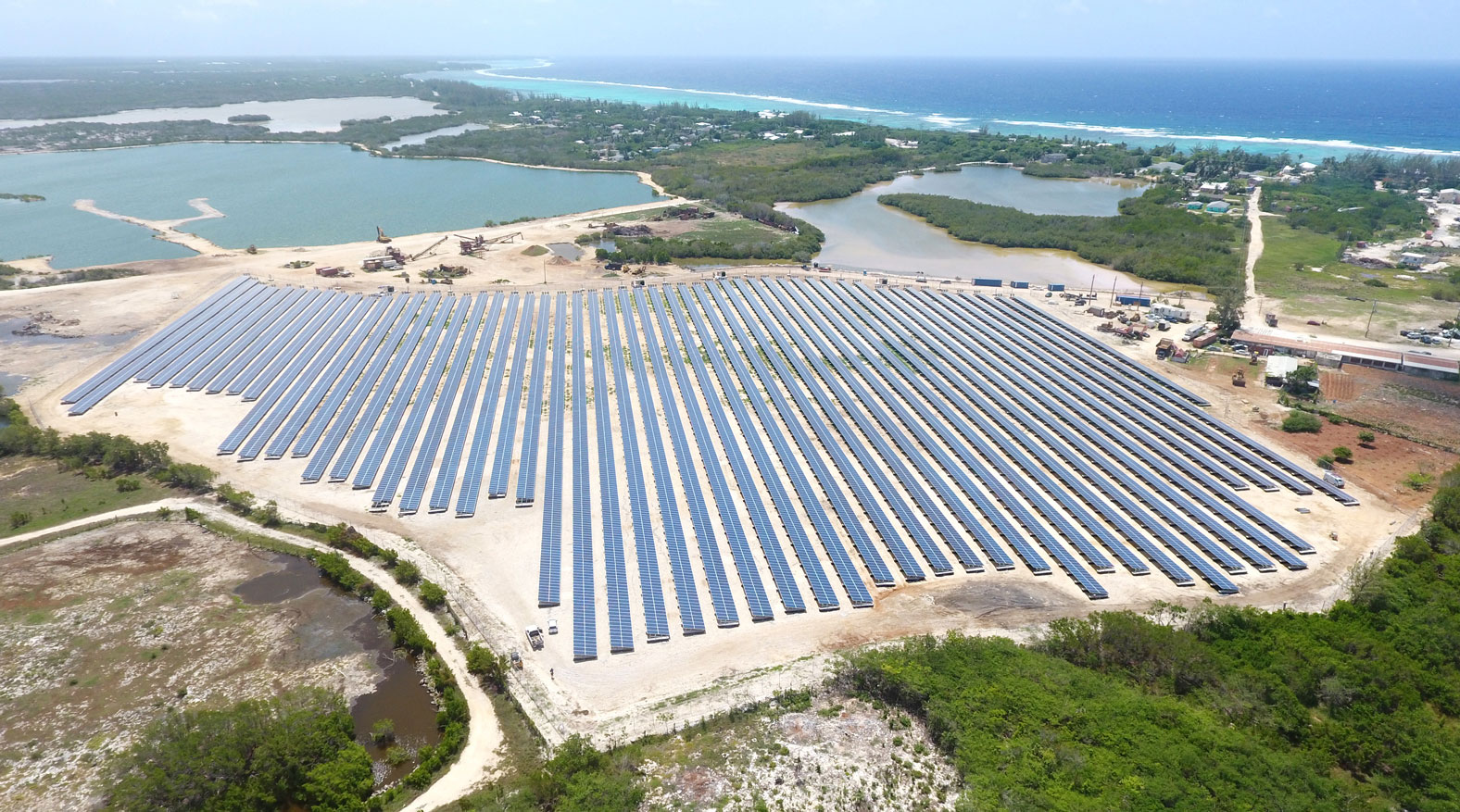
Plans for a new utility-scale solar plant are moving forward as regulators seek to kickstart Cayman’s transition away from fossil fuels.
Regulator OfReg says it is not waiting for government to produce the legislation and policy framework required to support Premier Wayne Panton’s recently-announced intention to co-own renewable power plants.
The details of how that initiative, which came as a surprise to both the regulator and the Caribbean Utilities Company, remain unclear.
And OfReg says, in the absence of any new directive, it is proceeding with plans for a competitive bid process involving private-sector companies.
Eight potential energy bidders took part in an initial screening process. Those will be narrowed down to a handful of serious applicants, including CUC, before a contract is awarded to build the islands’ biggest solar farm.
The project is expected to be around 23 megawatts – more than five times the energy output of the existing solar farm at Bodden Town.
Gregg Anderson, OfReg’s executive director of energy and utilities, said the recent announcement that government wanted part-ownership of solar farms to ensure profits stay on island, had not impacted the procurement process.
While that may happen further down the line, he said legislation and other supporting policy documents will be required.
As it stands, OfReg is legally required to go through a competitive process to find the cheapest and best qualified bidder to provide solar energy to Cayman.
The project currently out to tender is expected to be the first of at least five utility-scale solar projects. It is possible, therefore, that the new model of joint ownership proposed by Panton’s government may come into play later down the line.
The question of government ownership
The premier announced plans for the Cayman Islands government to have a majority ownership stake in future large-scale renewable energy projects.
He characterised the move as one which would speed up the adoption of renewables.
“We have to make up for lost time. Faster adoption of renewable energy moves us closer to energy security and energy independence,” Panton said in a keynote speech at a conference in Miami in April.
However, government acknowledged in a later press release that there would need to be a period of “stakeholder engagement” to determine how this process would work.
OfReg has just been through a multi-year consultation process to determine the best way to procure renewable energy projects, eventually landing on the auction process that is now under way.
Anderson said the regulator had a clear remit to follow the existing law and the National Energy Policy, and has received no directive from government to change course.
He said waiting for new policy or legislation to clarify government’s ownership ambitions would serve to delay the adoption of renewable energy.
“We don’t know when this change is coming or if it is coming,” he said. “To stop the process now could potentially set us back.”
Talks with government
OfReg chairman Rudy Ebanks insisted government and the regulator were talking to each other.
Questioned about the apparent disconnect in the two policy announcements, he said, “We are having that conversation. The issue is, first of all, the law hasn’t changed, nothing has changed that makes us deviate from what we’re doing.”
He added, “Apparently, government hasn’t yet finalised what they really want to do, how it’s going to work, what they’re going to put together. So they’re not yet in a position to give us any directive.”
CUC, which will be one of the bidders on the first OfReg auction for renewable energy, was equally surprised by Panton’s announcement.
Vice President Sacha Tibbetts said government’s announcement was a “clear and abrupt change in direction”, but he didn’t rule out the possibility of CUC partnering with government on a future project.
For now, he said the company would participate in the OfReg procurement process in the hope of winning the right to build its own solar farm. If the procurement process changes in future, he said the company would be willing to discuss partnering with government in a consortium that allowed it to achieve its aims.
Behind schedule
Tibbetts believes CUC could already have established significant renewable energy-generating capacity if the debate over the procurement process had not rumbled on for so long. He accepts the monopoly power provider will have to compete for generation licences under the new methodology but argues there is no time for further debate over the bidding process.
“CUC’s desire has always been to get as much renewable energy on the grid as possible,” he said.
The procurement schedule, he said, was already behind schedule to meet the targets in CUC’s integrated resource plan and in the National Energy Plan which calls for the islands to be 70% powered by renewables by 2037.
Despite the confusion over the potential policy shift, he remains confident that Cayman’s transition to solar can be vastly accelerated over the next decade.
“I think there is widespread interest on taking this forward and global frustration over how long this is taking.”
He said OfReg had been slow in getting to the procurement stage, but now that process is under way, CUC is happy to be part of it.
“We have been ready to execute on large-scale solar for three years,” he said. “When the RFP comes out, we will be submitting the plans we have had for quite some time.”
He said he was aware of no changes that would require CUC to partner as co-owners with government – at least not during this procurement process.
“Going into partnership with any entity is a longer discussion. We are not closing the door on anything but we would have to hear what has to be said.”
Solar makes economic sense
He believes both OfReg’s procurement process and government’s plans, if executed in a fair and equitable way, are viable methods of getting renewables on the grid.
But he insisted time is of the essence.
The war in Ukraine and the aftermath of COVID has resulted in spiking oil prices. Every year Cayman relies on oil instead of wind or solar, its residents lose out.
“We can’t continue to do things that delay this process any longer, Tibbetts said. “Every year we rely on fossil fuels over renewables, that is millions of dollars spent that could have been saved.”
Related Videos