

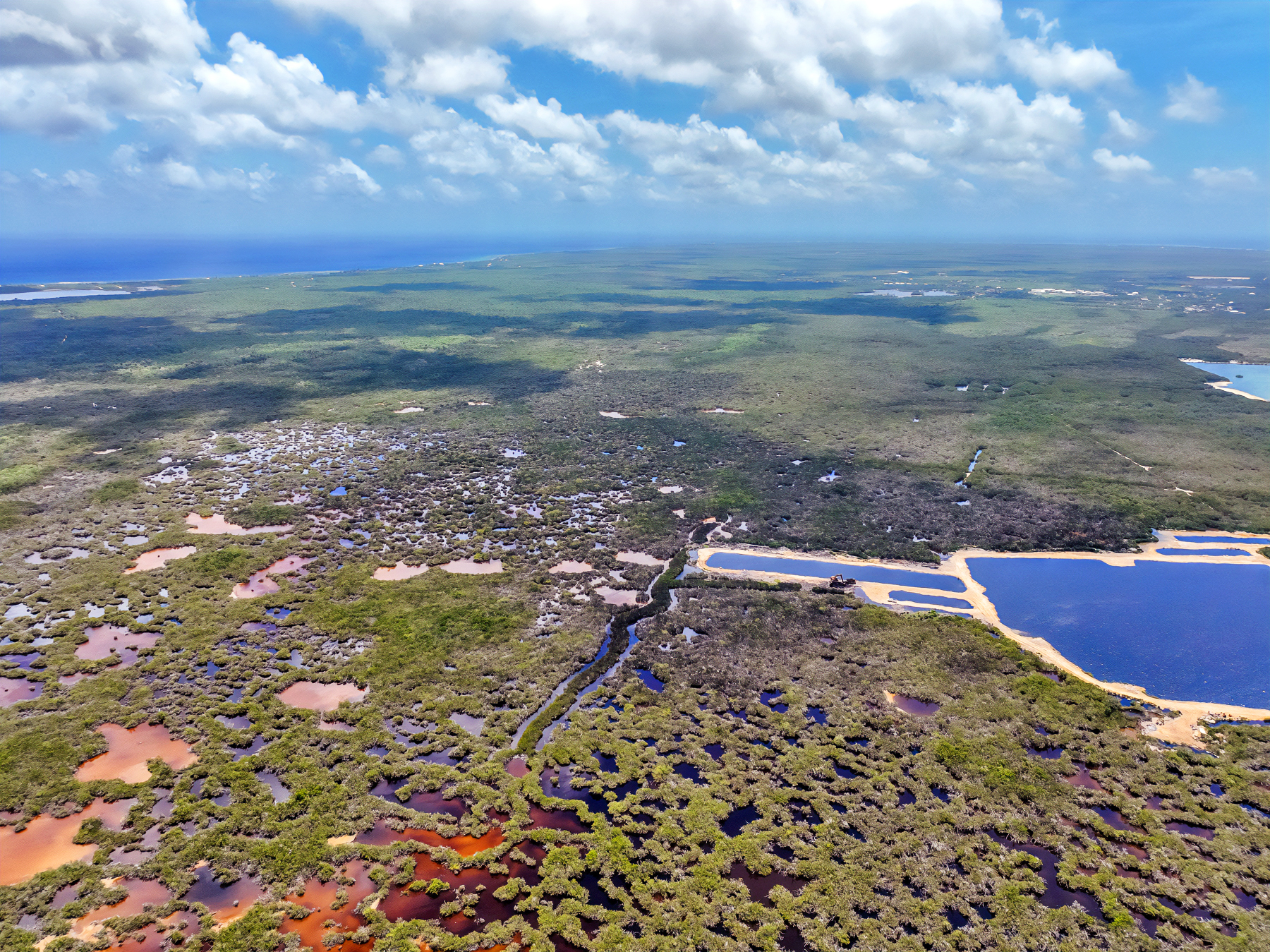
In the 8 July edition of the Compass, stunning drone footage, captured for this publication, showed the public a bird’s-eye view of the East-West Arterial from its current end at Hirst Road, through the route of its proposed extension to Frank Sound.
The aerial images show the course of the road, which will span almost 200 acres and four lanes, winding through the ecological heartland of Grand Cayman, bisecting the Central Mangrove Wetlands.
But they also illustrate a quandary that goes beyond one road; successive governments have failed to propose and implement a plan or policy that takes more of a panoramic approach to Cayman’s traffic congestion issues.
And so, we continue to tackle only one facet of a more complex problem. Building more roads remains the only plan, while, simultaneously, we acknowledge it fails to remedy anything long term.
Undeniably, there is intrinsic value in cutting journey times from the eastern districts, such as unlocking land for development outside the George Town nucleus that will help young families and essential workers secure a foothold on the property ladder.
Upgrades to the islands’ road infrastructure are clearly necessary; carving out a transport artery set back from the water’s edge would alleviate pressure on older, coastal roads and provide a disaster-relief corridor for the more remote districts, in the event of Cayman being hit by major weather.
But if highways beget housing, as they have in the past, the road extension can’t reduce traffic in the long term. It might stop commutes escalating exponentially, but for how long? NRA data, shared with the Compass, forecasts that – even with the road development – journey length will rise as the population grows.
The East-West Arterial extension, labelled a priority by PACT, has been a major project goal of previous administrations since its gazettal in 2005.
But things have changed in the 17 years since then. While traffic may have worsened, potential solutions have emerged that could be more impactful.
A coordinated approach to planning, managing and shaping the islands’ future is badly needed.
An updated Development Plan, which languishes as a work-in-progress, would ensure any road infrastructure upgrades worked, strategically, in consort with other land use.
Joined-up planning and development must take account of Cayman’s transport requirements, what land is zoned and needed for, climate resilience and preservation of unique habitats.
The environmental impact assessment on the extension road, if conducted and executed well, would ensure the mangroves – a vital flood plane and storm barrier – are protected. But how far can they truly be protected if development of the surrounding area is allowed to spring up haphazardly?
It’s time to stop solving old problems with outdated solutions. Roads can only ever be a single ingredient in the recipe for remedying what is essentially a transport and planning problem.
Reducing car use, either through congestion charging or restrictions on ownership, is a radical step that has proved effective in other jurisdictions. That can’t be achieved, however, without first offering the alternative of a clean, safe and fully functioning public transport network.
Bermuda is oft cited as an example of a functional bus and ferry system, working hand-in-glove with a culture of moped, rather than car, use and a policy of limiting car ownership by household.
If Cayman’s leaders are prepared to grasp this difficult issue head-on, then the routing of a highway through to the eastern districts need not be an entirely bad thing.
The repurposing of the coastal roads for cyclists, pedestrians, electric vehicles and green buses, with heavy traffic routed on to the central highways, creates an opportunity for a greener future, even as Cayman grows.
If car-sharing, cycling and walking were incentivised and made safe and practical alongside proper public transportation, a dreamscape of life in Cayman starts to emerge.
With that kind of integrated approach, the inevitable sacrifice of mangrove wetland and dry forest to create the road may not be in vain.
Without it, this project risks being a road to ruin for Cayman’s natural world.
Related Videos







It is simply not safe to commute by bike in Cayman. Absent dedicated bike routes not shared with traffic many of us won’t be tempted out of cars.. employers should be able to easily enough provide secure bike parking and showers. But it comes back to will I get knocked off on west bay road again? How will I safely cross the Butterfield round about?!
The author spends the whole time talking about not building the extension of the East-West Arterial roadway to Frank Sound Road but then concludes with this statement as a viable solution
“ The repurposing of the coastal roads for cyclists, pedestrians, electric vehicles and green buses with heavy traffic routed on to the central highways, creates an opportunity for a greener future, even as Cayman grows.”
We must fully abandon predict and provide models of transport planning, and assess a local Plan against health and well-being, lifestyle, and environmental criteria (including carbon emissions) – not just standard demographic and transport information. The information is out there: https://www.ciht.org.uk/media/10218/ciht-better-planning-a4_updated_linked_.pdf