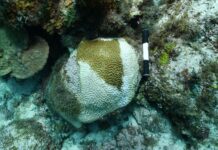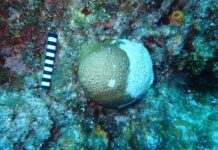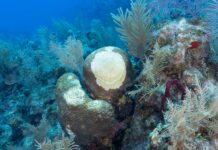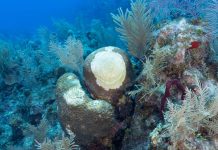
In the ongoing battle against stony coral tissue loss disease, samples of coral from the Cayman Islands are being examined by scientists in a bid to create a probiotic that may help ward off the disease that has infected reefs across Grand Cayman.
Little Cayman and Cayman Brac, so far, have been spared, with no signs of the disease having been detected there – and that very absence of infection is something the scientists think they may be able to use to develop a possible tool to protect the reefs.
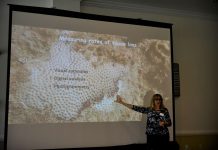
Sarah Gignoux-Wolfsohn, who is affiliated with the Smithsonian Environmental Research Center in the US, earlier this month, collected samples from Little Cayman as part of that project. She was in Little Cayman at the invitation of the Central Caribbean Marine Institute which had named her its first Women in Ocean Science Award scholar.
She is working on a project called ‘Stony Coral Tissue Loss Disease – a Coral Reef Crisis in the Cayman Islands’, which complements work being undertaken by the Cayman Islands Department of Environment.
She says if a probiotic can be found to be used as a prophylactic, it can potentially make the still-healthy corals on Little Cayman more resistant to the disease if it eventually arrives there.
Gignoux-Wolfsohn said she and the DoE are collaborating with microbiologist Blake Ushijima of the University of North Carolina, Wilmington, to develop a probiotic specifically for the Cayman Islands, based on samples from the healthy corals sent from Cayman.
On the university’s website page, Ushijima explains that, along with collaborators at various universities, government agencies and the Smithsonian Institute, he is investigating the cause or causes of SCTLD, as well as the development of probiotics to treat diseased corals.
“Pathogenic bacteria are involved with the progression of SCTLD, however, it is unclear what initiates infection. Additionally, this disease appears to spread through the water column, but it is unknown what mechanisms allow for transmission between coral colonies. In all, we hope to better understand SCTLD with the end goal of improving our current treatment strategies to slow or stop the spread of this disease before it can damage additional reefs,” he said.
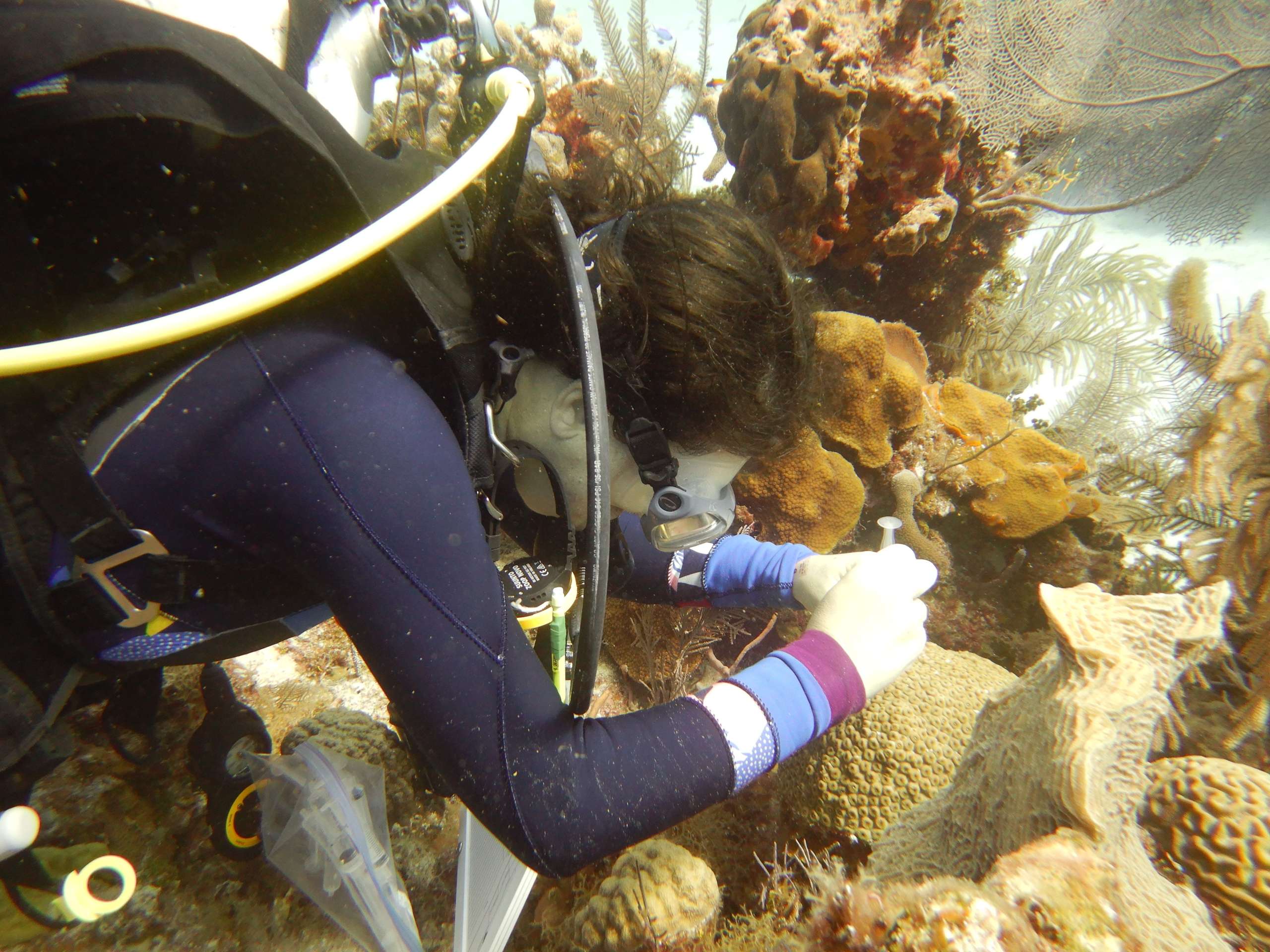
During her recent week-long trip to Little Cayman – with another Smithsonian Institute scientist, Leah Harper – Gignoux-Wolfsohn said they surveyed eight different sites around the island for signs of the disease, and to get a baseline of coral and fish diversity. The team tagged and sampled corals at three of those sites.
She explained that examining the DNA of those samples will be useful if or when the corals they were taken from become infected by stony coral tissue loss disease, so they can compare the before and after genetic structure of the coral.
She had carried out similar tagging and sampling in Caribou Caye in Belize, as the project involves multiple locations in the Caribbean.
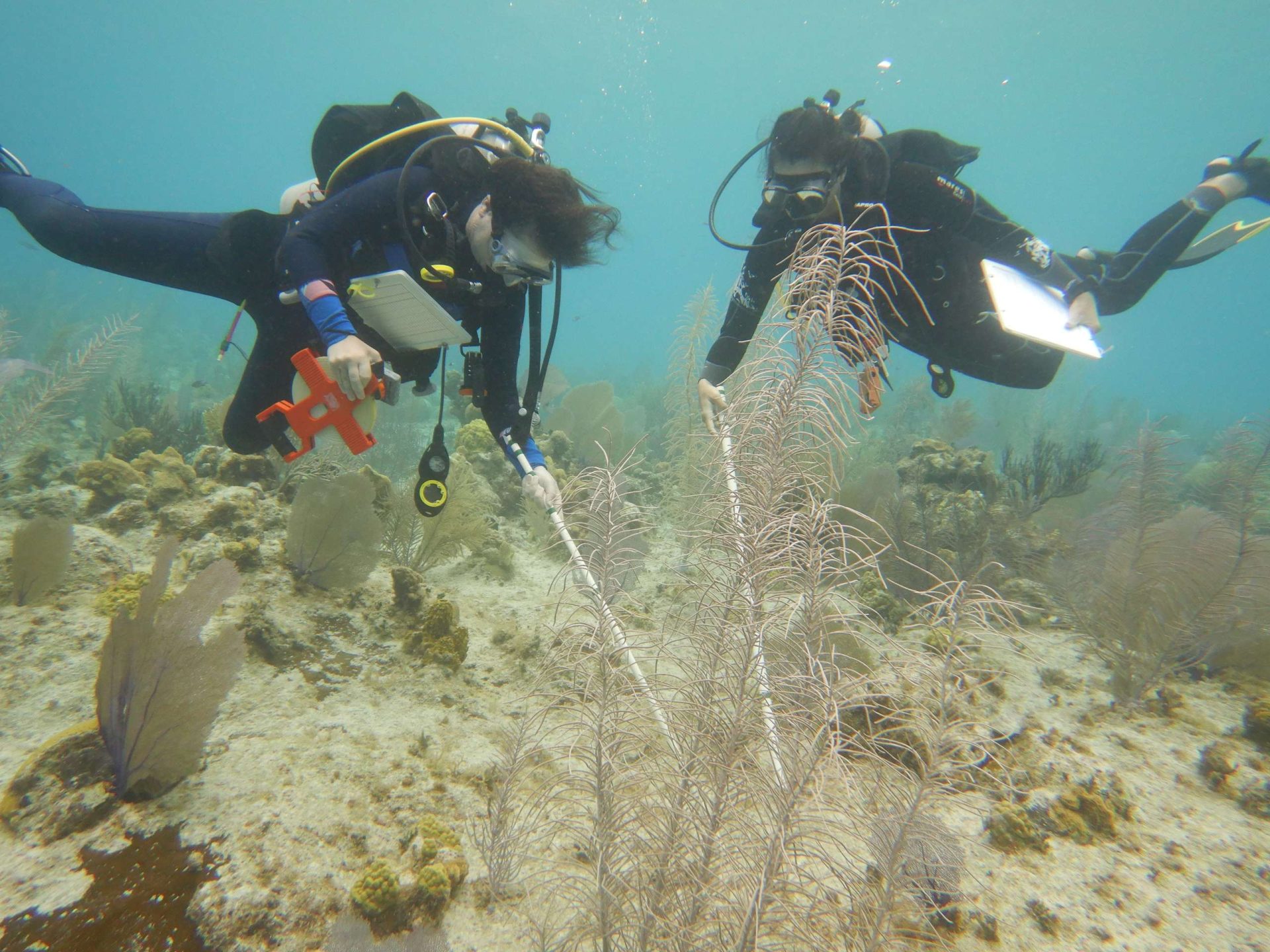
“We had tagged and sampled the corals in Caribou Caye before the disease got there and, unfortunately, it is now there. We were able to go back and see the same corals and see how they were doing and resample them, as they were still alive,” she said.
Such data can also help establish which corals are susceptible to the disease, and which are resistant.
“Some species of coral seem to be more resistant to the disease than others,” she said. “One of our goals is to figure out which corals are resistant and why they are resistant.”
For example, certain types of brain coral are “50% susceptible and 50% resistant”, she said. “When you’re looking at them before they become diseased, you can’t tell which ones are which. We are hoping to be able to identify the signatures of resistant coral so we can protect the corals we think can fare better than others.”
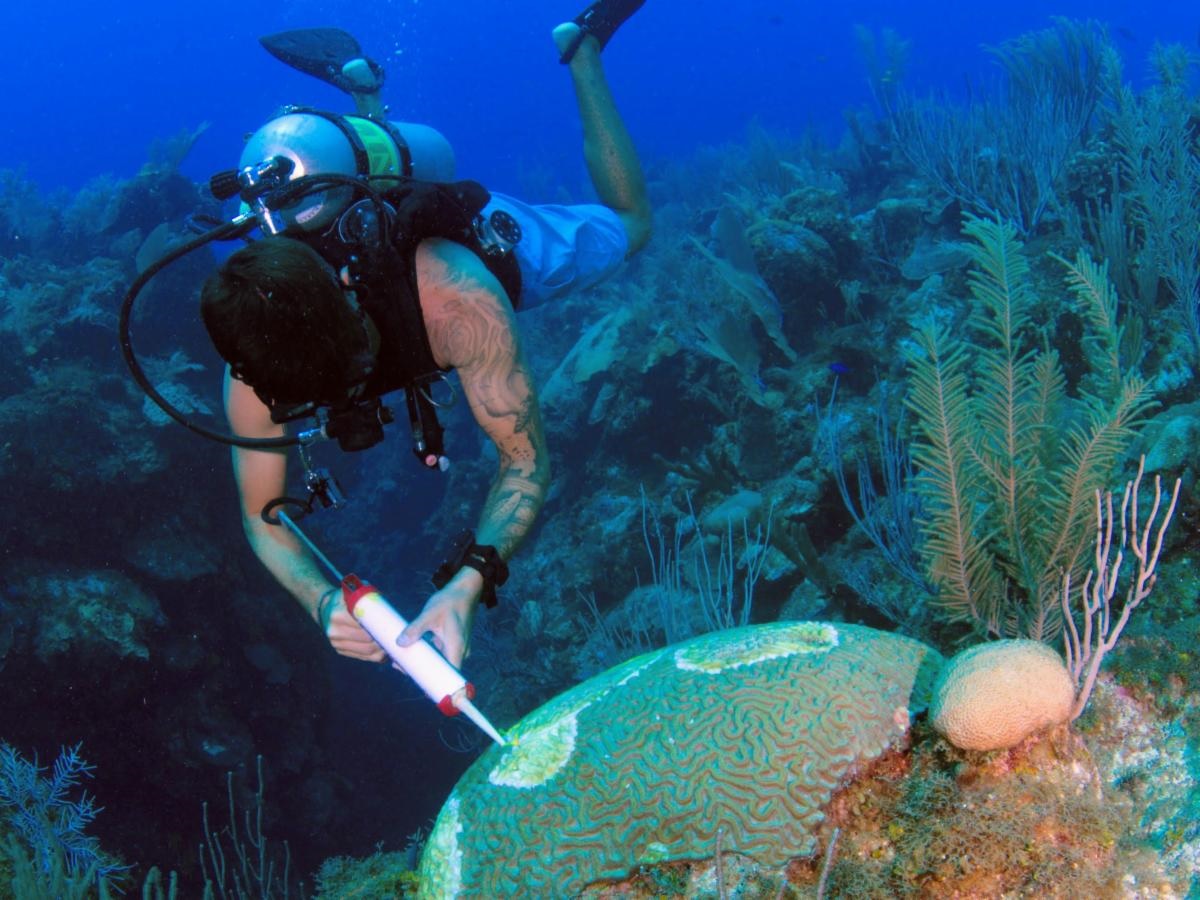
So far, the only weapon scientists have had in their arsenal against the disease is an antibiotic called amoxicillin, which is mixed with an epoxy and applied around the white lesions caused by the disease to stop the infection spreading on an infected coral. However, that does not prevent the disease from newly infecting another part of that same coral – it just stops the original site of infection from spreading.
“Even if it delays the onset of the disease,”Gignoux-Wolfsohn said, “ultimately, the disease still gets there. The antibiotic paste can mitigate it, but it’s not an enduring treatment solution.”
Tammi Warrender, the head of the Department of Environment’s Stony Coral Tissue Loss Disease task force, says the antibiotic does indeed slow down the speed of the spread of the disease, but acknowledges it hasn’t stopped it from moving all around Grand Cayman’s coastline since it was first spotted off Rum Point in North Side in June 2020.
Since then, Warrender said, the DoE has sent more than 1,000 samples to the Smithsonian Institute and other scientific bodies in the US to be analysed.
Being able to examine coral samples gives scientists information on the types of bacteria that is present pre- and post-infection, thus creating a baseline and enabling an analysis of information that might shed light on why and how the disease impacts certain corals.
Warrender says that, in the same way that COVID-19 affects different people in different ways, possibly depending on the level of health or fitness of the individual, SCTLD affects corals in a variety of ways because “all the corals have different genetics, bacteria, microscopic flora and fauna that make them unique”.
Asked why she thinks the disease that is so prevalent in Grand Cayman has not reached the Sister Islands, Gignoux-Wolfsohn said, “We have seen similar situations in other places in the Caribbean. It is confusing because, obviously, Little Cayman and Grand Cayman are not that far away from one another. But we have seen other islands where it has taken many weeks to travel the distance.”
She gave the example of Dry Tortugas, a series of seven small islands located about 70 miles from Key West, the most southwesterly point of the Florida Keys, where the disease has been spreading since 2016. The disease had reached Key West by December 2018, but was not seen in the Dry Tortugas until May 2021.
By comparison, Little Cayman is about 80 miles from Grand Cayman.
It’s still not clear exactly how the disease spreads – whether it’s by currents or by fish, or by boats and shops dumping infected ballast water, or divers’ scuba gear carrying the bacteria from an infected site to an unaffected site.
“I think there could be multiple pathways,” Gignoux-Wolfsohn said. “There’s no evidence that it is spreading by one single way.”
In Grand Cayman, there had been an extensive push by the DoE to get divers to disinfect their gear after each dive, but as the disease is now all around the island and no site is unaffected, the disinfection efforts have shifted to ensuring that no infected equipment is carried across the Sister Islands – either by divers or by boats visiting the islands from Grand.
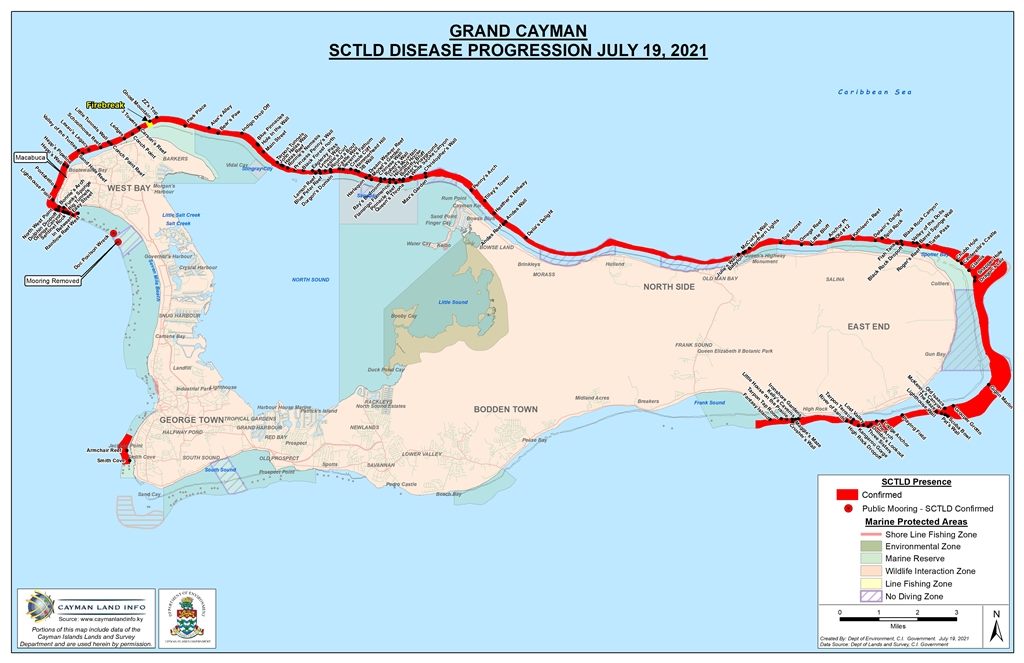
Warrender says DoE tracking of the spread of the disease around Grand Cayman showed that it had appeared at disparate dive sites, rather than following a consistent connected path, a possible indication that the infection was spread in those instances by divers or dive boats.
In July last year, the DoE reported that, after it was first discovered off Rum Point and began spreading along the top of the island in both directions, it had also been found at individual dive sites off Seven Mile Beach and George Town, such as at the Doc Poulson wreck off the northern end of Seven Mile and at Armchair Reef off Smith Cove.
A team of DoE staff go out five days a week to apply the antibiotic to infected reefs and to track the progress of the disease, and Ocean Frontiers in East End also has a team that carries out the same work in that part of the island.
Related Videos