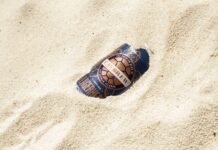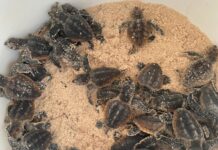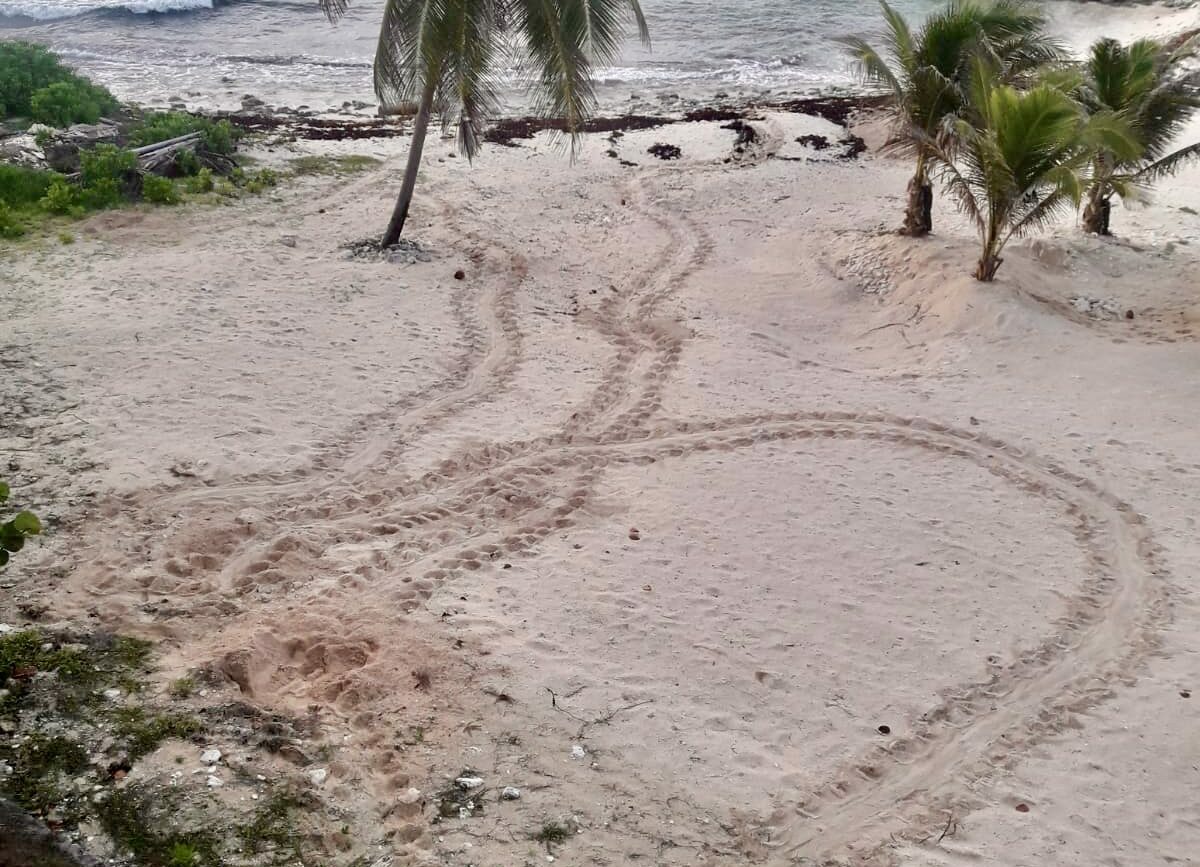
The sighting of loggerhead turtle tracks on all three islands has heralded the official start of Cayman’s 2023 nesting season.
Department of Environment sea turtle programme manager Jane Hardwick said an April start for loggerhead nesting has become the “new normal” for this species of turtle.
“In more recent years there has been more nesting starting in April. This is likely attributed to warming sea temperatures as a result of climate change,” she said Friday, in an emailed response to Cayman Compass queries.
She said so far there have been both false crawls (where a turtle leaves the beach without laying eggs) and nests reported across all three islands, all from loggerhead turtles.
“We have approximately six nests across the islands; two nests in Cayman Brac, three in Grand Cayman and one in Little Cayman,” she said.
Last year Cayman logged a record-breaking 858 nests, the highest total since the DoE started recording statistics in 1998.
Cayman’s previous high of 689 nests was recorded in 2017, and 2022’s numbers also represented a 54% increase over the overall total in 2021.
Hardwick said the DoE does not know what this season will bring, “but we are hopeful for another record year”.
Sargassum a concern
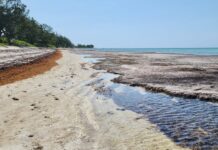
As Cayman’s coastlines continue to be inundated with sargassum, Hardwick has raised concern about the impact on turtles seeking to lay eggs on local shores.
“Sargassum is a challenge. And the forecast is showing it is likely going to be a big year for sargassum so all we can do is work together to manage it as safely as possible,” she said.
While government works on a multi-agency approach to dealing with the seaweed, South Florida-based company Weedoo Boats says it is seeing an uptick in orders of its sargassum-clearing machinery, which it says can clear 500 pounds of the seaweed a minute on the near-shore of beaches.
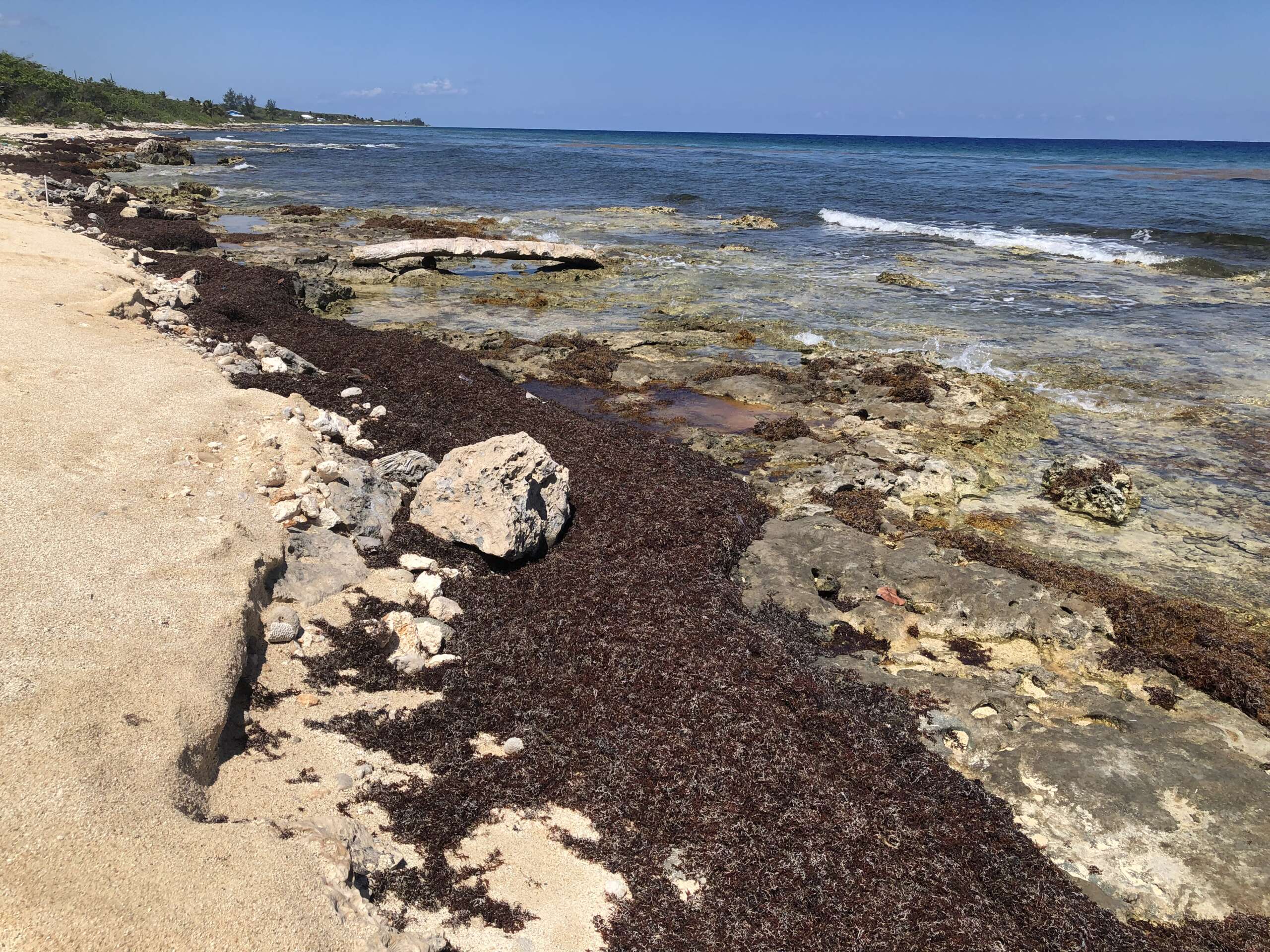
Generally, Hardwick said, nesting turtles will walk over reasonable amounts of sargassum but when it piles up high, “it’s definitely a barrier both for nesting mums and hatchlings making their way to sea. Whenever possible the Turtle Team will hand clear a pathway for a nest about to hatch to ensure there is a safe pathway to the sea.”
Hardwick implored anyone living on the beach to “hand clear any sargassum which presents a nuisance by carefully ensuring any sand and marine life are not trapped inside before disposal”.
She added that anyone wishing to use machinery for sargassum removal must contact DoE so checks can be made for turtle nests ahead of the clearing.
“Aside from potentially covering tracks so nests are not reported, machine clearing can remove significant amounts of sand from the beach while also compacting it, making it more difficult for nesting mums to dig or impossible for laid nests to hatch, especially if we don’t know one is there. So careful hand clearing is always best and contacting DoE if machine clearing is deemed necessary,” Hardwick added.
How to tell the difference in turtle tracks
The DoE, in a post on its official Facebook page announcing the start of the season, said that with the sighting of the turtle tracks, the department’s turtle hotline 938-NEST (938-6378) is now active 24 hours a day.
It has said the public can report, via WhatsApp, any suspected turtle tracks.
People can also report any suspicious illegal activity to DoE conservation officers on 916-4271 by phone or WhatsApp.
Guidelines for nesting season
With more turtles frequenting local shores, the DoE is urging the community to do its part to protect Cayman’s small population of breeding and nesting turtles.
“Never approach turtles in the water. During breeding season it is crucial that turtles are not disturbed and it is illegal to do so,” Hardwick said.
She added that by keeping beaches clean of litter as well as not leaving beach equipment, such as loungers overnight, turtles will have space to nest.
In addition, no bonfires, vehicles or heavy equipment are allowed on beaches without consulting DoE.
“Never rake over turtle tracks. Alert your landscapers to look out and report suspected turtle tracks,” she added.
Lights along coastline properties should be turned off for turtles as Hardwick said “artificial lighting disorients nesting turtles and hatchlings and is a major threat”.
As for boating, Hardwick had asked that those on vessels keep watch for turtles at the surface “where they spend extended periods of time while mating”.

Related Videos