

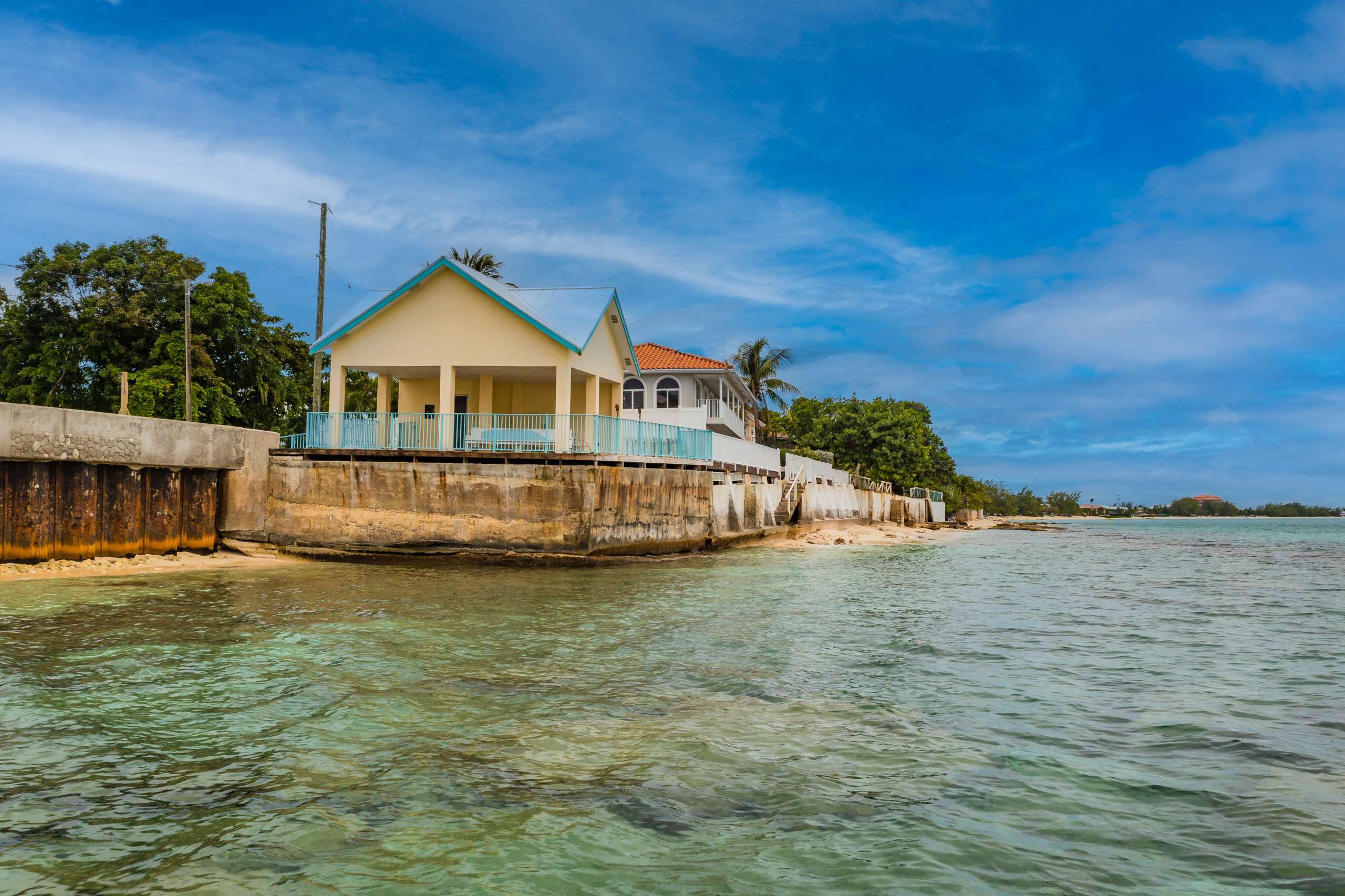
Court of Appeal judges are hearing arguments from lawyers this week on whether the Central Planning Authority was right to grant planning permission to a developer to rebuild a seawall and a cabana on Boggy Sand Road in West Bay, next to a protected marine area, after the National Conservation Council directed the planning body to turn down the application.
The landmark hearing, which pits two government entities against each other, will determine whether the planning authority should have abided by a directive given by Department of Environment Director Gina Ebanks-Petrie, under delegated powers from the National Conservation Council, that planning permission should not be granted because of the likely adverse impact on the marine environment.
The CPA, represented by Sir Jeffrey Jowell, KC, is appealing a judicial review decision made in August last year by Grand Court Justice Alistair Walters, who ruled that the conservation council had the power to direct an entity on a planned course of action which was likely to have an adverse effect on a protected area.
On Wednesday, 17 May, the first day of the hearing before the three appeal-court judges, Justice Sir Richard Field told the parties involved, “It seems to the court that the central issue is whether the CPA lawfully decided that the requested permission would not likely have an adverse effect, directly or indirectly, on a protected area or the critical habitat of a protected species.”
Flawed decision?
The National Conservation Council says the CPA’s decision to grant permission for the work on the seawall and cabana to go ahead was flawed, while lawyers for the planning board and the developer insist that it was not.
Jowell, making his submissions on Wednesday morning and afternoon, argued that because the developer – Cayman Property Investment Ltd., which appeared as an interested party in the judicial review and the appeal – had agreed to construction measures that the planning board believed would “eliminate” the risk of an adverse effect on the protected marine environment off Seven Mile Beach, there was no requirement for the board to consult the NCC nor follow its directive.

He stated that the planning board had invited the NCC under the Planning and Development Act to give its input on the application. Jowell said that under this Act the CPA has discretion on whether to take the advice or directive of the conservation council.
In its response, he said, the NCC “jumped the gun” by directing the planning board to refuse the application under Section 41 of the National Conservation Act, which states that every entity, except Cabinet, must obtain permission from the council on matters likely to have an adverse impact on protected areas.
Jowell told the judges that the planning authority was only required to consult the NCC under the National Conservation Act if it considered that granting planning permission would likely lead to a detrimental effect on the environment.
In this case, he said, the board did not consider there would be any adverse effect because the developer had agreed to build the new seawall inside the existing, deteriorating seawall before demolishing the original wall; install silt screens during construction; and pump any sediment-laden water onto land instead of out to sea.
The appeal judges questioned this rationale, stating that this seemed to suggest that the CPA could avoid ever having to refer to the conservation council under the National Conservation Law by determining that conditions imposed on a developer negate potential adverse environmental effects.
“If the planning authority decide the conditions imposed will eliminate the risk, they can then ignore, or not fulfil their obligation, under section 41(4) of the National Conservation Act,” Justice Sir Alan Moses said.
That section states: “Every entity, except Cabinet, in accordance with any guidance notes issued by the Council and regulations made under this Law, shall apply for and obtain the approval of the Council before taking any action including the grant of any permit or licence and the making of any decision or the giving of any undertaking or approval that would or would be likely to have an adverse effect, whether directly or indirectly, on a protected area or on the critical habitat of a protected species.”
Environmental concerns considered
Jowell told the appeal judges that the CPA was well aware of the concerns of the National Conservation Council, based on its submission on an earlier planning permission application for a two-storey house on the site which had been rejected.
He submitted that the CPA had sufficient expertise in relation to environmental issues to determine that the potential adverse risks had been eliminated in this case. He also stated that the planning board has the statutory power to make decisions on planning applications, while taking economic, cultural, environmental and other factors into account.
He told the court that, contrary to the contention of the NCC and its lawyers, the minutes of the CPA meetings and other documentation showed that the planning board did take into consideration the NCC’s concerns when coming to its decision to grant planning permission to Cayman Property Investment Ltd.
Late on Wednesday afternoon, Chris Buttler, KC, representing the conservation council, began his submissions, in which he stated that the CPA was statutorily obliged to consult the NCC over the planning application, as it was obvious from a guidance note issued by the conservation council and from the fact that the application dealt with construction immediately adjacent to a protected marine zone, that an adverse effect on the environment was likely.
He told the judges that the likelihood of this adverse effect would have triggered the requirement of the CPA to consult the conservation council under the National Conservation Act.
The hearing is scheduled for three days, though attorneys stated they are likely to complete their arguments by the end of the day on Thursday.
The judges welcomed detailed submissions from the parties, noting that that this case required “very careful analysis”.
Related stories
Boggy Sand seawall planning approval quashed in test case for Conservation Council powers
Boggy Sand seawall/cabana plan approved
DoE directs planning authority to reject Boggy Sand cabana/seawall plan
Controversial Boggy Sandy seawall property rejected
Related Videos













Just looking at your photograph, this is and ” an eye sore”, and if any West Bayers’ were on the Planning Board that originally approved this, should be well ashamed of themselves, and for the beautiful District of West Bay.
IT SHOULD NEVER HAVE BEEN APPROVED! It smells!