


Cayman’s new minimum wage can’t go ‘too high’ without risking job losses, business closures and cost-of-living impacts, according to the chair of the review committee.
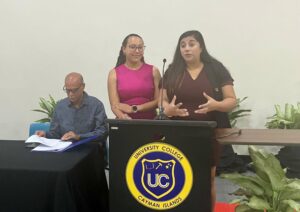
Speaking at a public meeting on Wednesday, Lemuel Hurlston said the Minimum Wage Advisory Committee had already established that the new rate should be more than $6.50 an hour, the statistical ‘vulnerability line’ in the territory.
He said work is now focusing on the ‘upper limit’ that the community can afford without causing job losses and business failures.
The current rate, set in 2016, is $6 an hour, or $4.50 for workers that get gratuities or accommodation provided.
Hurlston acknowledged that was inadequate and out of date.
But he stressed the committee had to take care not to over-correct and recommend a wage that is too high.
He said that could mean people losing out on pay through reduced hours or loss of employment as businesses adjusted. The net result would hurt those the policy was designed to help.
“We have to be very careful. The increase has to be affordable to the business community,” he said.
“If the minimum wage is too high, businesses go under, and we have a lot of other issues arising. The challenge… is not an easy one.”
He added that there would also be consideration of whether there could be a gradual or staggered implementation of the new figure to allow businesses time to prepare. For example, the committee could recommend the new rate be implemented in phases over a couple of years.
Vulnerability line
Claims that the ‘vulnerability line’ for wages in the Cayman Islands is just $6.50 an hour were met with deep scepticism among the 40-or-so people who attended the public meeting at the Sir Vassel Johnson Hall at the University College of the Cayman Islands campus.
The number, which amounts to a monthly wage of $1,040, based on a 40-hour week, has been identified by the Economics and Statistics Office as the absolute baseline a person could earn in Cayman without falling into poverty.
Some of the audience members expressed confusion about the statistics being quoted.
One man asked, “Are you saying the ESO believes a 21-year-old Caymanian earning $6.50 an hour is going to be self sufficient?”
Tapping on a calculator, he added, “Maybe I missed a maths lesson but that does not add up.”
Hurlston said the figure was derived by statisticians using available data, including from the Needs Assessment Unit.
“We are not in a position to change that because it is a mathematical equation,” he added.
He indicated the purpose of the minimum wage is not necessarily to come up with a figure that allows someone to live reasonably in the Cayman Islands, but a baseline below which it would be unrealistic for anyone to earn without falling into poverty.
Hurlston also referenced experiments with Universal Basic Income in the UK as a possible path for Cayman to consider as a means to counter some of the challenges with escalating costs for Caymanians.
The committee is an advisory body and has garnered significant public input, including more than 5,000 survey responses, which will go into its report to government, to be submitted at the end of September. Ultimately, it will be up to government to decide whether to implement a minimum wage increase, when and how to do it, and at what level.
Mixed views
While some in the audience seemed to support a higher minimum wage, others expressed concern about its impact on the cost of living, questioning how people would afford to pay for private nannies or domestic helpers, for example.
There was significant discussion around gratuities in the hospitality trade and how they are distributed, an issue the Compass will be looking into in more detail in another story.
One speaker pointed out that raising the minimum wage now wasn’t really giving anyone a pay increase – it was simply adjusting the $6 rate set in 2016 to account for inflation.
He acknowledged that this could cause issues for some, however.
“The minimum wage is not going to solve cost-of-living issues, it may exacerbate some of them,” he said.
Hurlston made similar comments, indicating that the minimum wage committee was not a panacea for a host of other economic problems cited by audience members, ranging from pensions and insurance to healthcare costs.
“We are trying to stay in our minimum wage lane,” he insisted.
Challenged over why there was no clear data available on how many people earn minimum wage in Cayman, Hurlston said it would be included in the advisory committee’s final report to government.
“There are a very small number of persons currently earning minimum wage,” he added. “There are very few people that will accept a job in this country for that level of wages.”
Related Videos












They are kidding right? The wage needs to be triple that amount in order to survive since cost cutting, and social services are not an option. In order for the business to survive, the minimum rate needs to be incremental. Decided on dates when business’ need to be compliant to a certain rate. Set a full implementation date, so business can plan ahead accordingly. Minimum wage goes to $15/hr and must be in full affect by Jan 1, 2028, for example, those who can afford or choose to proceed before said date may do so. This will draw potential employees as well. The government is starving their people, creating homelessness, and taxing the health care system. But don’t worry the airport needs to better support the Cessna family….
If the cayman economy can be hurt by raising the minimum wage, then i would say that the cayman economy is fundamentally broken. nobody can live themselves on a wage of just over $1000 unless they are sharing with 8+ people and eat only saltines. the cayman economy prices will likely not go down any time soon, so this minimum wage discussion needs to take that into account.
The best solution is a Public/Private one. CIG should allow an offset against stamp duties paid on food imports and work permits to cover the increased wages. It would keep prices flat so that the increased wages actually make an impact.
Over the past 24 months food and transportation costs have about doubled. Import duty percentage stayed the same resulting in an increase in CIG intake. No one else benefitted from high food costs. Return that excess duty to the people who need the money.
The question that Mr Hurlston and the committee need to be asking themselves is ‘What is the cost to society if a non-living wage is implemented?’
One has to consider the the less privileged members of society. Armed robbery seems to be a weekly occupancy and will / may eventually affect tourism. What would declining tourism cost society?
Nicholas Robson
It would be interesting to carry out a survey to ascertain the wages are paid to live in “nannies,” exactly what their duties entail, working hours, and if they have to pay for their own medical care.