


In a month-long series, the Cayman Compass has taken an in-depth look at the issues surrounding the minimum wage debate.
Increasing the $6-an-hour base rate is confirmed as a clear necessity amid reports of people working 70-hour weeks or living in cramped apartments to survive on poverty-level incomes.
But it is also evident that a slew of connected problems persist that simply raising wages won’t solve.
Today we look at 10 key issues raised by our reporting that will also need attention, no matter what government decides about wages.
Lack of affordable childcare options
Cayman’s lack of childcare options is reaching crisis point.
Parents who spoke to the Cayman Compass told us they had no choice but to hire domestic helpers on low wages in order to go back to work after having a child.
The daycare centres and nursery schools are full and provision has actually decreased, particularly for babies, amid regulatory restrictions. Government partly funds childcare costs for Caymanians with children aged 2-4, but many institutions now have years-long waiting lists and prices are rising as the population grows – fuelled both by new immigration and a sharp rise in the birth rate since the pandemic.
Lack of childcare options – especially in the evenings – were cited as a key reason that Caymanian mums could not take jobs in the hospitality industry. Meanwhile, low-wage workers from other countries are forced to seek help from friends in an emerging informal and unregulated voluntary ‘babysitting’ sector.
Getting to grips with the childcare shortage would help lessen the need for imported low-wage nannies and broaden the options for mums in the workplace.
Rental exploitation plagues low-wage workers
A common fear both from low-wage workers and their employers was that any increase in salaries will be seized on by landlords as an excuse to raise the rent.
“That extra cash will go straight into the pockets of the landlords,” one business owner insisted – a viewpoint that was echoed by several employees.
That kind of opportunism is difficult to stop in a free market, governed by supply and demand.
While rent control remains an option, opinions differ widely about the effectiveness of such strategies.
Compass economics columnist Simon Cawdery insists they do not work, potentially acting as a dampener on the new building necessary to bring more affordable properties to the market.
Rental standards is a different issue and one that needs to be addressed. Some workers in our series were sharing studio accommodations meant for a single person with up to five other individuals. Others were living in apartments riddled with mould, without air conditioning or other basic requirements.
Cayman’s rental market is still governed by legislation that dates back to 1837 and there is little in the way of quality assurance for tenants.
There are uncomfortable parallels with the rigorous standards associated with short-term tourism rentals, which require annual inspections and licensing before they can be put on the market. Why, some wondered, were there not similar standards for Cayman Islands people living in long-term rentals?
Affordable accommodation in short supply
High rents are a symptom of a wider, much-discussed issue – the lack of lower cost housing.
Cawdery argues a better solution than seeking to cap rents would be to sort out “zoning and development bottlenecks” to allow for more low- and mid-range properties to come on the market.

Several business owners have sought to provide accommodation for their staff, some even seeking to build dormitory-style accommodation. Multiple workers in our series said they were here without their families and just needed a small room and kitchen – similar to a university-style hall of residence. But current regulations limiting the number of bedrooms on a development site have seen previous efforts to bring that kind of project flounder.
Housing Minister Jay Ebanks, in a speech to Parliament last month, indicated this was on his radar, saying developers had asked for tweaks to get lot sizes much smaller in order to build more property.
He was responding to calls from Deputy Opposition Leader Joey Hew for a package of concessions incentives, among other stimulus, to encourage the development of lower- and mid-priced homes.
Previous Compass reporting indicates that without partnership between the government and the private sector, new development will continue to skew towards higher end, high-profit condos, exacerbating the supply-and-demand issue that is driving up rents for the lowest earners.
Whistleblower protection may be needed for workers
Several low-income workers told us they were being abused, bullied and overworked by employers – outside of the terms of their contract. But none felt empowered to make an official complaint or tell anyone in authority.
The Department of Labour and Pensions is understaffed and under-resourced on the enforcement side and foreign workers, in particular, are too concerned about their work permits to make a complaint against their employer.
Some of the stories outlined in our series – including women who said they were treated like slaves as live-in domestic helpers – are harrowing. But the system, as it is, lacks an outlet for them to complain in confidence.
Industries depend on overtime waivers
Almost every security guard in the Cayman Islands has signed an overtime waiver allowing them to be scheduled for more than 45 hours a week, without any extra compensation. Some are working 75 hours a week at the flat $6-an-hour rate.
The Labour Tribunal approved 456 separate agreements for workers to waive their right to overtime pay over the past year, up to July.
The Labour Act allows this, when a waiver is “requested by the employee and entered into voluntarily by that person”.
The reality of the clause in practice stretches the definition of the term ‘voluntarily’. Some security guards said they were given the waiver to sign with the contract. Others said they had no choice but to accept the conditions because they believed they would not be given enough hours to survive without signing.
The practice appears to be less common in other industries with landscaping, hospitality and retail business owners insisting they pay staff time-and-a-half for anything more than 45 hours a week.
Pitiful public transport impacts job, housing options
Even at $2 a ride, Cayman’s bus system is expensive for minimum wage workers. Getting from Bodden Town, where housing is slightly more affordable, to Seven Mile Beach, where jobs are more plentiful, takes two buses and costs $4 each way.
For some workers that’s the first hour-and-a-half pay gone on bus fare and another four hours of earning time spent in transit to work and back.
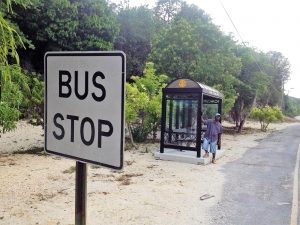
Within that, there are frequent complaints about reliability. Buses are often full, don’t arrive according to any organised schedule and sometimes don’t go to North Side or East End, as they are supposed to.
The need for an overhaul of public transport is well documented and a report from consultants Deloitte is expected to be published ‘soon’ according to government.
Inflation remains a concern
One of the most-often-cited concerns about raising the minimum wage was that it would contribute to rising prices. Depending on the scale of the increase, that seems probable.
While Foster’s, for example, has already budgeted an increase for all its staff to bring the minimum up to $10, anything above that would be a multi-million-dollar hit that the business has indicated it would have to pass on to customers.
In other industries, security for example, even funding a $2 pay rise above the current $6 minimum would involve increased prices to strata, according to business owners.
Cawdery debunks the myth that this is unsustainable for Cayman, however. Increasing wages by $2 for 2,000 people, for example, would cost the economy an aggregate $9.2 million, he wrote – just $185 per working person per year.
“Set against the inflationary costs already suffered, it’s relatively trivial to most consumers but really important from a poverty-alleviation perspective,” he wrote.
Controlling inflation on essential costs – including rent, food and utilities – is an entirely different issue and one over which Cayman has little control. Reforming social services and providing more support to the most needy is the best avenue to deal with its impacts, Cawdery argues.
Money will continue to leave the country
Our reporting on remittances, shows that, despite low wages and poor living conditions, low-wage workers continue to send a large portion of their salaries home.
One worker earning $1,600 a month, told us she sends half of that back to the Philippines.
That is fairly typical. A total of $300 million was sent by thousands of workers – mostly from Jamaica and the Philippines – using money transfer services in 2022.

There’s an argument that increasing the minimum wage would only increase the amount leaving Cayman and do little to improve living conditions. There may be some truth to that. Some workers told us they were willing to suffer and make sacrifices to their lifestyles in Cayman in order to fund their children’s educations or other costs back home.
For others, though, the money could make the difference between eating once or twice every day. The reality is that many would do both – improve their living conditions slightly and send more money home.
Caymanians still can’t afford to take low-wage jobs
A once radical concept, Universal Basic Income is now an important part of the global discussion on the future of work.
For Cayman, the maths doesn’t work. Funding every Caymanian on a universal monthly stipend of $1,500 would cost nearly $700 million each year.
It is a non-starter in a country which spends $1 billion annually on its entire budget. Derivations of the concept are starting to be mooted, however. A wage subsidy for the working poor, for example, might allow Caymanians access to jobs, which they have been priced out of by low-income labour imports.
The definition of a ‘living wage’ is one that allows a family to meet its basic needs – and that cost is demonstrably different for a family who has all of its living and schooling expenses in Cayman.
Topping up wages for Caymanians who earn below $12, for example, would cost much less – for the sake of argument, estimate $6 per worker per hour for 2,000 people – just shy of $33 million a year.
One recruitment specialist, speaking anonymously, said this would enable Caymanians to bridge the gap in living costs with foreign workers.
As a welfare subsidy, they said, this would benefit the people who deserved it most – the working poor and could eradicate the need for other costly government programs.
Release letter requirement needs review
Current law effectively means anyone on a work permit must obtain a release letter from their employer before they switch jobs. The alternative approach requires them to file a formal complaint with the Department of Labour and Pensions about their boss.
Many overseas workers don’t have the trust in the system to do that. All of the people who raised issues with us – ranging from unpaid overtime to unsafe working environments, bullying and abuse – said they wouldn’t be prepared to make a report against their employer.
Many said they had effectively been forced to stay in jobs, despite having offers of alternative employment, because they could not get a release letter.
Related Videos












The bottom line is the government is more interested in expats, and revenue than actually looking after the people. We are so far behind the times. How can we be in a surplus but still suffer from homelessness? I emailed the Premier asking for some insight or a meeting, he has not answered he must be busy counting.