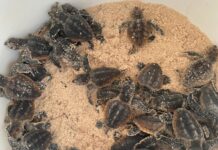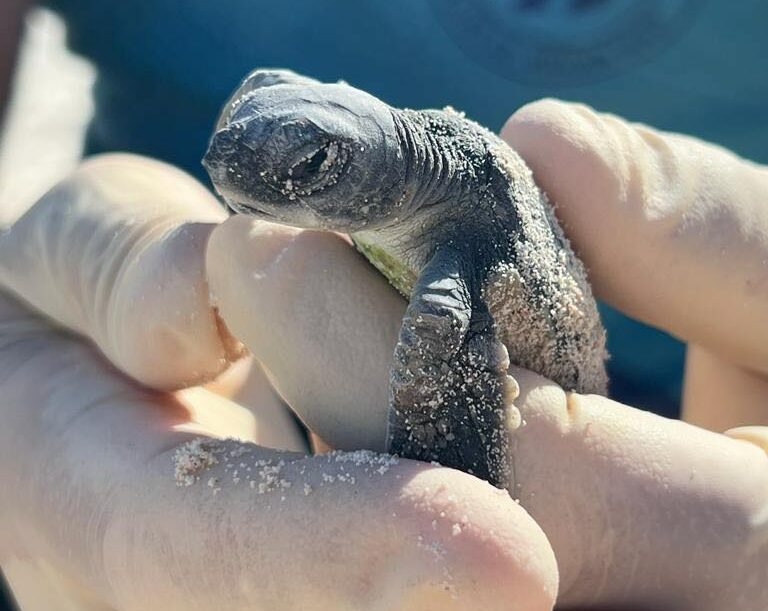
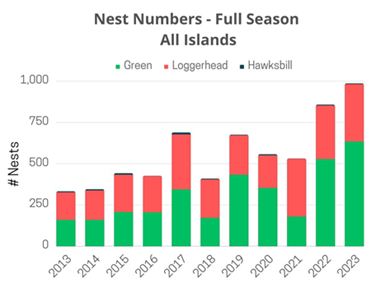
The year to date is already another record-setter for turtle nesting with 986 nests recorded and more than 60,000 hatchlings making it to sea.
Department of Environment sea turtle programme manager Jane Hardwick, who holds a PhD in tropical ecology, welcomed the continued increase in turtle numbers.
“We are amazed every year at the success of turtle conservation efforts which have seen an increase from a mere 38 nests across all three islands when monitoring systematically began in 1998, to 986 nests to date in 2023,” she said.
Last year, Cayman logged a record-breaking 858 nests, the highest total since the DoE started keeping statistics in 1998.
Cayman’s previous high of 689 nests was recorded in 2017.
This year’s figure, to date, represents a 15% increase over 2022.
Grand Cayman has recorded a total of 644 nests, Little Cayman 229 and Cayman Brac 113 so far.
Hardwick said the DoE does not have the final nest count yet as the turtle team is still finding some unrecorded nests after they have hatched.
She said that while nest numbers are the most common and accessible index for sea turtle population monitoring, those counts cannot be used as a direct measure of the abundance of nesting female turtles, since they lay four to seven nests each season.
She added that when one considers that only about one in 1,000 hatchlings survive to adulthood, population growth becomes even more challenging.
“That’s why doing everything under our control to ensure our nesting turtles and their nests and hatchlings have a safe environment to live is crucial to the recovery of our local population. This includes using coastal development best practices like deep setbacks for pools, paths and buildings and turtle friendly lighting,” she said.
Ensuring beaches are kept clear of obstacles like loungers at night, and that nests are logged by the turtle team before raking any tracks in the morning, also help efforts to protect the turtle population, Hardwick added.
“This nesting season, 40% of nests on Seven Mile Beach required some sort of intervention due to artificial lighting. Baby sea turtles are misdirected away from the sea by artificial lighting which often results in their death. We do our best to anticipate issues but turtle friendly lighting is the only sustainable solution to keep our turtles safe,” Hardwick said.
She said 107 hatchlings recently emerged from the nest laid by the large female green sea turtle that was rescued by a visiting family in August.
“One hatchling remained in the nest when DoE’s turtle team excavated the nest to log the number of eggs,” she added.
The family was excited that the baby turtles made it to the sea.
Storm surges always have a devastating impact on turtle nests and this year was no different.
“The passing of [Tropical Storm] Idalia in late August created more than anticipated amounts of intense wave activity across Seven Mile Beach, which unfortunately affected a large number of nests by either inundating them with water or washing away nests before they were recorded. We’re still calculating the data on the impact of wave action on our known nests as many are not yet due to hatch. Turtle eggs are resilient and can withstand some wash over but it depends on the severity of the wave action,” Hardwick said.
She said warming seas and increased storm activity are factors outside of the turtle team’s control, but they continue to monitor and manage “as best we can throughout the season”.
Hardwick added that anyone wishing to find out more about coastal development best practices, including turtle friendly lighting, may email [email protected].
Related Videos