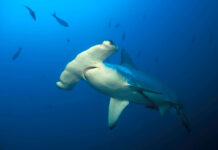
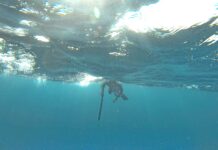
A young female scalloped hammerhead shark has been examined to determine the cause of death after a member of the public found it on a beach in South Sound.
It had not eaten for a long time and, in a weakened state, was likely attacked by a large shark, the Department of Environment said in a Facebook post on 15 Dec.
Shark project coordinator Dr Johanna Kohler performed the post-mortem following the discovery in October.
She recorded the Sphyrna lewini shark to be 130 centimetres long and estimated it was about two to three years old.
“The noticeably shrunken appearance and black coloration of the liver indicated that it had gone without food for a very long time,” the social media post said.
Dr Kohler also noted the gills appeared damaged, and there were bite marks on the tail between the anal and caudal fin.
However, the bite marks were not significant enough to have been the lone cause of death, the post said.
She concluded that the shark had not eaten for some time, eventually eating a small fish which was found partially digested in its stomach.
It was “probably already in a weakened state and preyed upon by a larger shark, likely leading to its eventual demise,” Dr Kohler said.
The shark did not show signs of human interaction, but the department said young sharks will often swim in shallow coastal waters, making them susceptible to hooks and lines.
In October 2022, a school of scalloped hammerhead sharks was spotted by local and international marine researchers as they surveyed Cayman’s deep waters.
At the time, Dr Kohler told the Compass she had thought these schools of hammerheads were locally extinct.
The website of the Oceana organisation said “conservation scientists have considered the scalloped hammerhead to be endangered with extinction for quite some time”.
Related Videos