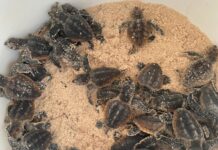
Grand Cayman experienced a remarkable event this week – a rare nest of hawksbill turtles hatched on its sandy shores.
The Department of Environment posted a video of the baby turtles on its Facebook page on Thursday, 21 Dec.
An accompanying written message said: “The final turtle nest for the 2023 nesting season in Grand Cayman hatched on 19th December! This late season nest was a hawksbill nest.”
According to the DoE, hawksbill nest numbers in the Cayman Islands are extremely low, with many years where no nests were found.
Nine hawksbill nests were recorded across the islands in 2023, which is above the average of 6.5 nests annually over the last 10 years.
Of the three islands, most hawksbill nesting occurs in Little Cayman – so a nest in Grand Cayman is extra special.
“Despite low nesting numbers, Cayman’s reefs host a healthy feeding population of juvenile hawksbill turtles, where they feed primarily on sponges,” the post read.
However, as migratory species, the juveniles that the department encounters will not be nesting locally.
“Once mature, they will migrate back to the beaches they hatched from, likely elsewhere in the Caribbean,” the post said.
Worldwide, hawksbills are critically endangered due to human impacts.
These include exploitation for their shells, meat and eggs, as well as their susceptibility to getting tangled in gillnets – a major source of mortality for all sea turtle species.
Cayman’s 2022 turtle nesting season was the longest on record after the last official nest of the season hatched on 22 Feb. on Little Cayman.
The final nest of that season was from a hawksbill that had a very long incubation time of 75 days due to the cooler winter temperatures.
In November this year, Cayman’s turtle nesting season broke another record.
The number of nests passed the 1,000 mark for the first time since the Department of Environment stared monitoring nests in 1998.
However, Jane Hardwick, DoE sea turtle programme manager, said that came against the backdrop of serious challenges for sea turtles.
“Sea turtles face increased threats from coastal development and climate change, as well as having a naturally low survival rate of around one in 1,000 or less,” she said.
Related Videos