From the shadowy depths of the waters off Little Cayman emerged a discovery for local scientists, who captured on camera multiple roughskin dogfish sharks, a rarely seen species in the region and a first-time find for the island.
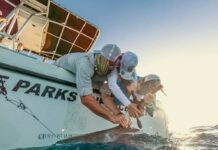
Researchers from the Department of Environment and project partner Beneath the Waves clocked the species during their study of deep waters around the island using a modified baited remote underwater video system called BRUVS.

“To our knowledge, this is the very first record of the roughskin dogfish in the Greater Antilles and the central Caribbean Sea. Even more excitingly, it is a new species record for the Cayman Islands,” Johanna Kohler, DoE shark project officer told the Cayman Compass Tuesday via email.
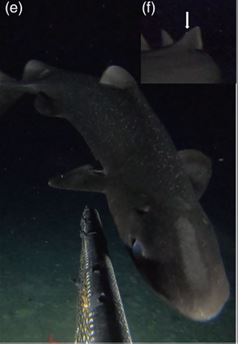
Kohler, who holds a PhD in shark ecology and was largely involved in the project, said “two individuals of this species” were recorded at a depth of 1,045 metres in the waters off Little Cayman.
“It is also the first footage of live individuals. Previous records were from dead specimens collected elsewhere. So we were able to observe and study its behaviour and movements on the video recording,” she said.
Kohler said the deep-sea study fieldwork, which used a remote underwater video system with bait attached, was conducted from March 2022-March 2024 and the video of the roughskin dogfish was recorded on 13 Aug. 2023.
The discovery became official following the publication of the findings in the scientific publication Journal of Fish Biology on 11 Nov. 2024.
The study was authored by Kohler, Olivia Dixon, Shannon E. Aldridge, Anne Veeder, Paul Chin, Teresa Fernandes, Timothy Austin, Rupert F. Ormond, Mauvis A. Gore, Diego F. B. Vaz and Austin J. Gallagher.
“It’s incredible for the Cayman Islands. It shows the importance of our three islands for global biodiversity and there might be so much more that we don’t know. We have precious endemic species in Cayman as well as others that are incredibly rare globally,” she said.
More than a shadow
Recounting the discovery, Kohler said the animal was a “very curious little shark” that was passing the deep-sea lander multiple times and even investigating the bait arm.
“A few times it nudged the bait bag with its snout,” she said.
At first, however, she said the team did not know what they were recording as all they had initially detected was a shadow.
“Imagine you look at a black screen. Only the bait arm with the bait bag and a few meters of muddy sea floor are highlighted by the lights of the deep-sea lander. It’s an eerie feeling. Then suddenly, you see a black shadow slowly passing just outside the area which the light illuminates in the camera’s field of view,” she said.
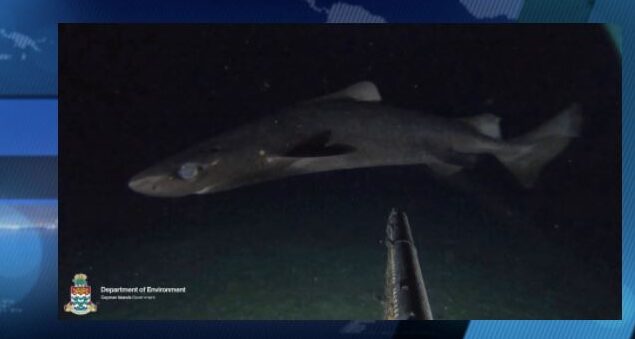
She said at that point, “You are hoping the animal will come back and closer so that you can see what it is.”
Kohler said finally when it did, it was “magical.”
“You see this shark with big eyes and a rounded snout slowly approaching the camera without much movement like it is just floating. When it does turn in front of the camera to avoid collision with the unit, the skin shimmers like oil in the lights of the deep-sea lander,” she said.
Kohler said after a long day in the field, the research team was watching the footage together and “we all were like, ‘Ahhhh, oooooh, wow!’ We were captured by this magical moment.”
She said at first she thought it was a “kitefin shark”, which has a very similar appearance to the roughskin dogfish shark.
“But after careful examination by taxonomic experts, we got confirmation of the species and we were excited about what it means for Cayman,” she said.
Kohler said she hopes the discovery “motivates us as a community to continue to take care of our islands’ environment to protect our biodiversity from the tree tops down to our deepest waters”.
First living record
Throughout 2022 to 2024, the research team used deep-sea landers with baited remote underwater video systems (BRUVS) to systematically survey Cayman’s near-shore, deep-water habitat and biodiversity, the Department of Environment said in a post on its Facebook page.
Through this work, the DoE said it made the “astonishing discovery of a new shark species for Cayman, the roughskin dogfish (Centroscymnus owstonii)”.
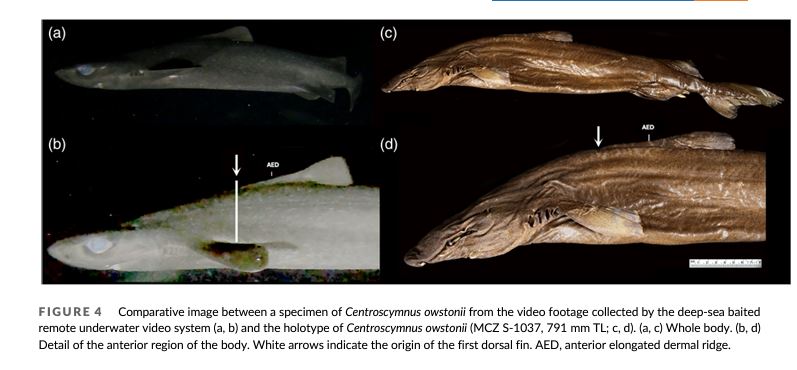
It said there are two known records of this species in the waters of the wider Caribbean, “both based on deceased specimens: one from the Exuma Sound, The Bahamas, and another off the coast of Venezuela, in the southern Caribbean Sea”.
“The roughskin dogfish is a holobenthic squaliform shark, meaning it is a deep sea shark spending most of its life close to the sea floor. Originally described from the Japanese Islands in the 1980s, they have patchy global distribution, found in waters ranging in depth from 150-1459m, with most knowledge stemming from incidentally captured specimens,” the DoE post said.
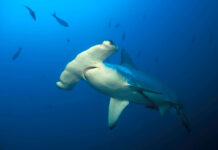
During the two-year study, which commenced in August 2022, glow-in-the dark sharks as well as scalloped hammerheads were among the discoveries as scientists explored the deep underwater world.
Kohler said the DoE plans to continue deep-water exploration around the Cayman Islands.
“There are still loads to discover about our deep water habitats and biodiversity. This initial two-year survey just scratched the surface,” she added.
Related Videos