
Students in Cayman’s public secondary schools are continuing to struggle with attaining passes in mathematics, according to the latest Education Data Report, released by government on Monday.
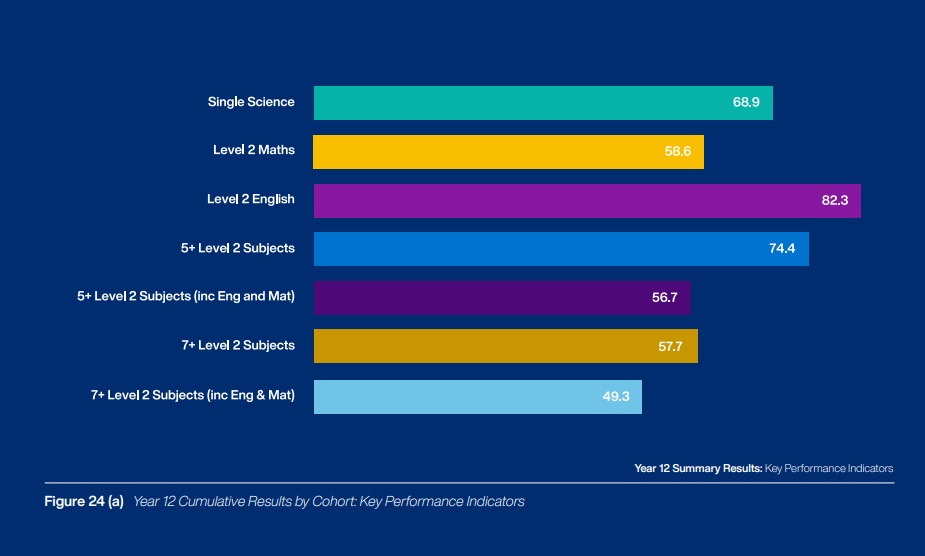
The report noted that 56.7% of students completing Year 12 last year reached the nationally expected standard for Key Stage 4, which requires a minimum of five Level 2 qualifications, including mathematics and English.
It showed that 82.3% and 68.9% of the Year 12 cohort achieved Level 2 qualifications in English and a single science, respectively, while 58.6% passed mathematics, with 56.7% meeting the expected standard and 49.3% exceeding it.
The report qualified that not all students sat those subjects, and that the results improved when the performances of only those who sat the exams were analysed. In that instance, Level 2 English qualifications rise to 86% (increase of 3.7%), science to 80.5% (increase of 11.6%) and mathematics to 60.6% (increase of 2%).
Year 11 results
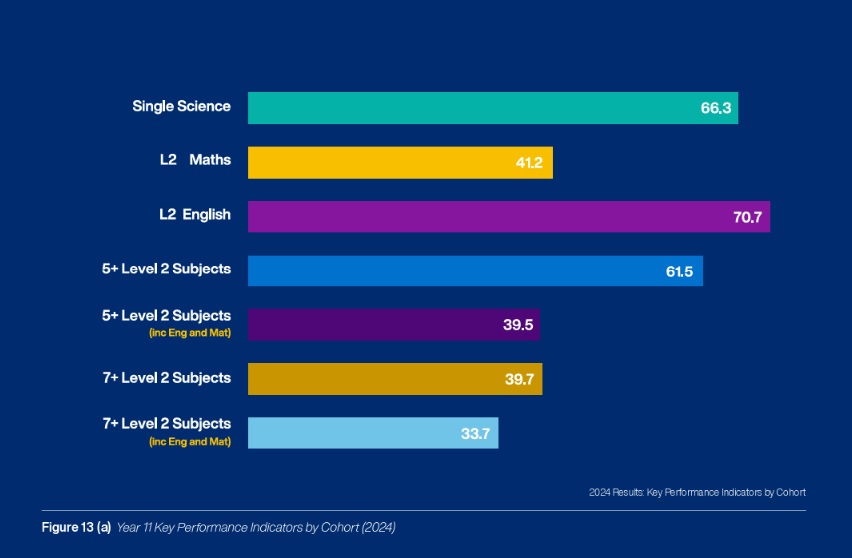
The report showed grimmer results for Year 11 students at government schools, with fewer than two in five passing the expected standard of five or more subjects, including maths and English, in the 2023-24 academic year. Its data indicates that 39.7% of students passed the relevant subjects, including English and maths – a drop of 8% over the previous year, according to the latest Education Data Report, released by government on Monday.
The report gives a breakdown of academic results, attendances and other data gathered across local schools, as well as measures under way to address shortcomings.
Mathematics continue to be a weak spot among school exam results, the report shows. It indicated that, at completion of Year 11, only 41.2% of the students had achieved a Level 2 qualification in mathematics.
Results were higher in English language, with 70.7% of students attaining a Level 2 qualification, and in science with 66.3% passing the subject.
If only the students who sat the exams by the end of Year 11 are considered, the numbers rise to 47.2% achieving a Level 2 pass in mathematics, 73.8% obtaining a Level 2 qualification in English, and 78.5% gaining a Level 2 qualification in science.
There was a drop in results across the board in English, mathematics and science, the report found.
“Notably, English performance dropped by 9 percentage points, mathematics by 11.1 percentage points, single science by 1 percentage point, five or more Level 2 qualifications (including English and mathematics) by 9 percentage points, and five or more Level 2 qualifications by 6.2 percentage points,” it noted.
“Of consideration for this analysis by cohort, is consideration of the cohort size and the number of students that did not take the exam in the key subjects reported,” the report stated.
The findings also reveal that for students who sat five or more subjects by the end of Year 11, 72% achieved a Level 2 qualification in English language, while 41.9% reached this standard in mathematics. In science, 67.4% of students attained a Level 2 qualification and 62.6% achieved five or more subjects. Additionally, 40.2% of students met the national benchmark of securing five or more L2 qualifications, including both English and mathematics.
The report authors stated, “Looking ahead, improving performance in mathematics remains a priority. Strategies currently include revisiting curriculum resources and delivery, providing professional development for teachers, increasing access to tutoring and interventions, and fostering a positive attitude toward mathematics through innovative teaching methods.
“By addressing these challenges, schools can better equip students to meet and exceed national expectations, ensuring mathematics becomes a strength rather than a limiting factor in their academic journeys.”
The qualifications considered in Key Stage 4 include the Caribbean Secondary Education Certificate (CSEC), the General Certificate of Secondary Education (GCSE), the International General Certificate of Secondary Education (iGCSE), BTEC awards, IMI awards, ASDAN awards, and City & Guilds certificates.
Key Stage 2 results
Just 43.5% of students completing their Key Stage 2 primary school education achieved the expected national standard in mathematics.
The results in grammar, punctuation and spelling were higher, with 64.1% reaching the expected standard. In reading, 54.9% attained the expected standard, while 52.3% achieved the expected standard in writing. Those results were assessed by teachers and externally moderated, the report notes.
Despite these results, the Ministry of Education report stated that, among Key Stage 2 students, there has been an average improvement of 6.5% across core subjects since the introduction of the 2019 curriculum.
“This improvement highlights the successful implementation of evidence-based teaching practices and robust teacher development programs,” the report notes.
“In reading, a notable 12.5 percentage point increase since 2022 demonstrates the system’s focus on literacy as a cornerstone of academic success. While mathematics results remain an area of focus, the steady upward trend underscores the potential for continued improvement through targeted interventions.”
Tackling the mathematics problem
The Ministry of Education and the Department of Education Services say changes are being made in how mathematics is being taught in primary and secondary schools in Cayman, including placing an emphasis on foundational skills.
Three new specialist mathematics teachers were added to the public schools last year, and the ministry says there have already been “marked improvements in the schools where they were deployed”.
For this academic year, 12 specialist teachers have been employed, with plans to increase this to 14 by year’s end, the report noted.
Targeted intervention programmes, such as Maths Whizz, have also been made available to students “working below expected standards, providing personalised learning pathways that help bridge gaps in understanding”, the report said.
Enrolment increasing slightly
According to the report, 4,377 students were enrolled in primary schools and 4,677 in secondary schools for a total of 9,054 students in the 2023-24 academic year — a tiny increase of just 0.13% compared to 2022-23.
It noted that enrolment was nearly evenly split by gender, with 49.8% female and 50.2% male students.
The data does not include the 116 students enrolled in special education at the Lighthouse School for that academic year.
A slight increase was also seen in the number of young attendees for Cayman’s early childhood care and education centres, with 2,082 children enrolled there — a 1.3% increase compared to the previous year’s enrolment.
At primary level, 46.7% of students were in private schools, 52.3% in public schools and 1% homeschooled. At secondary level, 57.6% were in public schools, 40.9% in private and 1.5% homeschooled.
“Overall, the ratio of private to public school enrolment has remained stable over the last two years, with an average of 45% enrolled in private schools and 55% in public schools,” the report noted.
It pointed out that there had been “consistent growth” in enrolment in government schools, with an increase from 4,757 students in 2022 to 4,982 in 2024.
Meanwhile, private school enrolment declined from 4,061 to 3,958, “signaling a potential shift in parental preference, affordability issues, or capacity limitations”, the report noted.
It added, “This suggests a growing preference for places in public education.”
Attendance rates
Truancy rates in Cayman’s public schools hovered just above the 9% mark, according to the report, which noted that the overall attendance rate for the public education system in 2023-24 was 90.8%.
“This rate is above the previous year’s 88.4% but significantly under the national benchmark of 96% set by the Office of Education Standards,” the report said.
It noted that the attendance figure at secondary level averaged 88.8%, though when the Cayman Islands Further Education Centre is excluded, the rate rises to 91.1%, “indicating CIFEC’s significant influence on the overall metrics”.
Girls outperforming boys
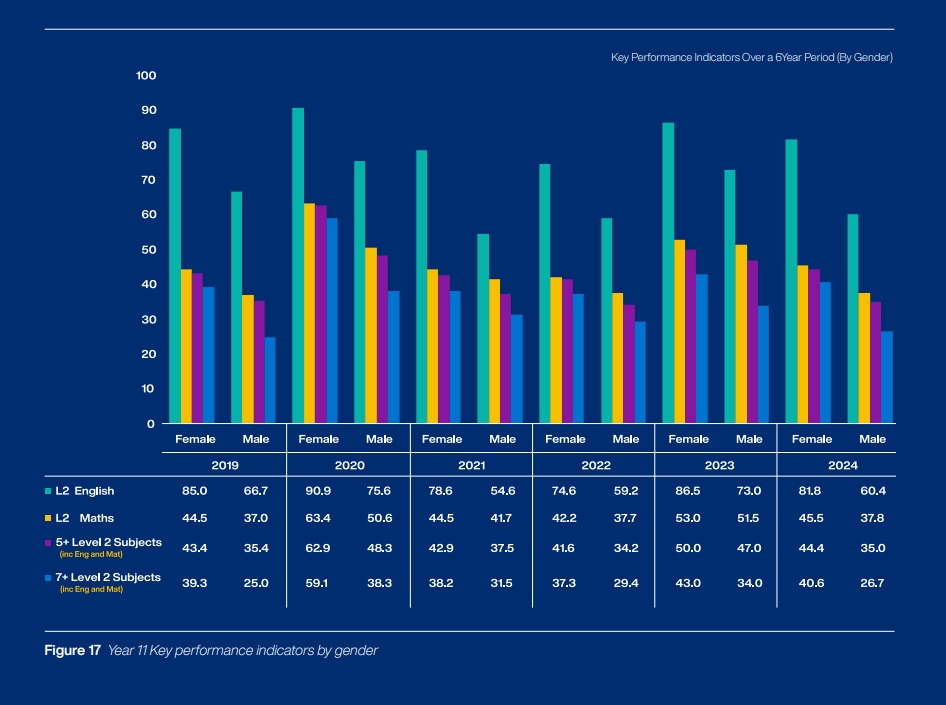
The statistics also show the continuing trend of girls outperforming boys across all academic subjects in primary schools.
On average, the girls were performing 16% better than their male counterparts, with the most significant difference observed in writing at 27%.
“This phenomenon is generally recognised and acknowledged among educators within the system. Efforts are ongoing to address these gender disparities and to create more inclusive learning environments which cater to the diverse needs and strengths of all students, irrespective of gender,” the report stated.
When it comes to achieving five or more Level 2 qualifications, including English and mathematics, girls outperformed boys by an average of 7.9%.
The report noted, “This gap could be indicative of factors like greater persistence, better study habits, or higher levels of overall academic engagement among girls. These trends are consistent with broader international research, which often shows girls excelling in structured academic settings, particularly in languages and multi-subject benchmarks.”
Related Videos