


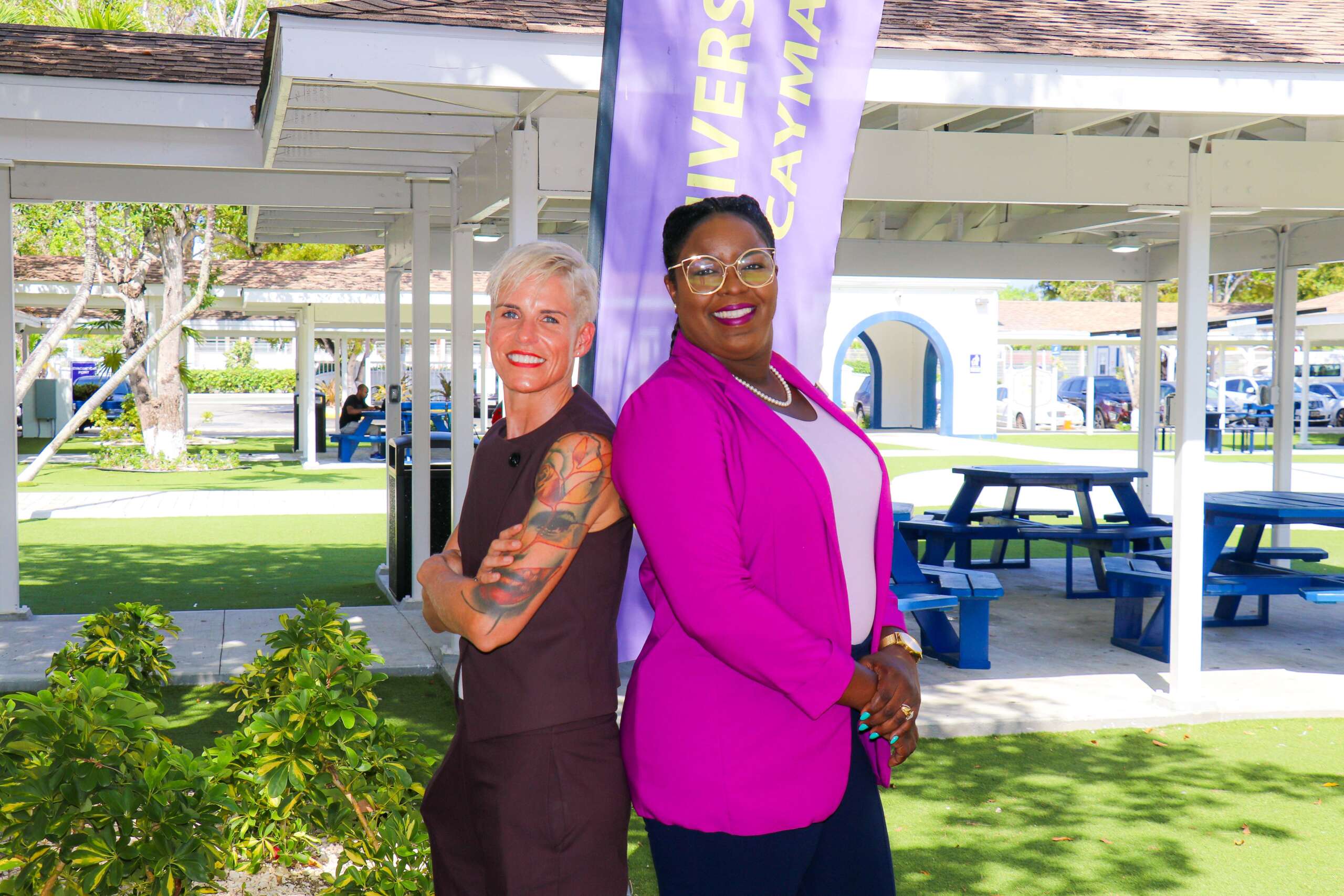
Artificial intelligence may be Cayman’s secret weapon in tackling its heavy reliance on foreign labour. That’s the message from Tamsin Deasey-Weinstein, director at the University College of the Cayman Islands and a key voice in the island’s growing AI movement.
“Done right, AI can augment Caymanian workers’ capabilities, opening opportunities for higher-skilled jobs and entrepreneurship,” Deasey-Weinstein says.
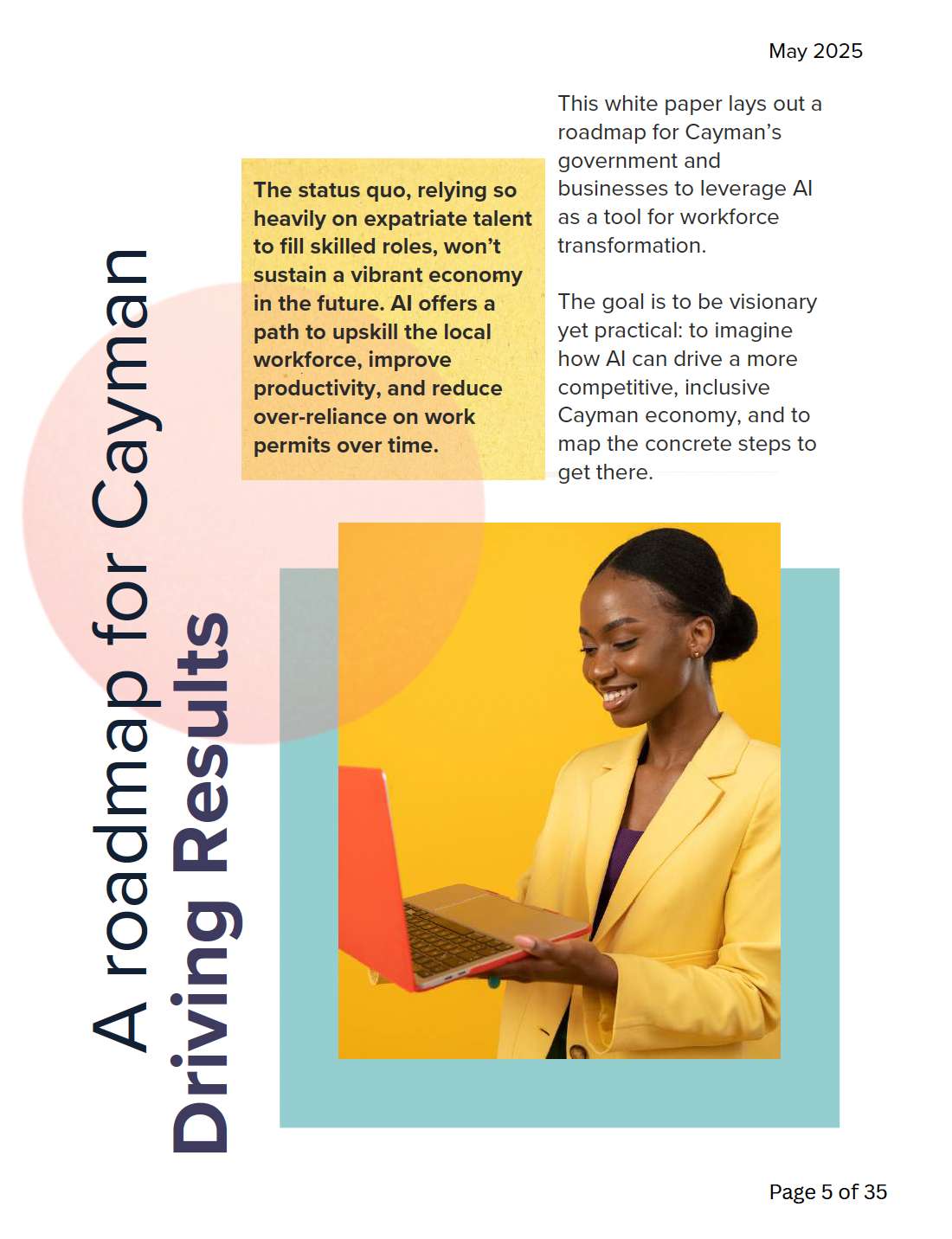
Her newly published white paper, ‘AI and the Future of Work in the Cayman Islands’, argues that relying heavily on imported talent is no longer sustainable. Instead, she says, AI offers a pathway to upskill local workers, boost productivity and reduce the long-term need for work permits. The white paper lays out how AI can help build a more competitive and inclusive local economy.
Instead of fearing job losses, Deasey-Weinstein calls for a mindset shift. The key is preparing local workers to work with AI — not compete against it.
“The key for Cayman is to prepare workers to collaborate with AI so they can do more in less time, rather than fear that AI will simply take jobs away,” she says.
Deasey-Weinstein, who co-chairs the National AI in Education Steering Committee and sits on the Chamber of Commerce and the Cayman Islands Artificial Intelligence Society, is also an MIT-certified AI practitioner and a published academic on AI’s impact on labour markets.
She recently co-authored a peer-reviewed study entitled ‘Harnessing Artificial Intelligence for Educational Reform and Workforce Development: The Case of the Cayman Islands’ with Dr. Genève Phillip-Durham, dean of humanities and social sciences at UCCI, in The Round Table: The Commonwealth Journal of International Affairs. The paper outlines how small island states like Cayman can harness AI to overcome geographic and scale limitations while maintaining global competitiveness.
In the report, Deasey-Weinstein draws on the findings of the ‘Future of Workforce in Cayman’ report‘, a collaborative initiative between UCCI and Compass Media, which outlines steps to address the mismatch between the skills local job seekers have and those needed in high-growth sectors.
The report frames AI as a pillar of Cayman’s future economy, warning that while 46% of emerging jobs will be in IT-related fields, including AI, just 8% of Caymanians are currently showing interest in the area. It highlights a critical gap in AI and digital literacy across the workforce and calls for urgent investment in education and professional development to close the divide.
“If proactively addressed, AI could become a catalyst for closing the skills gap, providing tools to upskill Caymanians faster and creating entirely new career pathways locally,” she says.
Deasey-Weinstein says AI will transform every career, so every Cayman graduate must be AI-ready. She points to UCCI’s digital skills partnership with Cayman Enterprise City as a start, but stresses that schools can’t do it alone. The private sector, she says, must get involved across all levels of education, including vocational training.
To accelerate progress, she’s calling for a national AI workforce task force, co-led by government and the Chamber of Commerce, to launch pilot projects where businesses improve operations while Caymanians gain hands-on AI experience.
With many local businesses unsure of where to begin, she recommends practical workshops, sandbox testing zones and tailored toolkits to help small and medium enterprises integrate AI, cut risk and boost productivity.
Deasey-Weinstein says immigration policy can also support the transition by fast-tracking permits for highly specialised AI professionals, such as data scientists, on the condition that Caymanians are included as understudies on projects. She also suggests short-term visas for visiting experts and using incentives to encourage companies to take on apprentices and invest in local training.
Ultimately, she believes the government must play a central role in harnessing AI to reduce Cayman’s long-standing reliance on expat labour.
“The takeaway for Cayman: Broad-based education initiatives can rapidly accelerate AI adoption,” she adds, stressing that preparing future generations starts in the classroom.
Related Videos













Try collecting a work permit fee from AI which can then help with Cayman schools, roads, people who need help.
If AI takes expats jobs, it wouldn’t take Caymanian jobs?
The last point that raises cause for concern is if you have people that still aren’t higher educated in the actual subjects but know AI, that’s great I guess but someone who actually knows the underlying subject and AI is likely more impactful to the business rather than someone who just asks everything to AI and doesn’t have critical thinking skills. While AI is wonderful, it’s not a silver bullet yet. Some of these jobs are more complex than one could imagine on island. They need years of formal education and often experience abroad.
AI is like that double-edged sword of social media….having both benefits and curses.
However, AI could benefit how many Government processes are managed. Clearly CUG suffers from a big problem with effective and efficient project management, across the board. Also, many CIG departments are inconsistent in their service and information delivery
One can speak to 3 different officers in any department and get 3 different interpretations of the rules/regulations/requirements.
AI could address these gaps in CIG outputs but most certainly assist in speeding-up processes. The Dept of Planning would be a great candidate for AI; NRA another, with road designs.
AI could also reduce the personnel bloat in the entire public service. Would CIG embrace AI to it’s known potentials? Perhaps not so much if it would mean less hiring, which could be a political driver over reducing the costs of public services.
Most of our imported workers are filling jobs that Caymanians don’t want, A.I. cannot address this issue.
Impressed that she has managed to insult Caymanians, expats and the institution that she works for all at once.
Ain’t that the truth.