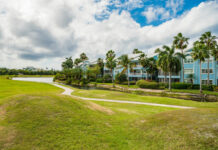
The UK’s highest appellate court, the Judicial Committee of the Privy Council, has ruled in favour of Britannia Villas homeowners, confirming their long-disputed right to access recreational facilities at the former Hyatt Regency Grand Cayman resort.
In a landmark decision delivered Monday 23 June, the Privy Council overturned a 2023 ruling by the Cayman Islands Court of Appeal and reinstated an earlier Grand Court judgment, declaring that homeowner’s rights attached to more than 190 residential units in the Britannia development are valid easements that remain legally binding, even after the land was subsequently acquired by Dart-owned companies.
The dispute centered on whether these rights, registered in legal documents at the time of property sales, were incorrectly classified as “restrictive agreements” rather than “easements” – a legal distinction that determines whether rights are permanent and transferable.
The Privy Council concluded that although the documents were mislabelled, they clearly set out legally enforceable easements. The court stressed that it is the substance of the rights, not the terminology used, that determines whether they can be enforced.
The ruling ends a longstanding legal battle between Britannia residents and Cayman Shores Development Ltd. or CSDL, a subsidiary of Dart.
Dart’s response
CSDL responded to the ruling with a statement acknowledging the Privy Council’s decision and noting the case’s complexity, which was evident in the varying judgments delivered by the Grand Court and the Court of Appeal.
“The outcome, following differing decisions from both the Cayman Islands Grand Court and Court of Appeal, highlights the complex and unique circumstances that have surrounded this case for many years,” the company stated.
CSDL also thanked the courts and all parties involved for their commitment and indicated its willingness to engage with residents moving forward.
“CSDL respects the Privy Council’s judgment and thanks the Court for its careful consideration of the issues. We also express our appreciation to all parties involved for the time, energy and commitment dedicated throughout the legal process.”
The company added: “CSDL remains committed to engaging constructively with the Britannia owners and looks forward to productive and collaborative dialogue to understand and discuss what the decision means for them and their community moving forward.”
Long-running legal battle
The Privy Council hearing, held in London on 30 April, followed legal back-and-forth that began when Dart entities acquired the one-time Hyatt Regency hotel and adjoining lands in 2016 and sought to redevelop the site – including the now-closed golf course and the beach club, which was later reopened as Palm Heights.
When Dart offered homeowners a limited licence to use the facilities, residents pushed back, insisting they already had property-based rights that were attached to their land titles through agreements registered in the Cayman Islands Land Registry.
The original agreements were entered into between the developer and the original homeowners. These agreements guaranteed use of the hotel’s golf course, tennis courts and beach club – benefits that were used as selling points during the resort’s phased development in the late 1980s and early 1990s.
Dart filed suit, arguing that the rights granted in the 1990s were not properly registered as easements and therefore should not be enforceable against a new landowner.
In 2021, Grand Court Justice Nick Segal sided with the homeowners, stating that the rights were clearly intended to be permanent and binding.
But that decision was overturned by the Cayman Islands Court of Appeal in 2023, which ruled that the rights had been registered under the wrong legal category – as “restrictive agreements” instead of “easements” – and therefore weren’t legally binding.
That judgment was challenged by Britannia owners and on 30 April 2025, the Privy Council in London heard final arguments in the matter.
Final Word
On Monday, the Privy Council disagreed with the Court of Appeal. The court found that the documents registered with the Land Registry clearly set out easement rights that were binding on future owners.
While the court confirmed that the mislabelling does not affect the enforceability of the rights, the Privy Council described the entries as “inelegant” – meaning awkwardly or unclearly worded – and noted they could be improved through correction.
Citing greater legal clarity following a prior case (Regency Villas Title Ltd v Diamond Resorts (Europe) Ltd) which confirmed that recreational rights can qualify as easements, the court recommended that the Cayman Islands Registrar of Lands consider updating the language in the registry – both in this case and potentially in others – to better reflect the true nature of such property rights.
“The RLA [Registered Land Act] does not prescribe different legal consequences as flowing from restrictive agreements as opposed to easements, although the precise registration technique is slightly different. If properly registered, either has essentially the same consequence of being,” wrote Lord Briggs in the final decision.
Britannia homeowners respond
In a statement issued through their legal representatives at Walkers, the Britannia homeowners welcomed the ruling and stressed its significance for residential property owners in the Cayman Islands.
“The ruling is important not only in the context of the Britannia development, but also for residential owners elsewhere in the Islands when considering the security of their recreational and sporting property rights,” the statement read.
With Dart expressing a willingness to work collaboratively with the community, the focus now shifts to how the ruling will be implemented in practice.
“The Britannia owners now look forward to re-establishing access and exercising their rights into the future,” the homeowners said.
Related Videos