

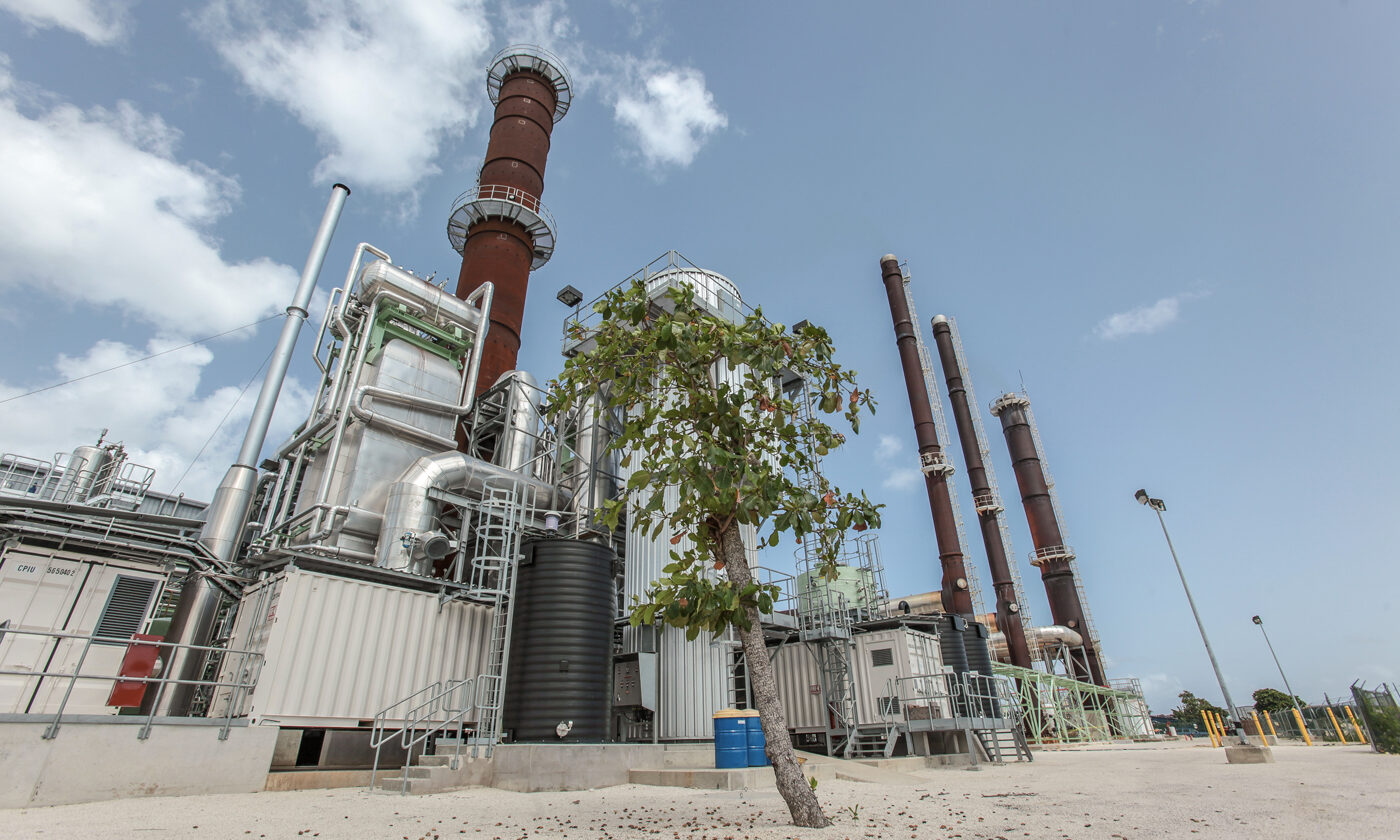
Government is seeking to tackle high energy costs as part of a broader effort to ease mounting cost-of-living pressures in Cayman.
Premier André Ebanks, speaking in a wide-ranging interview with the Compass, said the government was putting a stronger policy focus on lowering electricity prices in the new year.

His comments coincide with the release of a new regional index which shows electricity costs in Cayman are higher than in many neighbouring Caribbean countries.
“One of the central challenges for us to crack the cost of living in the country is the cost of energy,” Ebanks said.
While food prices are difficult to control in a country that imports most of what it consumes, he said electricity costs is an area where government believes meaningful progress can be made.
Accelerating the transition to renewable energy is considered central to that aim, with utility scale solar power now significantly cheaper than diesel generated power.
“Food is tricky for a country like us that imports everything … we can’t grow our own food to sustain ourselves forever, but energy can be solved.”
He added that cutting power costs would lead to lower food prices by cutting costs for businesses and retailers.
And he targeted resolving the impasse between regulators, utilities and renewable energy advocates to kickstart a long-desired move away from expensive, imported fuel.
“Doesn’t look like a happy bunch between OfReg, the green energy folks and CUC, right?” Ebanks said.
“This is clearly not working. They’re going and spending money on litigation, and the country is not getting a lesser cost of energy to be able to have more money to go get food.”
Ebanks said government may need to take a more active role in setting the overall direction for the sector amid ongoing disputes which have slowed the transition to green energy.
“This is where macro policy kicks in”, he said.
Cayman currently derives around 3% of its power from renewable sources despite a National Energy Plan which targets hitting 100% by 2050.
New index shows high price of power
His comments concur with findings from the Caribbean Energy Price Index, published in January, which compares electricity prices across the region.
The index shows that electricity prices in the Cayman Islands are around 20% higher than the Caribbean average. When prices are adjusted for purchasing power and the wider cost of living, Cayman ranks among the most financially burdensome electricity markets in the Caribbean.
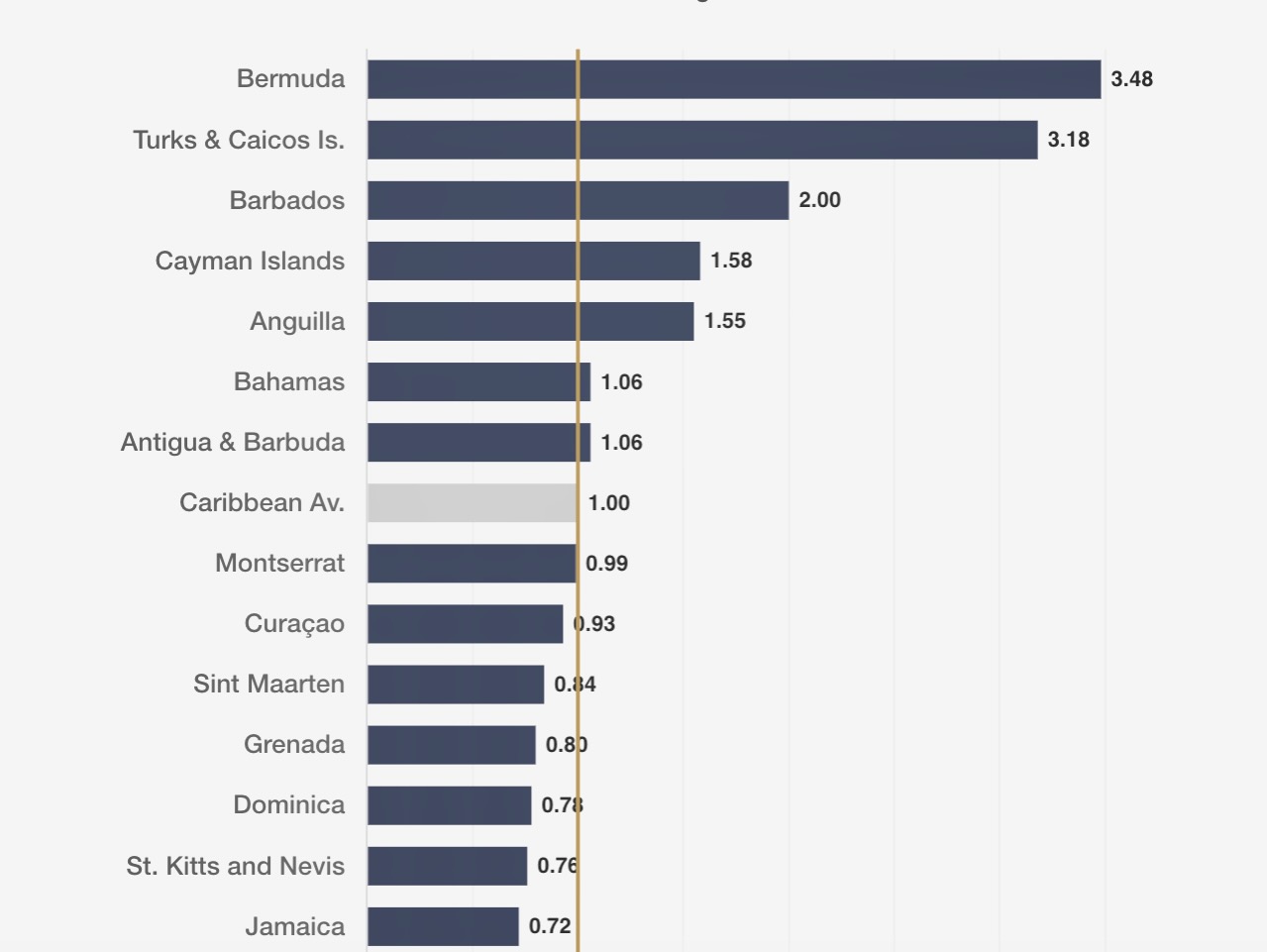
The report also identifies a clear regional pattern linking energy prices to the transition to renewables. Jurisdictions with higher levels of renewable electricity production tend to have lower power costs, while those with limited renewable penetration, including Cayman, generally face higher prices. Bermuda has the highest costs in the region.
Economist Marla Dukharan, who co-produced the Caribbean Energy Price Index with SOL Ecolution, said electricity costs were a fundamental driver of wider cost-of-living pressures across the region and a key factor in economic competitiveness.
“You would notice that about half of the Caribbean has electricity prices above the Caribbean average, and only six countries have electricity prices below the global average,” she said.
“This means our cost structures – the cost of doing business and the cost of living – make us less economically and socially prosperous than those at or below the global average. Put another way, our above-average cost of electricity, which drives the cost of almost everything else, is making us poorer.”
Dukharan said Cayman’s electricity costs appear even more burdensome once broader cost-of-living factors are taken into account. While the Islands rank 12th in the Caribbean on nominal electricity prices, they rise to fourth place once prices are adjusted for purchasing power.
Premier Ebanks echoed that view, saying energy reform was critical to easing pressure on household budgets.
Premier André Ebanks comments are taken from a wide-ranging interview with Compass Media on 5 Feb.
Related Videos













Amazingly, a country with 300 days of sunshine relies so heavily on burning diesel generators for electricity.
I see the problem as CUC being a publically traded monopoly and the government needing the tax revenue on imported diesel as the reasons why. Plus, it is a large local employer.
Perhaps we could kill two birds with one stone.
A year or two ago there was a Compass feature on a local startup company that was growing produce in a converted shipping container. It didn’t go ahead because CUC refused to buy the surplus electricity generated by the solar panels on the container’s roof.
Let’s revisit that idea and REQUIRE CUC to help.
All
Each 1 M solar will require 5-7 acres of land and only operate during the day…then what.
You can over build solar by 2X then battery storage for when the sun does not shine.
Thus, you need 240 Mw x 7 acres = 1,680 acres of land is needed from the large solar. Entire Grand Cayman is 48,640 acres so to meet the goal or 3% of the land needs to be dedicated to solar.
They should focus on rooftop and not take useful land for large solar.
So how does Govt’s humongous increases in the cost of driving licences help the problem?.
They did raise prices because the price of oil and gas went up. However, I see oil and gas prices cut in half and my electricity bill is not lower. Time to lower it.
Hon. Premier, I beg to differ with some of your assertions.
Energy costs are often fundamental to the cost-of-living in any economy or society. However, in Cayman it’s unreasonable to expect energy costs comparable with say, Florida, as we have to recognize supply chains, economies-of-scale and other factors, unique to being an island relatively distant from our main supply sources. Yes, we’d all love to pay less for our energy but Government’s own fees on fuel imports and sales contribute to CUC’s costs and that of every fuelling station in our islands. These are passed on to the consumer. Considering the logistics of providing energy to Cayman’s consumers, CUC costs are not predatory. However, their service is stellar and yes, we pay more for electricity than some other jurisdictions but we get value for money. Whatever impediments exist to having solar energy more widely used should be addressed. The Govt. agency in charge of that seems incapable, somehow. Although, energy use savings (thus lower costs) need not come solely from the provider; consumers can help reduce their own energy usage. For example, a couple years ago I replaced my AC system with a more efficient system and my bill for my 4 bedroom house dropped from averages of CI$900 to CI$500, with low $300’s in the cool season. I still prefer to drive my gas guzzling V8 vehicles and expect to pay for that choice. But I have the choice to buy more efficient vehicles, including e-bikes (more on that in a bit). So, personal choices and habits can dictate lower costs in some cases.
Where Government should really focus it’s efforts is in attempting to reduce its own fees. Not just on the energy sector but across the board. Yet, it increases same, while crowing about the high cost-of-living it itself contributes to. Our successive Governments’ only approach to revenue earning is to repeatedly increase fees on various sectors, instead of seeking to diversify its sources of revenues. This is quite evident, as the current Government recently did its part in that tired cycle with vast increases. Meanwhile, this Government has a mandate on two new revenue sources which it has ignored so far.
I recently overheard a prominent business owner complaining about the latest tranche of Government fees and saying “we won’t be absorbing them, we’ll have to pass them on.” Government should be working with the Chamber of Commerce to encourage its member and non-member retail goods and services providers to absorb a bit more. It’s evident that the largest goods and services providers in Cayman enjoy healthy profit margins and could possibly absorb some supply chain impacts without passing everything on to the consumer, every time. I recently discovered that a piped water utility provider’s payment cycle is 14 days, thus costing customers late fees after that period. I was told that is the company’s policy, notwithstanding that normal billing cycles are 30 days. In my opinion it’s unjustified “gouging”. And what is Government doing to discourage such practices? Nothing!
But surely the Hon. Premier could have chosen a better time to claim Government is is intending to do something about the cost of living, than during the same period it implements unjustified fee requirements on an alternate, clean-energy transportation choice – e-bikes. This is the Government which cannot get any decent form of public transport system implemented, yet it targets (largely minimum-wage) people who have to resort to more reliable transport than Jamaican-inspired “robot” buses, with an ill-conceived and poorly-implemented brain fart by the NRSC and its Chairman who carries a track record for chaos and failures. Why? Just for revenues, thus fees on the public, thus increase in the cost-of-living.
My 10th generation (on both sides) son recently had to provide documentation to “prove he is Caymanian”. This was a request by his employer to meet Government requirements. I still can’t understand why. Therefore he had to BUY birth certificates for both parents, himself and a police record, for somewhere in the region of $125….which he may have otherwise been able to put into his savings account. I imagine this happens to someone every day. Why? Because Government requires it. Why? They’re not sure!! Yet, this and many other questionable Government polices like it impact the overall cost of living.
Hon. Premier, kudos to taking this on but please start within “your own house”. Public service waste is rampant, without accountability. The Civil Service is bloated and inefficient, yet growing and its unaccountability remains “world-class”. Recent glaring examples of unaccounted waste of public funds are 2015-17 Airport development gross over-runs; sponsorship of a football club in the UK; GT revitalization Project; Brac glamour high school; NDHT purchase of bathroom “cattle feed troughs” then “correcting” it by buying the most expensive bathroom fixtures; any project undertaken by NRA; pork barrel basketball and pickleball courts in North Side which have yet to be used by anyone, etc., etc. In addition, vanity projects are in the pipeline like an unnecessary runway extension and a GA Terminal in the swamp; DoT paying 2 weeks vacation with all perks to a “Chief Relaxation Officer” (give me a break!) and who knows what other absurdities come up every Tuesday at Cabinet “wish list” meetings.
Government needs to assess its own fees and determine if and why some are really necessary, review its own wastage and vanity projects and other pork-barrel “expenditures”, reduce the unnecessary growth of the Civil Service (try utilizing something called AI), then the private sector may be more willing to take note of the desire to really address the cost of living and possibly partner with Government to achieve same.
Without such an approach, Hon. Premier, you are just paying lip service to the issue.
Seems to me if we don’t have more room on top of Mount Trashmore for expired solar panels 10-15 years from now, perhaps we should consider modular nuclear using palm-sized, renewable materials as a way to safely and cleanly provide power to each of the districts. Adopting new technology like this would be a game changer for my beloved island. And please don’t start with the “dangerous rhetoric” about nuclear energy production since thousands of submarines around the globe have used this scaled-down technology for multiple decades. Eyes wide open Hon. Premier…?