

In late 2007, a policy advisor named Philip Pedley circulated a report among the upper echelons of government.
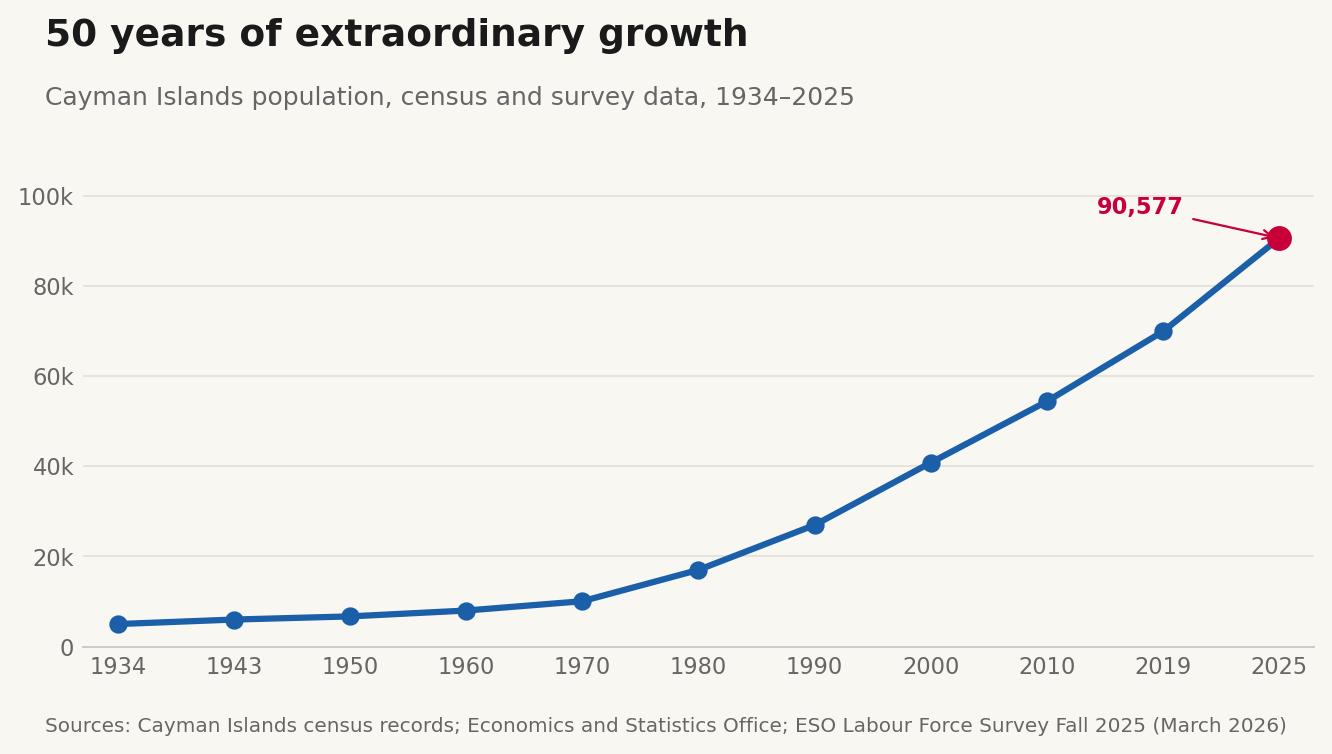
At the time, the islands had a population of around 53,000.
Growth over the preceding decades had been so intense that a Caymanian born in 1970 had already seen their country’s population multiply by five times.
And he predicted the population would reach around 96,000 within 20 years.
Pedley closed his report with a warning and a question.
“How will the population of Cayman change in the next 20 years?
“The question has important implications for every area of government policy and public life – from the number of schools needed to demands on the healthcare system to environmental, social and infrastructure pressures, to the size of the George Town landfill.”
The latest estimate from the Economics and Statistics Office for December 2025 put the population at 90,577.
Two new high schools have been built at a collective cost in excess of $250 million. A third is on the way on Cayman Brac with a projected cost approaching $60 million
But elsewhere across the public and private sector there has been little sign of serious investment.
And almost every item on Pedley’s list is now a documented problem.
Cargo challenge
Cayman’s cargo port is one of the principal choke points.
Everything in Cayman, from groceries and vehicles to building materials and the ‘paint on the walls’, comes through a small facility built in 1976, when the population was around a sixth of what it is today.
Consultants projected in a 2022 report that Cayman would reach the absolute limit of what could be physically imported through the port when the population approaches 100,000.
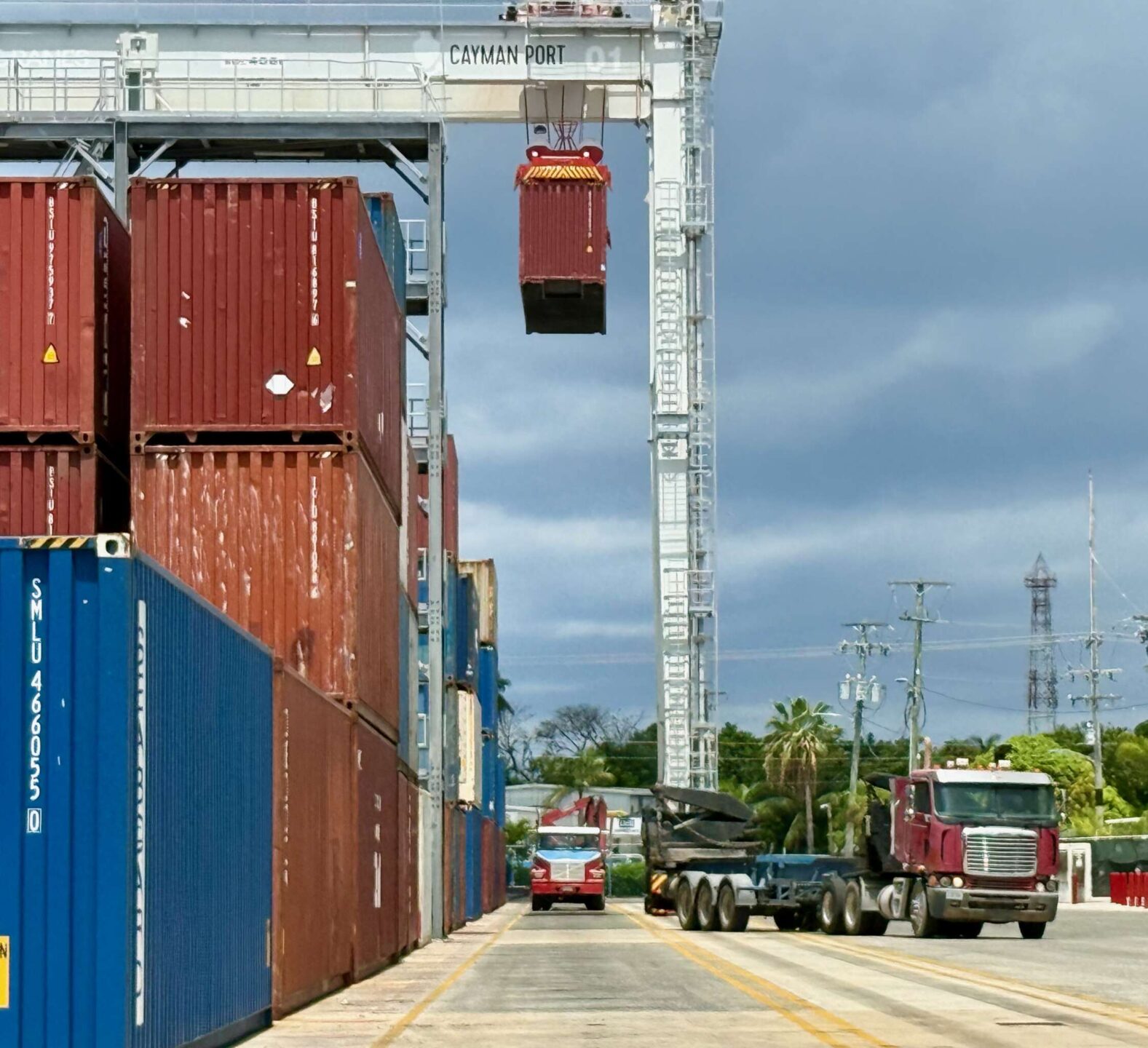
Long-term projections, cited at a public meeting last year, suggested the number of people living on the island could double again by 2074 based on conservative projections. There is not sufficient room to expand to that degree at the existing site and the report proposed a new deep-water port, with Breakers identified as the most plausible location.
Infrastructure Minister Jay Ebanks insists “we need a new port” and that it will likely cost between $400 million and $500 million. But that level of investment is not currently on the cards with a number of costly infrastructure projects competing for limited funds.
Airport needs investment
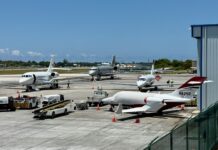
The airport is also under extreme pressure during peak season amid tourism’s post-pandemic rebound.
After years of discussion, a relatively cost-effective renovation of Owen Roberts International Airport was completed in 2019. But the upgraded facility was outdated almost as soon as it opened.
A 2014 masterplan set threshold numbers that would trigger the need for a new terminal. Those were surpassed in 2019 and reached again last year after a dip in arrivals during the pandemic.
Massive investment is also needed in the General Aviation Terminal, airside parking and apron space. A project to expand the runway is currently undergoing an environmental impact assessment.
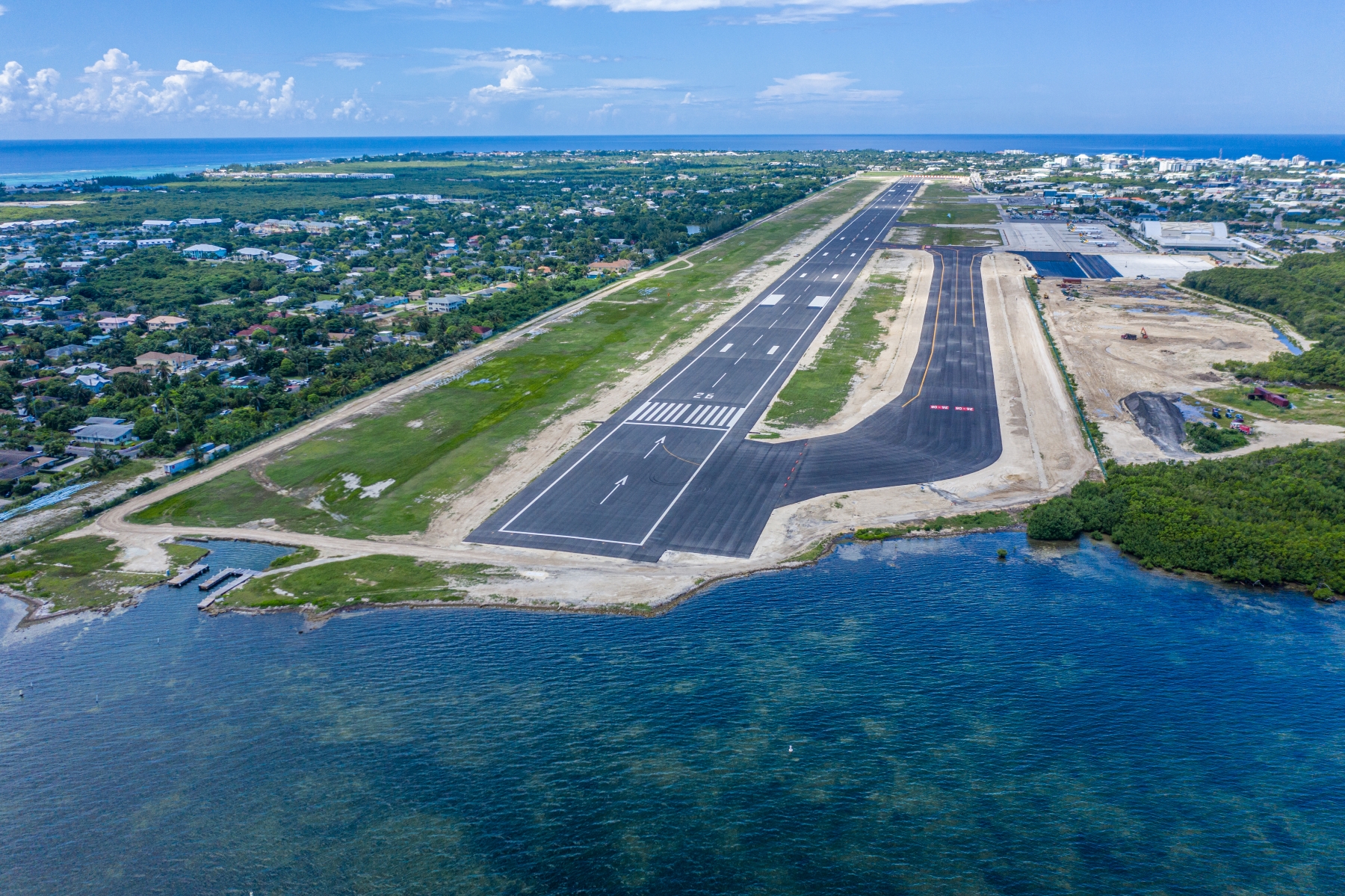
The government’s own consultants say Cayman needs to spend $860 million across its three airports over the next 15 years to meet forecast demand. But only a fraction of that is allocated over the next two years and a new terminal is not budgeted right now.
Landfill plans back to square one
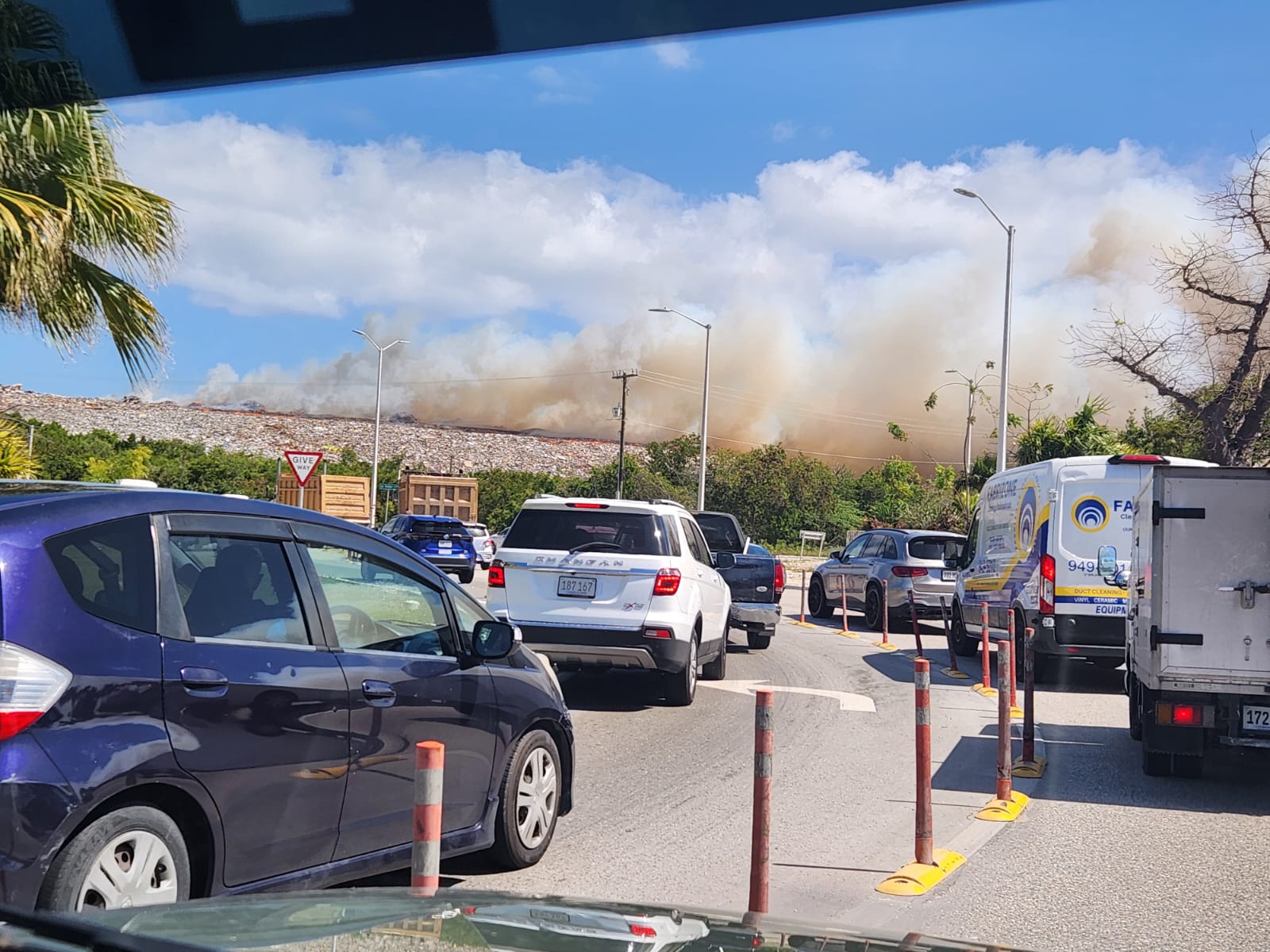
Efforts to replace the George Town landfill, which burst back on to the front pages following the latest in a succession of major fires last month, are also back to square one.
Beginning life as an informal dump in the early 1960s, it now processes more than 130,000 tons – roughly equivalent to 25,000 African elephants – each year at an unlined mound on the edge of the capital.
New room has been created by shipping some materials off island but the clock is still ticking.
“If we keep sending the same volumes of waste to the same place, the current landfill will reach capacity by the end of 2030,” Minister Katherine Ebanks-Wilks said in Parliament earlier this month.
The deal with ReGen was cancelled after government decided it had become too expensive, with estimates for the price tag reaching $790 million for the 25-year life span of the project, a price-tag the auditor general said was ‘not value for money’.
No new long-term solution has been costed.
Power struggle for energy future
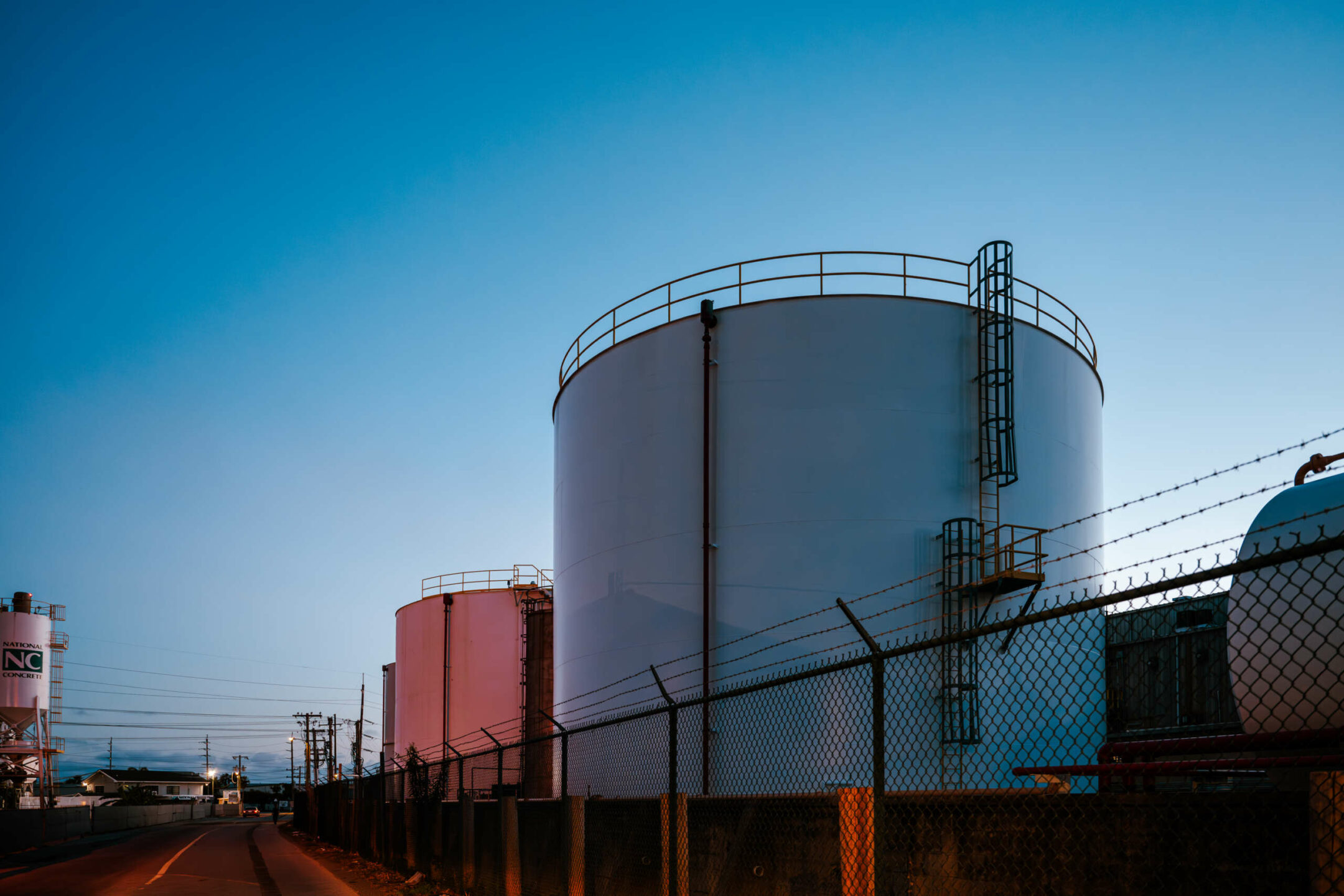
Funding for new electricity generation is badly needed, with CUC warning Grand Cayman could face rolling blackouts because of increasing demand from a growing number of households.
New generation is needed, but a power struggle over how that happens has delayed progress. Cayman’s electricity comes almost entirely from imported fossil fuels, with consumer prices and clean energy targets impacted by lack of movement on green infrastructure.
Nonetheless, a National Energy Policy has set a target that 70% of our power will come from clean energy in little over a decade.
“Our continued reliance on fossil fuels poses significant risks to our nation’s energy security, cost of living and environmental health,” according to the policy.
Increased traffic strains road system
Meanwhile, commuters in the eastern districts continue to report journeys of two hours or more to get to George Town in the mornings.
The combined solution, proposed by the last three governments, includes a new highway and investment in public transport.
Part one, in the shape of the East-West Arterial Road extension, is under way and Minister Ebanks expressed hope it could be completed as far as Midland Acres by end of this term.
The extent to which that will fix traffic is debated. The National Roads Authority has acknowledged it will prevent the situation from getting worse rather than making it better.
A public transport strategy is a longer work in progress. It was highlighted as essential component of Cayman’s future by the Strategic Economic Advisory Committee, a private and public sector group set up in 2020 to look at how Cayman could develop long term.
Deloitte won a $200,000 consultancy contract to look at options and recommended a $30 million overhaul of the island’s bus system, bringing it under government control. Now the NCFC coalition has gone out to bid for another consultancy firm to design an ‘integrated public transport system’.
No cost parameters or timelines for implementation have been revealed at this point.
Telecoms link hanging by a thread
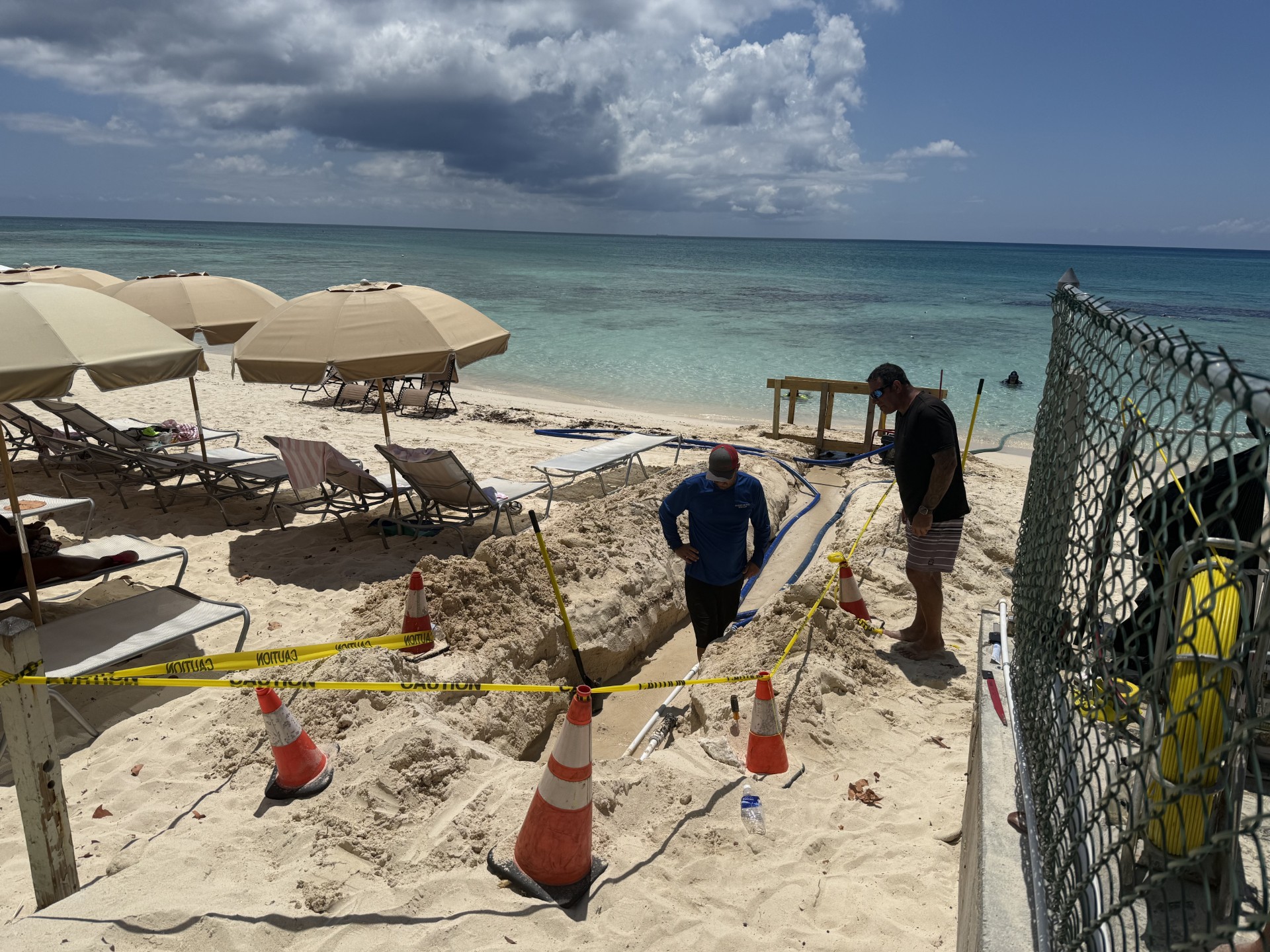
Under the sea, Cayman faces similar problems with its telecoms infrastructure as the tech and business sectors grow.
The cables that carry the islands’ internet and phone connections to the outside world are aging and lack redundancy.
“High capacity, reliable and affordable telecommunications services can be seen as the life-blood of any modern economy,” a government-commissioned report concluded in October 2022.
“The Cayman Islands Government has no certainty or control with regard to the future of either of the existing cables. The lack of certainty about their future introduces various risks to the islands, and represents a threat to the islands’ future.”
Affordable housing in short supply
The latest addition to the list of reports outlining urgent national infrastructure concerns arrived in Parliament last month.
A government-commissioned housing study found that Cayman is already short by more than 3,000 homes and will need 5,000 additional units over the next 15 years just to keep pace with population growth.
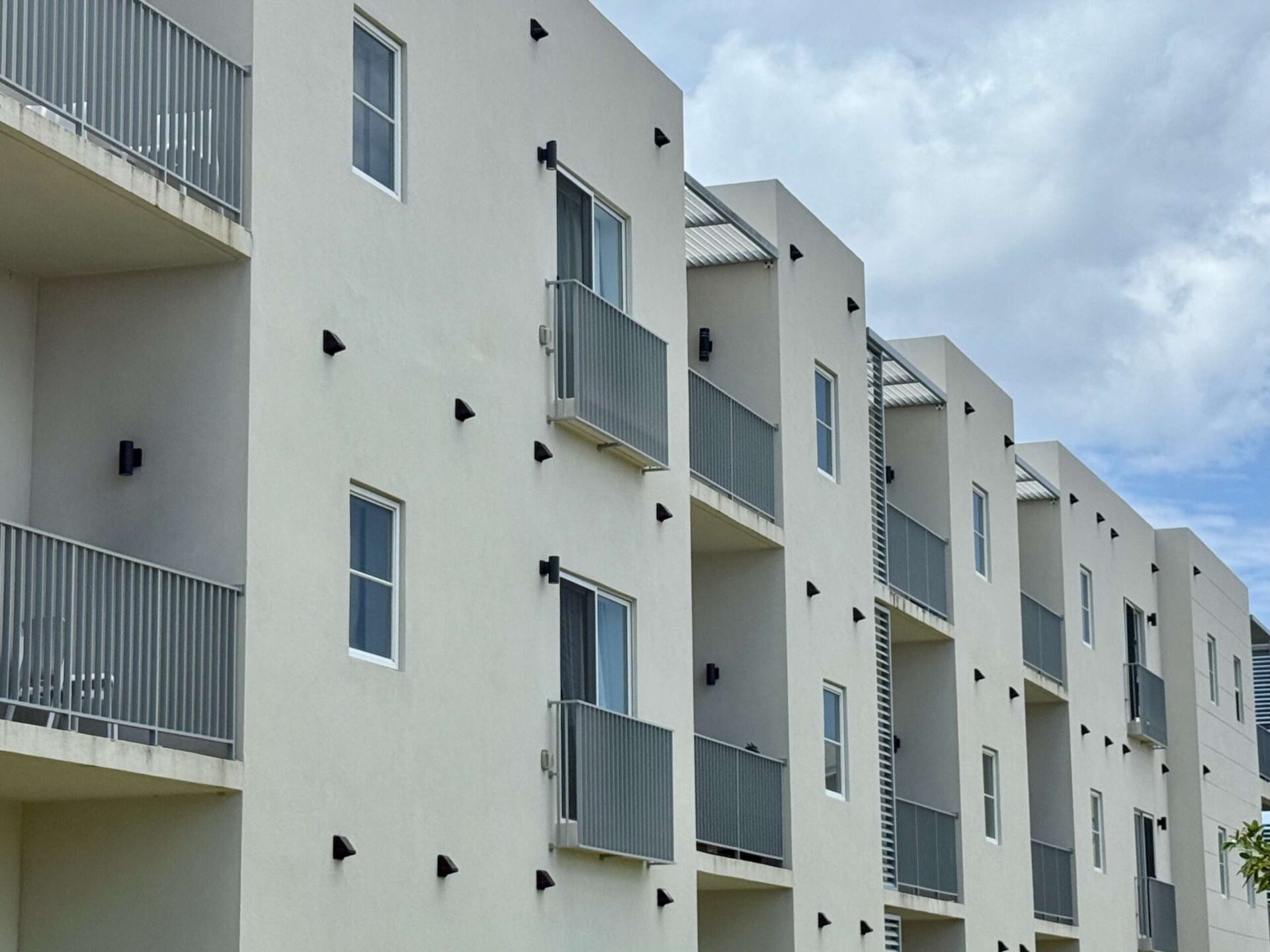
That is a rate of construction that would require tripling current building activity for a decade and incentivising developers to work in the lower-cost end of the market. But the report warned that building homes is not enough.
“The necessary infrastructure for expanding housing – from roads, sewer systems and water to environmental and sustainability safeguards – are not adequate to support substantial growth.”
Sand, storms and sewage
Separate concerns exist around national stormwater management, with new development and loss of mangroves impacting natural drainage systems and putting new areas at heightened flood risk.
Wastewater treatment is an ongoing challenge, with only the Seven Mile corridor connected to a fully functioning sewage system, and a high prevalence of outdated septic tanks servicing much of the island.
The beach itself – Cayman’s premier tourism attraction – is threatened by erosion and a replenishment project is being contemplated, but has not been budgeted, despite being identified as a ‘crisis’ in 2021.
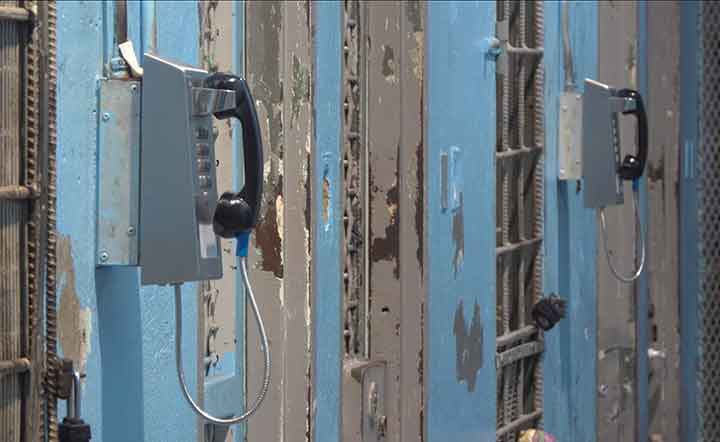
Meanwhile, the first phase of a multi-year redevelopment of Cayman’s prison system is being planned, almost 15 years after the decrepit and overcrowded HMP Northward was condemned by UK inspectors as “unfit for human habitation”.
Minister targets quick fixes
For Jay Ebanks, the in-tray is extensive. But government is facing significant challenges to balance the books and find cash for upfront spending on major capital projects.
The budget for 2026 and 2027 included a total of $210 million for capital expenditure – most of it for roads and schools, with more limited funds to advance design and business case research on other major projects.
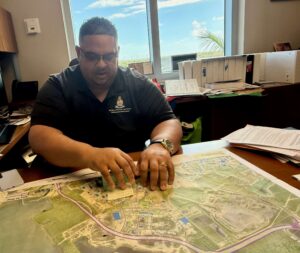
The only national infrastructure projects currently under way and expected to be completed in the next few years are the highway extension and the Layman E. Scott High School on Cayman Brac. A project for a sub-sea cable, potentially partnering with existing private sector companies, is also under way.
Elsewhere, government’s strategy appears to be to make incremental progress in phases over a number of budget cycles or to make smaller-scale investment to prolong the life of moribund infrastructure.
Where feasible, public-private partnerships are considered. But the failure of the cruise and cargo terminal project and the ReGen deal, both of which involved years of work and millions of dollars spent for no result, has created hesitancy about that methodology.
Ebanks says the business case process itself is lengthy and can take up to two years to complete.
“I think we’re hindered by a lot of red tape, more than anything else, in terms of getting some of the infrastructure done,” he said.
With those timeframes, almost every major project risks being impacted by a change in government.
With limited funds available, Ebanks is targeting the East-West Arterial highway as the signature infrastructure achievement of this term. He believes it can be completed up to Midland Acres in Bodden Town before the next election.
He argues it will open up options for the cargo port too, which don’t exist without it.
The prospect of a deep-water port at Breakers, which has been outlined as the preferred option in a Strategic Outline Case from the Port Authority, is contingent on there being a highway for trucks to carry freight to the rest of the island.
“The expansion of that port is desperately needed,” Ebanks said.
“Ships are already sitting low at certain tides and have to be unloaded in stages to prevent them from scraping the harbour bottom.
“We’re probably talking $400 million or $500 million to inject into a new port, if we’re going to look at a new location,” he said.
For this term, the focus is on expanding at the current site – itself a project that requires a business case study – to prolong the facility at George Town for another decade and effectively buy time to plan a sustainable long-term solution.
He acknowledged this amounted to “putting a Band-Aid on” for the time being.
The ‘Band-Aid’ approach
The approach is mirrored across projects.
The airport masterplan was always intended to be carried out in phases. The estimated cost of the complete airport development programme across all three islands comes to $860 million.
A plan to redevelop the General Aviation Terminal with public funds has been scrapped and a new PPP approach initiated to preserve finances for the Owen Roberts arrivals hall.
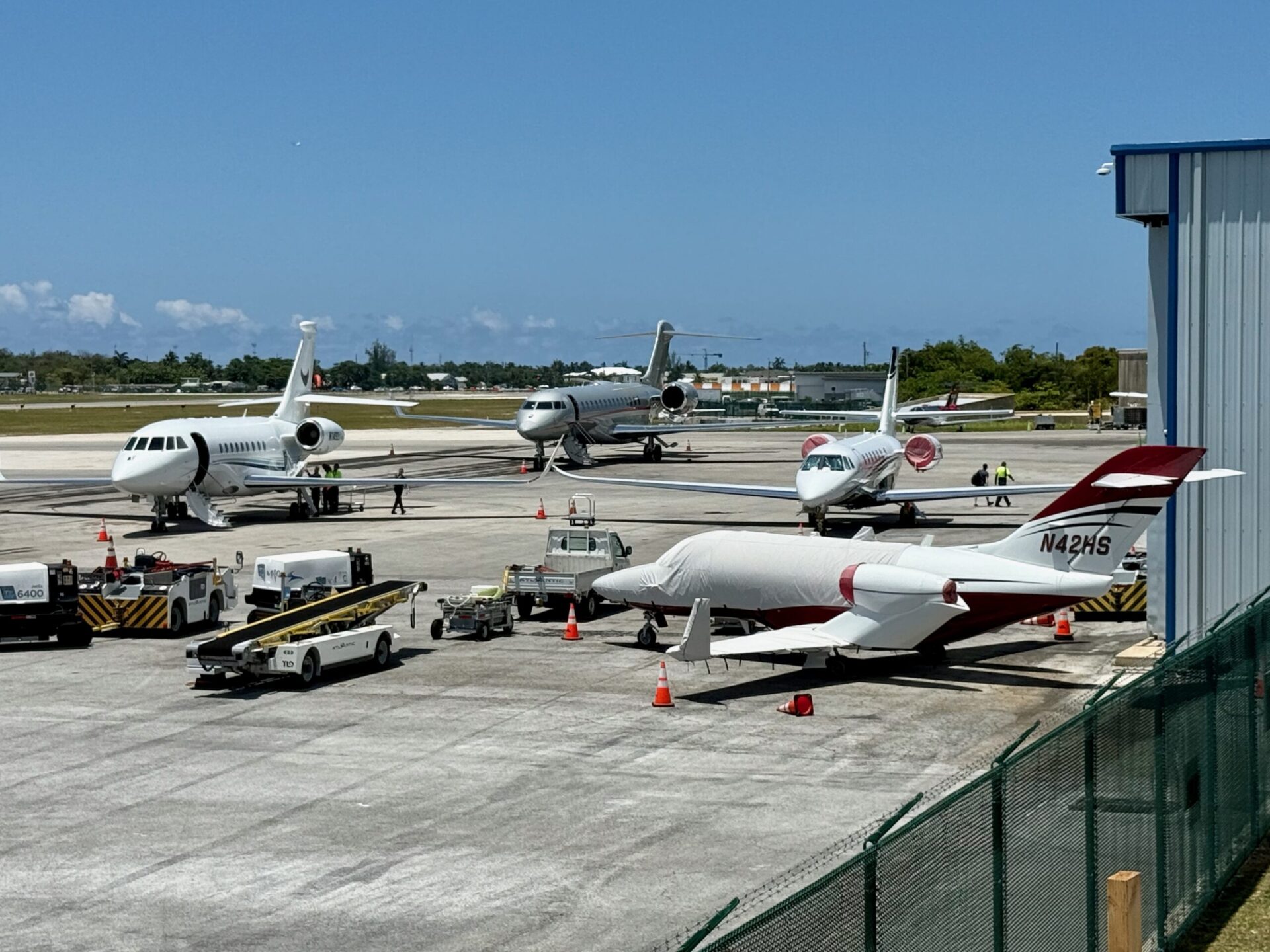
“The main airport is bursting at its seams right now,” Ebanks said.
There are 12-13 flights arriving early on a Saturday afternoon in peak season.
“The weekends are the ones that we really sweat the most on,” the minister said.
The plan for the immediate future is to work within the existing footprint to make better use of space and reduce wait times.
Longer term, Ebanks wants to see a second-floor build and the introduction of jet bridges, but that is not on the cards for now.
A multi-storey car park, pickup and rental vehicle area could proceed this term.
The plan for the landfill, as outlined in Parliament by Minister Ebanks-Wilks, involves a similar process. A mini-infrastructure project to create a new lined fill site on the current premises could expand the life of the George Town dump through 2036.
Technical work and business case studies are also planned for recycling and composting facilities, as well as a longer-term solution for waste management.
A steering committee for a long-term solution will be in place by the summer of 2026. An outline business case identifying that solution will not be ready until autumn of 2027 at the earliest.
But as fast as Cayman makes plans to upgrade its infrastructure, surging population and changing economic conditions threaten to make those plans redundant.
Cayman did not pay much heed to Pedley’s warning in 2007 that it must consider the impact of population growth on the community and its infrastructure over the following decades.
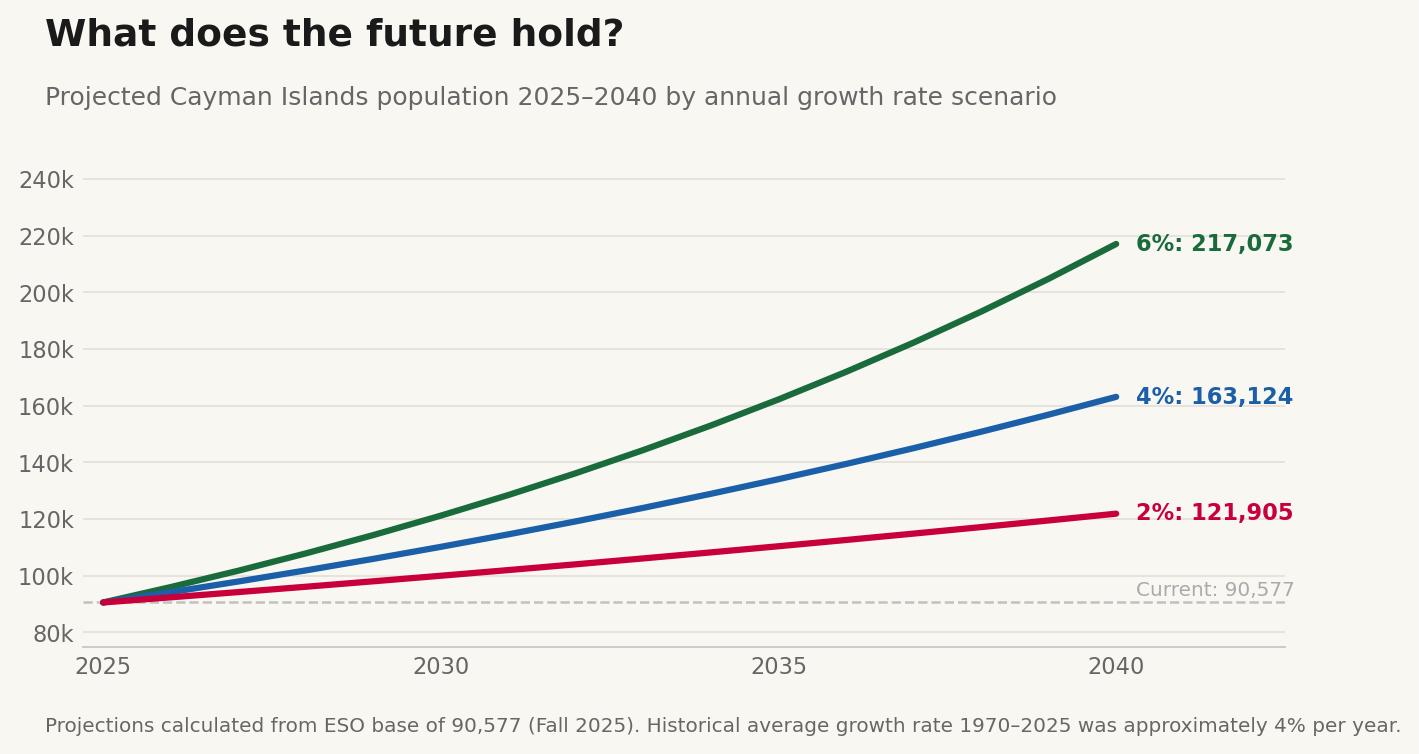
At current growth rates, Cayman’s population will cross 100,000 within the next three to five years and could reach 150,000 by the mid-2030s to mid-2040s depending on how quickly that growth moderates. Even at the more conservative end, 2% annual growth, consistent with slowing momentum as the population base expands, the islands would reach 150,000 inhabitants within 20 years.
The option remains for Cayman to consciously work to rein in its population growth.
A dominant theme in the discussions of the new cargo port proposal in 2024 was that Cayman should ‘control the population, not expand the port’.
As one Compass correspondent put it, “Can you imagine what these little islands would be like with a population of 250,000 in 50 years! It would be a complete disaster!”
The housing report indicates that past governments have enacted policies that “consciously and affirmatively choose to grow the Cayman Islands’ population significantly”.
But changing that without impacting the economy and the government’s own revenue is a minefield.
The current coalition has moved to make changes to immigration legislation, but its annual revenues are still built off the backs of work permit fees, business activity, development and customs duties from imports.
Premier André Ebanks accepted the “can has been kicked down the road” on long-term infrastructure decisions, but insisted his government was confronting problems that predecessors had avoided.
He said the Caymanian Protection Act created greater flexibility to manage population growth.
Asked if Cayman needed to find a way to advance its economy without adding more people, he referenced high-impact but lower-labour-demand sectors, like financial services and tech, as the growth areas he was targeting.
He believes Cayman can continue to grow its economy and its population in a more sustainable way, without having to completely redesign the formula that links the two.
“I don’t know that necessarily they need to be decoupled at this stage,” he said. “I think we’ve seen steady growth. I think we’ve seen sustainable growth. I think, had we not made the immigration changes, it might have been more of a concern. Now, I think we’re in a good place.”
The Cayman Compass infrastructure series will continue with dedicated reports into the cargo port, the airport, the landfill and energy infrastructure.
Related Videos








The government isn’t committed to to reducing traffic otherwise they wouldn’t be taxing scooters and E bikes. Were in 2026 and they are doing everything possible to not make transportation easier for the common person. This goes hand-in-hand with not having a large solar project on the island and competitors in the energy space. The government continues to want to be diesel and oil dependent. Until the government makes a push to have proper bike lanes and repeal the taxes on scooters and E bike, traffic will continue to be terrible. Knowing this government, they will say that experts can’t have cars at all in the next year, will need to walk and will charge them for a license to walk.
I am very happy the Government has taken the initiative to enforce a law that was already in place. No one should be on the roads without insurance with any form of vehicle which is able to go at speeds of 30MPH and over.
Government must now also limit the population growth of our Islands by controlling immigration via work permits and permanent residency. This Country cannot take any further population growth.