

At a glance:
- Private jet arrivals have nearly doubled since 2014
- Government has scrapped a $49 million publicly funded rebuild
- New business case will explore a public-private partnership
- Peak days see aircraft turned away due to lack of space
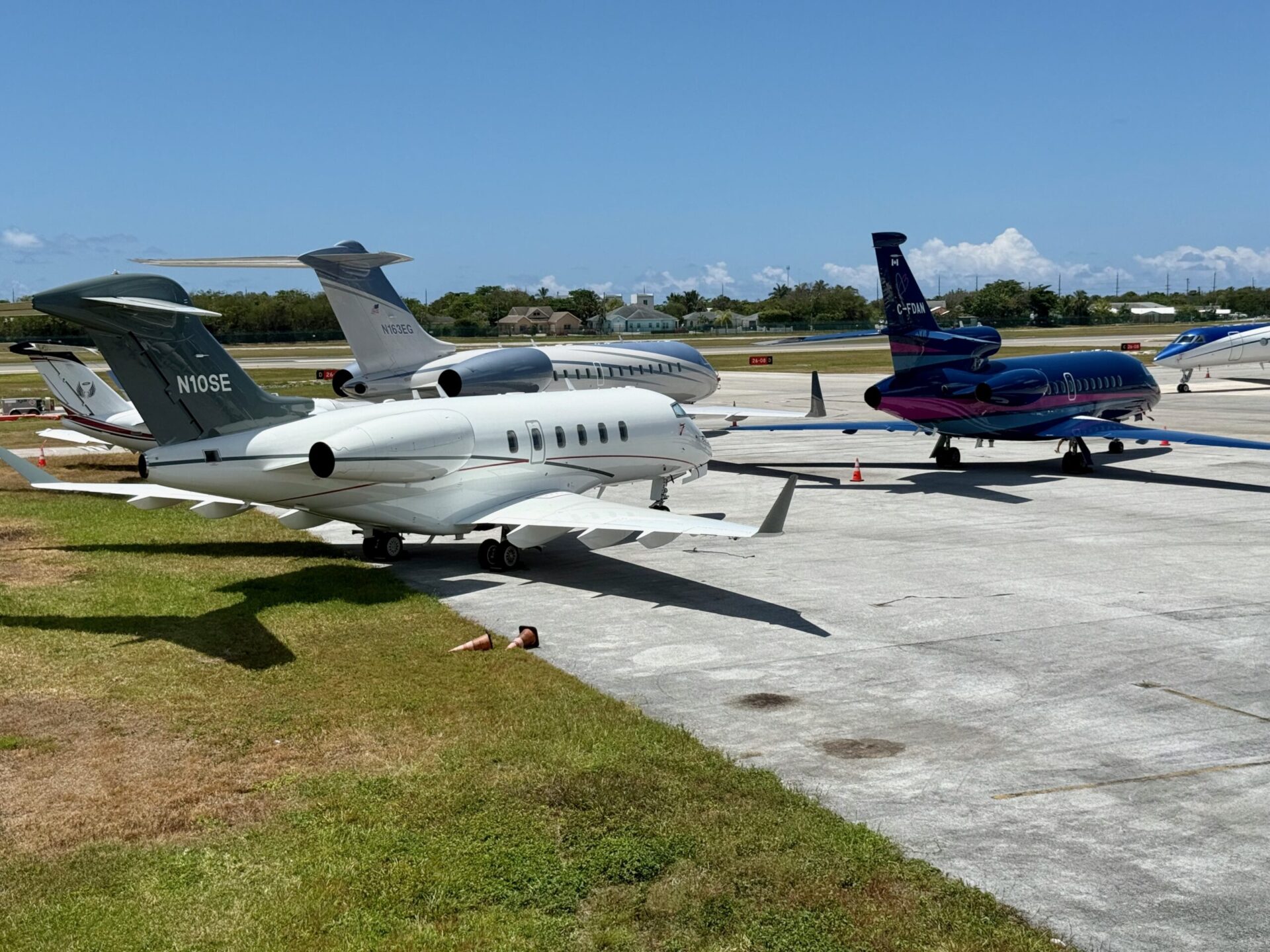
On a bright Saturday afternoon, some of the world’s most expensive private planes were parked nose to tail on the apron of Grand Cayman’s airport.
Top-tier Gulfstream and Challenger jets, their sleek fuselages gleaming in the hot sun, delivered business executives and high-net-worth visitors to the island in style.
On the tarmac, it was a different story. Ground crews weaved between wingtips and baggage carts in narrow cone-marked lanes.
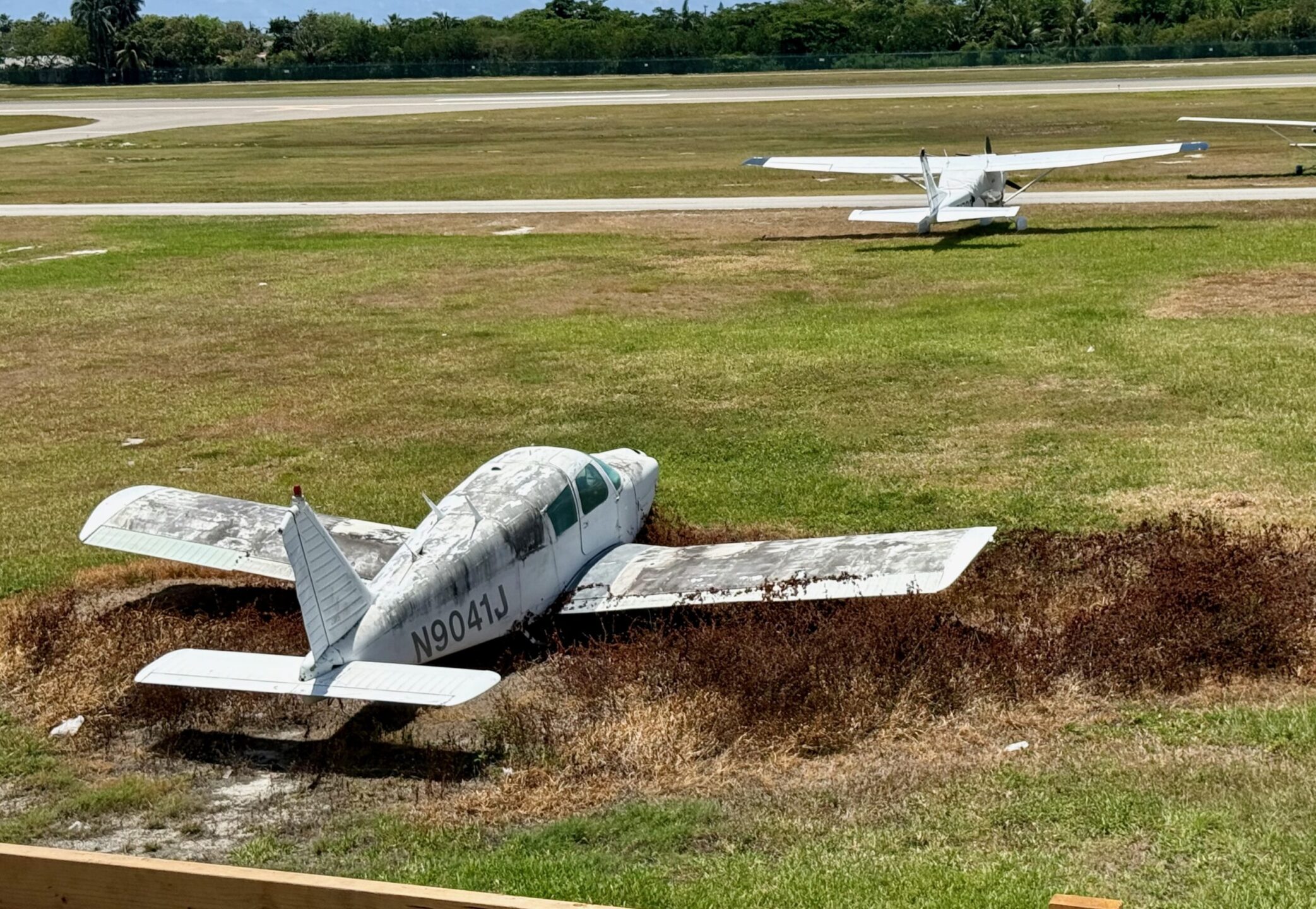
Arriving visitors wound their way through the chaos, past an abandoned aircraft slowly sinking into the dirt at the edge of the grass, to a cramped and ageing building bearing the sign ‘General Aviation Terminal’.
Welcome to the Cayman Islands.
In the post-pandemic aftermath, government has pursued a strategy of targeting high-net-worth visitors on the premise that such tourists provide maximum economic benefit to hotels, restaurants and other businesses.
Data from the Cayman Islands Airports Authority suggest the strategy is working, with the destination seeing a surge in private jet travel culminating in successive years of record-breaking arrivals.
The General Aviation Terminal and airside infrastructure are struggling to meet demand and, without investment, government accepts there is a limit to future growth.
The National Coalition For Caymanians has scrapped plans for a publicly funded $49 million redevelopment of the facility, despite the previous administration spending at least $1.2 million on designs and a construction tender process.
The new government has now commissioned a new business case to explore whether a public-private partnership, or PPP, could be used to design, build and operate the facility instead.
Infrastructure Minister Jay Ebanks accepted that upgrades were needed.
But the islands’ infrastructure is creaking, with the prison, landfill, cargo port, roads system and main airport all in need of significant investment.
He said government’s focus and limited capital budget had to go towards dealing with pressing issues at the main commercial aviation terminal, where lines of tourists snake outside the customs hall on busy Saturdays.
“What we don’t want to do is go and spend that money into a general aviation terminal when I have an airport that’s bursting at the seams right now,” Ebanks said.
He believes a commercial partner could fund the necessary work on the private airport side and recover costs through a long-term lease arrangement. Alternative formulas could include the private operator controlling revenue streams, such as plane parking fees or an aviation fuel concession. Ebanks said the right formula would be determined through a new business case study.
Private air traffic has taken off
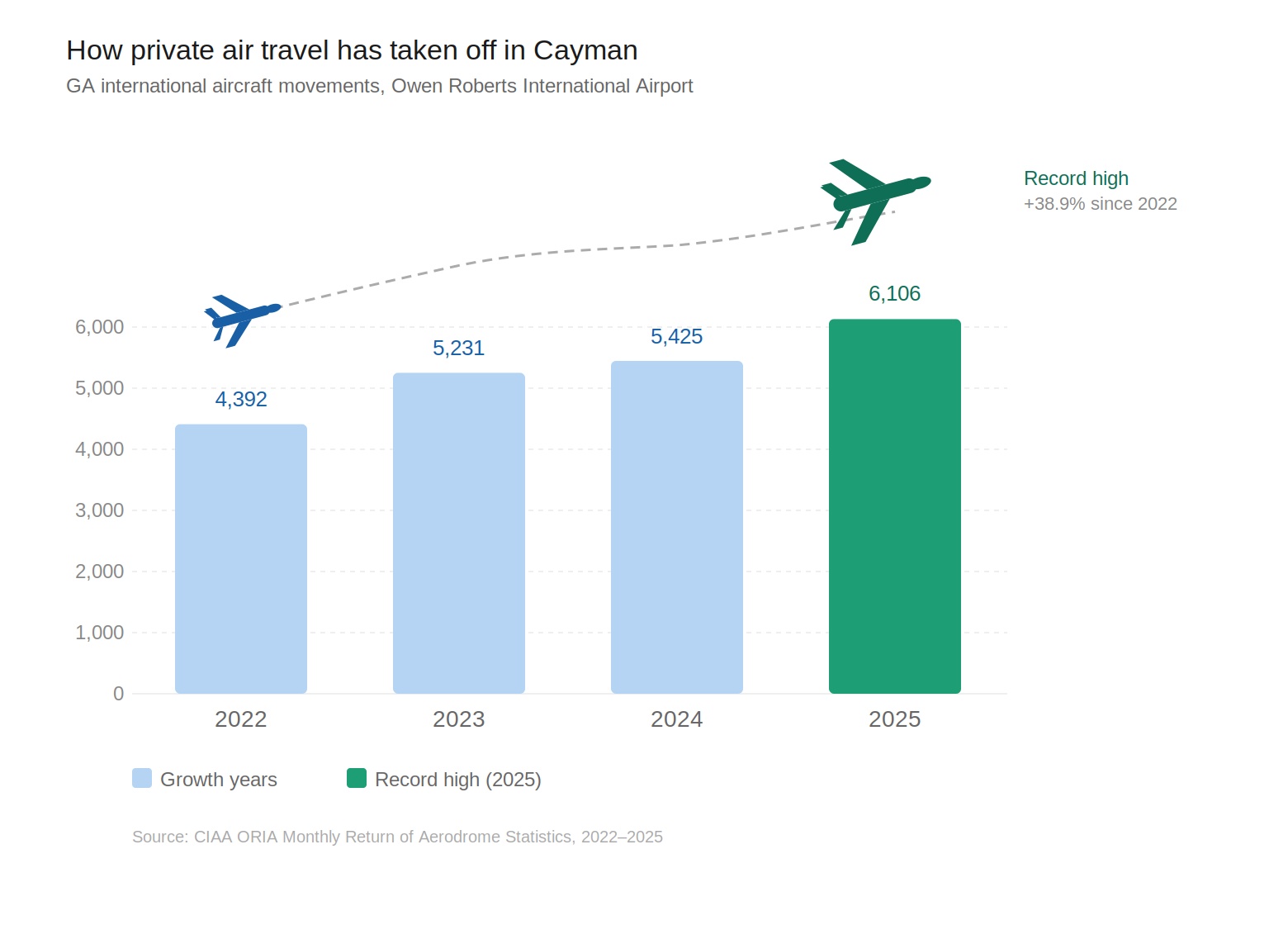
Private jet traffic into Grand Cayman has hit record levels in the past two years and has almost doubled in the past decade.
High-net-worth tourists and long-term residents have flocked to the islands since the COVID-era lockdown. Recent sightings in the tarmac at Owen Roberts International Airport include the grey elephant-print Gulfstream G650ER of basketball legend Michael Jordan – one of the most recognisable private jets in the world.
But lack of apron space and the poor state of the General Aviation Terminal is seen as a barrier to growth in this demographic. Frequent users report issues with planes being turned away because of lack of parking space.
In 2014, there were 3,437 international general aviation movements at Owen Roberts International Airport.
Data obtained by the Compass under freedom of information laws shows that figure had reaching 6,106 in 2025 – the highest on record.
Cayman’s 2014 airports masterplan described the facility as “too restricted to accommodate the number of passengers”, with customs and immigration facilities “very small to effectively process pilots and passengers”.
Fixed-base operators interviewed for the plan said at that time, “The existing facilities and apron exceed their capacities during peak periods about 3-4 times per year.” The report noted that many private pilots would drop their passengers off in Grand Cayman and go to Miami or Cayman Brac because of lack of space at Owen Roberts.
That was the situation when the terminal was handling 3,437 movements a year. It is now handling 77% more than that.
Make room for billionaires and their spending
Frank Schilling, a Cayman-based entrepreneur and long-term private aviation user, said those problems still exist. He said apron space was the biggest issue and the easiest and cheapest to fix.
“They need to put the asphalt down to park the planes. Putting down pavement is always the cheapest part. Nothing gives you more bang for the buck,” he said.
He pointed to the ramshackle facilities at St. Maarten, the gateway airport for the ultra-luxury St. Barts market, as valuable context.
“The day after New Year’s leaving St. Barts, you’ll have 40 or 50 billionaires going through customs on a delaminated melamine desk where they get their customs stamp.
“There’s Larry Page and there’s Sergey Brin and here comes Eric Schmidt, all three Googlers, collectively worth $200 billion, and they’re standing there getting a customs stamp.”
He agreed that terminal fixes and improved services, such as a lounge, hot coffee and the capacity for drivers to meet planes on the tarmac, would be nice. But he said such perks were in short supply across the Americas.
Cayman’s more pressing problem, he said, was having to turn away high-spending visitors because of a lack of airside infrastructure.
“On the busiest days, we’ll land and they won’t have room for us on the ramp.”
The economic consequences of turning away wealthy visitors in private planes are significant, he said.
“Think about what this means. He’s coming with an entourage, going to be spending $20,000 a day for hotel rooms, $4,000 a day in meals. You don’t want to be telling these people don’t come.”
Problems exist for local aviators too. The Compass tracked the tail number of the plane abandoned on the grass and found it was last registered to Caymanian Walling Whittaker. He said he had donated it to a local youth organisation after suffering health issues in 2005.
The plane appears to have had limited use since then.
“Unfortunately, the lack of availability of hangars in Cayman for general aviation aircraft, coupled with the corrosive salt air, makes aircraft ownership a challenge on the island,” Whittaker said.
Public-funded project shelved
The previous UPM coalition government was advancing a plan for a full publicly funded rebuild of the General Aviation Terminal, at an estimated cost of up to $49 million.
The Outline Business Case justification for that spend indicated: “[The Cayman Islands government] recognises the importance of attracting high-net-worth individuals and VIPs to the Cayman Islands.”
The document explicitly assessed and rejected a public-private partnership model.
It stated revenue generation from the project “would be hard to distinguish from the business-as-usual or ‘do nothing’ option revenues”, making it difficult to pass demand risk to a private partner.
It also concluded that a public-private partnership procurement process “would likely involve lengthier procurement timelines versus a traditional process”.
In April 2024, the Cayman Islands Airports Authority awarded a $1.264 million design contract to Dutch firm Avia NG Airport Consultants.
The original plan was to be delivered in three phases. The first stage, covering an extension to the existing commercial apron, a new general aviation apron, a heliport relocation and a marine dock went out to bids but was cancelled in late October 2025 after the new government decided on a change of direction.
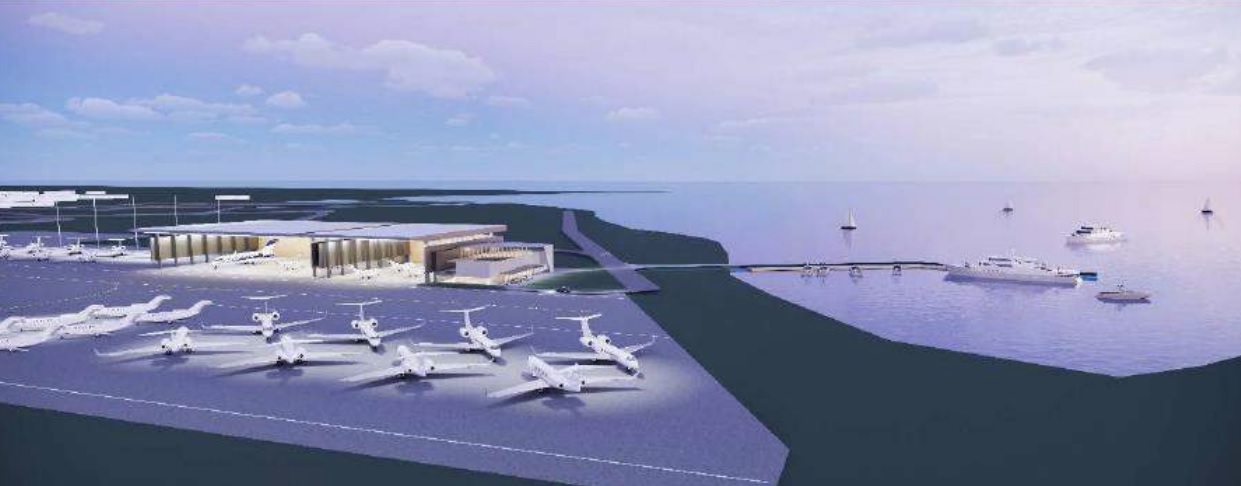
Cabinet announced earlier this year that the process was going back to the drawing board with a new business case.
Minister Ebanks said the shift to PPP reflected a deliberate choice to redirect public capital to the main terminal.
“The only way that they [the previous government of which he was also a member] were looking at it was for government to build it and operate it.
“When I became minister, I took the approach that we do a PPP on it,” he said.
“What we as a government will get is that we will be able to continue to keep our focus on the main airport.”
Under the PPP model, he said, a private operator would recoup its investment through a lease agreement or fees collected from general aviation users.
The 2023 Outline Business Case identified Cayman’s average per-unit aeronautical fee at US$65.40, below the Caribbean average of US$94.97 and well below competitors, including Barbados at US$182.20 and Jamaica at US$114.65, suggesting scope for significant fee increases.
Related Videos










Something has to be done Over a million dollars has bee wasted. It’s like the million dollars to fix SMB Lots of money for consultations and then nothing done FIX THE AIRPORT AND FIX SMB
Living under the flight path of incoming aircraft I Have noted the increased number of private jets arriving here, generally in the early part of the morning, probably to ensure a parking place. It seems to me this type of visitor should be encouraged as they certainly spend a lot more than most of our cruiseship passengers many of whom it seems cannot afford a $2 bus fair to the beach. I am encouraged that Cabinet are looking at new ways of funding a purpose built facility for the private jets, it is badly needed.
I’ve learned that CIG has a process which includes hiring consultants, getting third party evaluations and consulting local interests. These are good things. Money is spent and often nothing received. I think shortening decision time frames would be something to strive for. It should not take years to get information to make a decision.