Research focused on developing a simulation model of coral disease has been conducted by Marilyn Brandt at the Little Cayman Research Centre.
Marilyn has just received her Ph.D. in Marine Biology from the University of Miami’s Rosenstiel School of Marine and Atmospheric Science.
Her research was based on fieldwork conducted in the Florida Keys and the Cayman Islands. The support of the Little Cayman Research Centre was critical to the success of Marilyn’s thesis work.
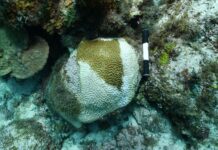
Results from the ongoing monitoring activities of the centre and support of the centre for specific studies that she undertook were central to the development and success of the model, which is focused on understanding the dynamics of coral disease, one of the greatest sources of coral mortality on Little Cayman reefs and reefs in the Caribbean at large.
Dr. Brandt’s thesis, titled: ‘Coral Disease Epizootiology in the Florida Keys (U.S.A.) and Cayman Islands (British West Indies), and the Development of the Simulation of Infected Corals Model’ provides an excellent understanding of the distribution of the diseases and has helped us realise that every different major coral species is being impacted.
Her work is being published in a major peer reviewed journal and represents the first PhD. dissertation completed at the research centre’ said Dr. Carrie Manfrino, President of CCMI
While working towards her degree she was awarded the International Society for Reef Studies and Ocean Conservancy’s Coral Reef Fellowship, the Rosenstiel Fellowship, and was inducted into the University of Miami’s Iron Arrow Society, the highest honor attainable at the University.
After graduation, Marilyn accepted a Post Doctoral Associate position from the National Park Service in conjunction with the University of Miami to help develop a reef fish monitoring protocol for the South Florida and Caribbean Network of National Parks, including the Dry Tortugas, Biscayne Bay, and U.S. Virgin Islands National Parks.
The Little Cayman Research Centre, located near Bloody Bay on the North side of Little Cayman, has become an international resource for visiting scientists to learn more about our marine environment and threatened coral reefs. The Research Centre has developed local programmes aimed to educate Cayman’s youth and overall community on the importance of our fragile marine environment, including Caribbean SeaCamp, Ocean Literacy and Eco-Weekends.
For additional information on the research, education, outreach and conservation initiatives of the Central Caribbean Marine Institute, please visit the website at www.reefresearch.org
Related Videos