Monitoring station one of 4 worldwide
A sophisticated weather and oceanographic monitoring station being installed off the coast of Little Cayman will give the world a unique insight into how climate change is affecting coral reefs, as well as provide Cayman with better information about storm threats.
Installation of the station, a joint project between the US National Oceanic and Atmospheric Administration and the Central Caribbean Marine Institute, began last week and is expected to go live by the year’s end.
NOAA choose Little Cayman as one of four international locations for the station, which will continually measure temperature, winds, barometric pressure and ultraviolet and photo-synthetically active radiation around Little Cayman’s shallow reefs.
‘The data that we will collect using the new instruments will help us understand how changes in the ocean and atmosphere are affecting changes in fish and coral populations … [and] how longer term climate variability may be resulting in real changes in the coral reef structure and community,’ said CCMI Director Ms Carrie Manfrino.
She said Little Cayman’s isolation and low population make it an ideal location for the station.
‘There are few places left where coral reefs are minimally impacted by local human activities such as coastal development, pollution and direct exploitation.
‘Our local reefs are a gem for climate change work because we can decipher a signal and assume that it is not confounded by human input,’ she said.
Ms Manfrino said the station will also improve hurricane predictions, helping to protect human life and property.
Scientists hope the station will help them better understand the connection between changes in atmosphere, changes in the ocean and changes in fish and coral populations across the region.
They are also keen to learn more about how longer term climate variability will impact the structures of coral reefs, and whether increasing carbon dioxide emissions in the atmosphere will stunt skeletal development of marine organisms.
Scientific studies have warned that increasing CO2 emissions – one third of which are absorbed by the world’s oceans – are changing the ocean’s chemistry and could cause coral reefs structures to die out within 50 years.
With dive tourism alone estimated to generate $100 billion annually for the Caribbean, the consequences of coral reefs dying out could be dire, a study published in the Journal Science warned on 14 December.
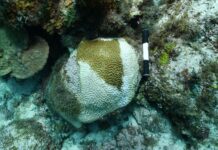
The station will also help guide NOAA and CCMI researchers on how to respond to coral bleaching incidents, a phenomenon that causes coral to turn white under increased stress from factors including changes in water temperature, increased solar iridescence exposure and changes in water chemistry.
Once operational, the station will transmit data in real time to NOAA, which will make the data available to the public through its website.
The Department of Environment, which has assisted with the station’s installation, also plans on making use of the data, as do other government agencies.
‘The project is an important technological step for the Cayman Islands,’ concluded Ms Manfrino. ‘It enables the Little Cayman Research Centre to enter a scientific arena working to find solutions to issues of global concern and specifically, to understand the dynamics of long-term changes in the ocean in relation the atmosphere.’
Related Videos