

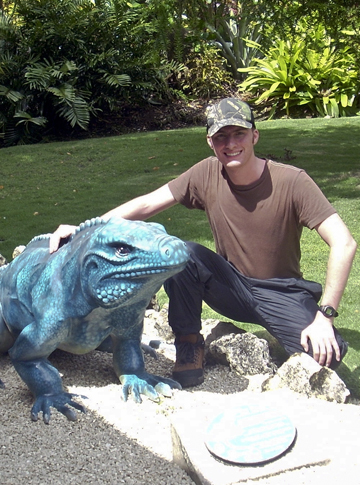
Daniel Hamilton of Indiana told Caymanian officials he had a “life-long fascination” with reptiles.
It was that fascination which led him to Grand Cayman last week to work with one of the rarest reptile species, the Blue Iguana. Sadly, that work also led to his death on Friday.
Fred Burton, director of the Blue Iguana Recovery Programme, said the 21-year-old Purdue University student, who was pursuing a wildlife science degree, “launched himself wholeheartedly into the work of the programme”, starting at the Queen Elizabeth II Botanic Park, then in the Salinas Reserve and finally at the new reserve in Colliers at East End.
Mr. Burton said Mr. Hamilton and two other volunteers were working to prepare for the release of the Blue Iguanas to their new home when he collapsed in East End. The iguana release is scheduled for July.
“[We] are deeply shocked and saddened by Daniel’s sudden passing,” Mr. Burton said. “Thanks and recognition [are] also extended to the emergency services who did everything possible to save Daniel.”
When emergency personnel reached Mr. Hamilton Friday afternoon in a treacherous part of the East End bush, his body temperature had reached 106 degrees Fahrenheit.
To make matters worse, the location was miles from civilisation in a place where emergency crews had to trek about two miles through rocky and heavily wooded terrain. Taking Mr. Hamilton out on a stretcher through the dense bush wasn’t a viable option, emergency crews said.
Videos taken of the rescue site Friday show firefighters shoving aside trees and foliage and stumbling on the terrain as the Royal Cayman Islands Police helicopter prepared to take off for George Town with Mr. Hamilton on board.
Dangerous assignment
The process of moving the Blue Iguanas to their new home in East End where, hopefully, they can breed and prosper, began last summer by the Blue Iguana Recovery Programme.
The animals, indigenous to the Cayman Islands, are believed to number fewer than 1,000 worldwide – including those living in captivity in the United States. There are fewer than 400 living in the wild in Cayman, according to the programme.
Moving the animals to the new spot involves putting them in backpacks and carrying them through the difficult terrain in some cases, Mr. Burton said last summer. The terrain, while it may be ideal for iguanas, is inhospitable to humans. Mr. Burton described some of the challenges faced by staff and volunteers in an interview last July.
“They’ll set up camp,” he said. “We’ll probably have one person living out there continuously putting retreats in the places they have to go and getting to work on very narrow, low-impact foot trails.
Retreats are large wooden boxes that offer shelter to newly released iguanas.
Supplies are transported to the camp site by helicopter. Since there is nowhere for the chopper to land, the material in the helicopter is lowered in a net and unloaded by those on the ground. The cargo includes 95 retreats, weighing 35 pounds each. Most of the released iguanas will be about two years old, having been raised in captivity in the breeding area at the Queen Elizabeth II Botanic Park.
“The retreat boxes will provide temporary homes to persuade the iguanas to stay where we let them go,” Mr. Burton said.
Because there is no access road in the area, the iguanas are transported to the site by staff and volunteers, on foot.
“We will have them in canvas bags, old pillowcases and anything else like that we can get together in numbers, and will rest them carefully in backpacks,” Mr. Burton said at the time. “A team of four will walk them in, and stay out there over the next two nights and days to complete the release and make sure everything is well.”
Mr. Burton could not comment as to the future of this endeavour on Monday, and said he was awaiting the results of a post-mortem exam on Mr. Hamilton before making short-term decisions on the effort.
Mr. Hamilton had done field work before, mainly with salamanders in the state forests of Indiana, USA, and had learned to employ techniques like radio tagging and navigation.
“Daniel’s volunteer application was outstanding,” Mr. Burton said Monday. “His enthusiasm sparkled in his communications as he prepared to come to Grand Cayman.”
Difficult rescue
Although emergency rescue crews pulled out all the stops in attempts to save Mr. Hamilton, it still took nearly two hours from the time the incident was reported until he was brought to the Cayman Islands Hospital where he was pronounced dead Friday evening.
According to Chief Fire Officer Dennom Bodden, fire crews received the initial call at 2.18pm Friday and arrived along Frank Sound Road at 2.31pm. They went into the bush a few minutes later with ambulance and fire crews carrying stretchers, machetes and medical supplies through the dense bush.
Trees and bush had to be chopped down to clear space for the RCIPS helicopter to land and take Mr. Hamilton out. The chopper actually landed in the bush, where Mr. Hamilton was loaded on board. It arrived at the George Town cricket pitch minutes after 4pm.
Bringing Mr. Hamilton over the terrain in the bush would have taken hours longer, Mr. Bodden said.
Paramedic crews treated Mr. Hamilton in the bush as best they could and performed CPR on him but never managed to revive him.
The RCIPS helicopter does not have a rescue winch that would have allowed Mr. Hamilton to be lifted in a basket up to the chopper, saving time in the rescue. Firefighters said they brought a rescue basket to the site but were told the aircraft couldn’t use it.
Although an exact cause of death has not been determined, Mr. Hamilton’s body temperature indicated that hyperthermia (heat stroke) may have played a role in his death.
Hyperthermia occurs when the body’s temperature control system – normally regulated by sweat – becomes overloaded. When sweating doesn’t offer enough protection from the heat, body’ temperature can rise rapidly and can damage the brain or other vital organs. Higher humidity levels can also pose difficulties, since sweat won’t evaporate as quickly – which prevents the body from releasing heat as quickly. Sunburn can also limit the ability to regulate body temperature.
Related Videos










Heat Stroke is seen as preventable accidents by most organizations, they go to extra lengths to train and prepare members to recognize the symptoms and to gear-up and regulate workload to avoid falling victim to heat exhaustion and heat stroke. Managers are held to high standards and disciplinary correctness for failing same.
First of all my sincere condolences to the family of the late Daniel Hamilton. To his fellow volunteers, I also offer my heart felt condolences. The Blue Iguana programme is something that is very important to the heritage of the Cayman Islands and to have a foreigner come here and die protecting something that is uniquely Caymanian says a lot about how people feel about this country and its wildlife.
As a volunteer myself, I have to say that I am shocked at the lack of commentary on this very depressing episode. While all deaths are tragic, this is even moreso, as this young man, in the prime of his life, left his home and came here to volunteer, not for money, or to stay in a fancy hotel, but to share his talent for the wellbeing of an animal that many of us here despise (most of us cannot tell the blues different from the greens anyway).
Once again my condolences to his friends and family and I hope that this particular tragedy will not let other volunteers decide not to volunteer anymore
First of all my sympathy goes out to the family of Daniel Hamilton. It is quite sad to lose someone so young while doing a good job.
I believe we should wait for the autopsy results before coming to conclusions about his death, perhaps there was another contributing health issue along with the heat factor.
I’m sure as an experienced volunteer he would have known to take plenty of cold water with him and drink a lot of it. Also I have experienced that if you take a cotton scarf (or any kind of cloth that will retain water for awhile), wrap it around your neck and put some cold water on it periodically, it will help keep your body cool.
May God comfort his family.
First my condolences on this tragedy.
I personally collapsed from heat stroke some years ago while trying to keep up with some much younger and fitter cyclists in Italy.
If you feel youself getting light headed or dizzy in the heat, don’t ignore it.
Stop immediately, get in the shade, lie flat and drink water. Remove clothing to help your body cool down.
Medically, when your body core temperature gets above a certain point, you have reached the point ot no return and you will cook yourself from the inside.
ALWAYS make sure you take more water than you think you need when you will be out in the heat.
One can’t in this field make comparisons, but this sort of extreme devotion to an objective- dare one say, almost obsessive – is in the same class as Everest, the North Pole, the Desert Races etc – it seems to make little sense, but somehow it adds to the extraordinary achievements of homo sapiens.
I hope his parents will understand my sentiments.
My condolonces go out to the family and friends of Daniel. I hope it is of some comfort to know that he died whilst in the beauty of nature, pusuing his interest and helping to save what might be the most endagered lizard in the world from extinction.
I volunteered with the program in the winter of 2004-2005 and saw first hand how difficult but rewarding the fieldwork is. I hope that this tragedy in no way slows the program, which is necessary and run by people who are tirelessly dedicated to conservation of the unique wildlife of Grand Cayman. I read elsewhere that his family had asked for doantions to the Blue Iguana program in lieu of flowers at the funeral, and I do hope that Caymanians will also support the program. Perhaps Daniel’s life and death can serve as inspiration.