Students of nature who live in the Cayman Islands can make important contributions to the documentation of our wildlife by keeping records of their own observations, even in a nature journal.
Explore your community and discover the treasures that are in your own backyard!
Thank you to Lois Blumenthal for compiling the following data as a quick reference for students of nature.
The invaluable herpetological section of The Cayman Islands: Natural History and Biogeography edited by M.A Brunt and J.E. Davies by M.E. Seidel and R. Franz, is part of this important book, which compiles numerous bodies of research on Cayman Islands fauna.
Racer, ground snake
Alsophis cantherigerus caymanus
The length of this snake is 500mm to 860mm. As is usual with most snakes, females are larger than males.
The record size for a female so far is 1,190mm and weighing 1.25kg. The basic colour is grey with a series of small dark blotches along the sides with larger adults sometimes showing a rosy pink wash.
When upset this snake will expand its throat to each side to make its head appear larger as a defence. It is active during daylight hours. It lives on both the ground and in trees. This adaptation enables this snake to be most successful given the limited resources of a small island.
This snake is well known as being the primary predator of Cuban Tree Frogs. It also takes the nestlings of birds, causing alarm calls from the adult birds which will often gather to mob the snake. This snake has been seen to drop from a tree, while yet holding a prey species in its jaws.
It will then seem to go into a temporary catatonic state or “plays dead”, following which it will rapidly slither away with its prey. One of the benefits of our local racer is that it feeds on baby rats. The Cayman Brac species is similar with some light banding on the neck and differs in the in scale count. The Little Cayman species is also similar except that the rear of the body is a solid dark colour. Not found on Owen Island.
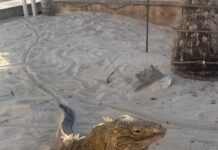
Curly-tailed lizard or lion lizard
Leiocephalus carinatus varius
The length of the males is up to 130mm; females are smaller. These are easily recognised by a long, banded tail that curls over the back. This lizard has a glossy look, though scales are rough. Their colour is brownish-green-grey with considerably barring and mottling. Underside is pale yellow. Full-grown males have a bulkier head than the females.
Males have throat fan, but this is hardly ever seen. They are commonly seen, even in urban areas, but usually near the beach and using rocks for cover. They bury themselves in the sand to sleep at night, but during the day they emerge to sun themselves to stimulate their metabolism before hunting insects. They lay eggs in small batches (perhaps three), usually adhering to rocky surfaces. Hatchlings emerge in July, August and September.
It is reported that they lay several batches of eggs during the season. Hatchlings have a bright orange throat that lasts only for the first three or four days.
These lizards can become very tame and will learn to expect food from humans. They prefer high protein snacks such as eggs, cheese or meat. This charming lizard, found all over the islands in gardens and on beaches is particularly vulnerable to predation by house cats. This lizard on Little Cayman and Cayman Brac is similar but are smaller, a lighter coloured belly and a slightly differently coloured tail.
This column was submitted by the National Trust for the Cayman Islands.
Grow Cayman plants and encourage Cayman wildlife: For more information, to share your knowledge or if you would like to get involved with the many activities in the National Trust’s Know Your Islands programme, please visit www.nationaltrust.org.ky, www.caymanwildlife.org or call 949-0121. The Trust can be contacted at 949-0121 or on email at [email protected]
.jpg)
.jpg)
Related Videos