

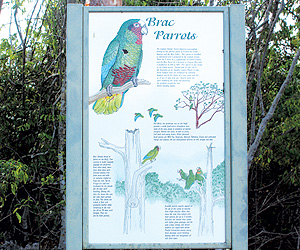
National bird could be extinct in 40 years

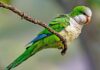
The good news is the parrot populations in Cayman Brac and Grand Cayman are almost back to pre-hurricane numbers. The bad news is Brac parrots could be extinct within 40 years.
Wildlife biologist Frank Rivera-Milán of the United States Fish and Wildlife Service presented these findings to the Cayman Islands Department of Environment and local media Wednesday of a survey of the populations of the national bird on both islands that looked at how they had recovered since Hurricane Ivan struck Grand Cayman in September 2004 and Hurricane Paloma hit Cayman Brac in November 2008.
Following Hurricane Ivan, Grand Cayman’s parrot population fell to as low as 2,879, according to the research and now, based on a variety of survey methods to calculate the number of parrots on the Island, there are approximate 4,300. On Cayman Brac, after Hurricane Paloma, the population number dropped to below 300. Prior to the hurricane, there were about 560 parrots, and now there are about 425, Mr. Rivera-Milán said.
While those numbers indicate that the birds are resilient species, they nonetheless face immediate and growing threats from encroaching development, especially in Cayman Brac, where it was possible the birds would become extinct within four decades, Mr. Rivera-Milán said.
“The population could become extinct very fast,” he warned, saying the birds were considered endangered simply based on their geographical isolation and additional threats such as hunting, hurricanes and the loss of their critical natural habitat increase the possibility of the birds disappearing forever.
Breeding pairs on the Brac, where there is about 3,555 hectares of land suitable for parrot habitation, could be as low as in their 20s or as high as 60, he said. “Parrots are long-lived animals with low reproduction,” said Mr. Rivera-Milán, adding that when one of a breeding pair dies, another parrot known in the study as a “floater” can take its place, but once the floaters die, it imperils the entire population.
Parrots begin breeding at 4 years of age and continue to reproduce until about 20.
At the moment, the food supply for the parrots seems to be plentiful, as fruit from red birch, mangoes, sea grapes and other foodstuffs that parrots abound. Red birch is the “hero” of the parrot, said Mr. Rivera-Milán, as they provide both nesting areas and food.
Despite this, environments for reproduction on the islands are becoming smaller, especially in Cayman Brac, as nesting areas for the birds are disappearing due to development.
“On the Brac, they are using what is available for feeding. For reproduction, they are really limited … What we have found is the Brac is going down the drain very fast. Development there is too fast,” said Mr. Rivera-Milán, who has been working on the Brac for several years.
He questioned why roads in Cayman Brac were being built so wide and the large number of sub-divisions which had been cleared of natural vegetation.
Ironically, a sub-division earmarked for development in Cayman Brac, Lot 11 of Parrot Estates, was where he spotted the single largest density of the birds – eight parrots and three juveniles – which is next door to the protected Parrot Reserve.
“The population was halved by the hurricane [Paloma], the effects were really dramatic and the population is coming back, not in a year, but in about five years,” he said.
Director of Environment Gina Ebanks-Petrie pointed out that convincing people that parrots are a conservation issue is proving difficult.
“First of all, people view them as pests, but also when people start to see parrots in their back yard, the assumption is that we have many more thousands of parrots, instead of the fact that the parrots are actually having to go look for food because their natural feeding areas have been developed over,” she said.
Cayman’s parrots are protected under the Animals Law. Until 1989, parrots were considered game animals and could be legally hunted.

Related Videos







Could the borders of the reserve be expanded? And perhaps an education program started? All of the Cayman Islands need to protect their rare and special natural heritage; once it is gone, it is gone forever. Or how about translocating parrots to Little Cayman trying to foster a second protected population there?
I agree Little Cayman.
LC has all the natural resources and requirements for their needs.
Any negative aspects to their survival such as overdevelopment, farming
(shooting of birds), poaching and hunting don’t/won’t exist…considering the size
of the island and its’ relatively close knit community and the peoples’ commitment to the environment.
They thrived here once before, prior to the storm of ’32, and can do so again given the opportunity.
The land is available so let’s make use of it.
Don’t squander what LC is offering…..Hope.