Wheel clamping is no more
Blowing through designated school and construction zones will now lead to much heftier fines for Cayman Islands drivers.
Under the Traffic Law, which came into effect Friday, the police will have the ability to prosecute a driver if they endanger workmen in the course of doing their jobs.
“The police were getting a lot of complaints that drivers were unnecessarily putting utility workers at risk by deliberately disobeying their directions,” said David Dixon, director of the driver and vehicle licensing department.
The Traffic Law states: “A person who, on approaching road works… does not obey all directional signals and signs, whether verbal, manual or automated, given to him by (a) a person authorized to man such place; or (b) equipment placed at such road works, has committed an offence.”
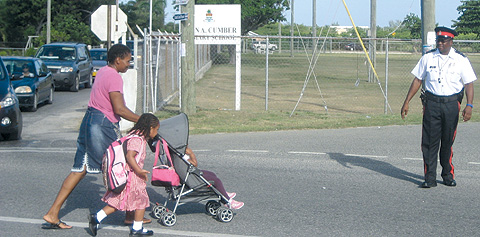
In addition, school zones have been gazetted under the law, which means drivers must follow the 15 mile-per-hour speed limit signs when lights are flashing or road signs are posted.
Driving offences in school zones will draw an automatic $200 fine.
Clamping
Another major change in the Cayman Islands government rewrite of the Traffic Law leaves the responsibility of public parking enforcement up to police officers or their contracted agents.
Wheel clamping has been outlawed in public parking places, according to the Traffic Bill, 2011, which seeks to repeal and replace Cayman’s current legislation governing driving and the use of public roads.
“A person who operates as an agent for the clamping of vehicles in public places; or clamps or tows away a vehicle in a public place commits an offence,” reads the amended law, which is expected to come before legislators next week. However, the change does not mean individuals who park illegally in public places, or who park illegally in private spaces cannot be towed or ticketed or both.
“As long as the public has access to a parking lot, then they must follow the law; otherwise they are committing an offence and if they are parked illegally or in an unsafe manner, the police will have the authority to ticket or tow the vehicle,” Mr. Dixon said. “The police will be looking out for four things — an abandoned vehicle; parking in an unlawful or unsafe manner, such as parking on yellow line; parking in a no parking area or in handicapped space; or if a vehicle was involved in accident.”
The fine for illegal parking is $100 and in the event the car is towed, there is a towing fee of $40, and a $10 a day pound fee for which the owner is responsible.
Vehicle removal
The Cayman Islands Traffic Law (2003 Revision) already gave a police constable the power to take possession of and remove a vehicle if it is abandoned, parked in an unlawful or unsafe manner, left in a dangerous condition, or if it is involved in an accident. In any of those cases, the vehicle can be towed to a police impound lot and its owner charged a per-day fee until it is claimed, with the exception of cars that have been involved in a wreck.
The revised Traffic Bill creates a new job called a “vehicle removal agent”; a person that will be licensed under regulations drawn up by the government to assist police in instances where vehicles need to be removed.
In such a case, fees for the removal would be paid to the vehicle-removal agent and not the commissioner of police, as the law current prescribes.
The government cannot be sued for any damage or loss of property from the vehicle as a result of any tow “done in good faith” under the revised Traffic Bill.

Related Videos