Cayman Islands history has come to life with two new exhibits at the Mission House in Bodden Town.
“After a tour of the Mission House last fall, American artist Joyce Everhart-Hoff was quite taken by the old way of cooking in Cayman,” said Trust Historic Programmes Manager Denise Bodden.
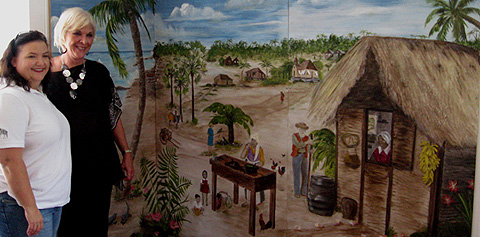
“She asked if she could work with the National Trust to create a mural with the old caboose as the main focal point.”
With the goal of engaging Mission House visitors of all ages in a novel way and taking the caboose as the starting point, Ms Bodden, the artist and Trust Chair Carla Reid arrived at a concept for the 9 ½’ x 7’ mural that features iconic symbols of Cayman’s past.
“This mural depicting life in the Caymans a century ago is dedicated to the children of the Caymans to foster a pride in their heritage as well as to encourage a desire to preserve the natural beauty of this most blessed of all Caribbean Islands,” said Ms. Everhart-Hoff.
The old caboose, cook room, traditional homes, a church and a Cayman Catboat are all featured, along with environmental icons including the Silver Thatch, Blue Iguana, Green Sea Turtle, Conch shells, Bay Vine and traditional Easter Lilies.
“The Trust provided a dozen books with images of Cayman of yesteryear to assist Mrs. Everhart-Hoff in her research,” said Ms Bodden. “Several of the characters you’ll see in the mural are real-life Caymanians photographed during the 1900s. This will only help make our history more familiar as students and other visit and learn more about Cayman.”
The second exhibit was the result of a collaboration between the CI National Museum and the Trust. Museum curator Debra Barnes-Tabora acted on the concept and text of a presentation given by Ms. Bodden on Cayman’s traditional architecture and specifically our wattle and daub architecture.
The exhibit also explains how the Mission House was transformed over the years from a modest wattle and daub building with a Silver Thatch roof to a more manor style home with a second floor addition built of shiplap wood and a cedar roof.
Plates painted by John Doak during the early 1990s summarise the four building styles and the Museum contacted Tony Powell, who provided a 5-foot high section of wattles from Cabbage and Bamboo wood in an Ironwood post frame. The exhibit also includes pieces of daub from the original Mission House after it was destroyed by Hurricane Ivan in 2004,a wood slice of Ironwood, a wood shingle and a section of a Silver Thatch roof. It was officially reopened in May 2007.
“This exhibit includes so many lessons relevant to the work of the Trust and the Museum,” said Ms Bodden.
“When I look at it I feel a great sense of respect for the early Caymanians who did so much with so little. I see how the difficulties they faced often brought people closer together and how hard they worked for what we would now consider a “small” home. We came from very strong, determined and ambitious people, qualities and building styles worth holding on to.”
Sonya Carlesso, a former Trust Historic Programs Manager, has also donated a painting of the original Mission House in the late 1990s shortly after the Trust acquired the property. Ms Carlesso conducted much of the early research on the history of the house and site.
The Mission House is open Monday to Friday, with guided tours from 9am to 1pm. Admission is $6 for adults or $3 per child. Groups of 10 and more require reservations. Call 749-1132 for more information.

Related Videos