

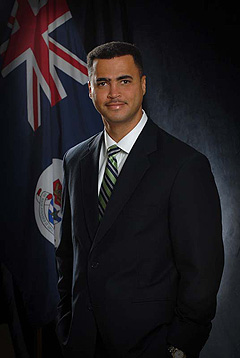
The Cayman Islands Complaints Commissioner would have the power to look into alleged maladministration within the police service, even if that mismanagement occurred during the investigation of crime, according to a motion filed by a George Town member of the Legislative Assembly.
Government backbench member Ellio Solomon said his private members motion aims to give Complaints Commissioner Nicola Williams’ office broad powers in finding the truth of allegations of malaadministration within the Royal Cayman Islands Police Service.
“There are issues of maladministration that need to be investigated and I believe this is the only way this is going to be done,” Mr. Solomon said Tuesday.
Since the formation of the Cayman Islands Office of the Complaints Commissioner in 2005, the office and its two leaders – John Epp and Ms Williams – have served as a government watchdog for all sorts of issues within the public sector. However, there are certain areas into which the commission’s remit does not extend.
Included in the “matters not subject to investigation” under the law are: “Action taken by or with the authority of the attorney general, the commissioner of police, the chief immigration officer or the collector of customs for the purposes of investigating the crime or of protecting the security of the Islands, including action so taken with respect to passports.”
Mr. Solomon said he believes there are certain instances where that power should be extended to the complaints commissioner. He pointed to one incident earlier this year where a senior police officer was accused of assaulting a junior officer that he felt needed further review.
About a month after that 15 February incident, Police Commissioner David Baines told the Legislative Assembly that “certainly, from the nature of it, no assault has taken place”.
Yet in late July, Director of Public Prosecutions Cheryll Richards determined there was enough evidence to bring a charge of assault. However, her office determined it was not in the public interest to prosecute the alleged offence.
“This is one of the things I’m concerned about,” Mr. Solomon said. “[Commissioner Baines] has pretty much decided this guy is innocent before he actually is.”
Members of the police association, the organisation that represents both police officers involved in the dispute, have declined to comment on the case.
Mr. Solomon said he is aware that the most recent version of the Police Law requires the establishment of a Police Complaints Authority.
However, he has doubts about whether that body is a high priority for either the police or the governor’s office or how much it will be able to accomplish if and when it is formed.
“The police authority – when funded – will only handle complaints against conduct of officers,” he said.
The lack of an established Police Complaints Authority has been holding up the investigation of certain resident complaints against police officers.
According to records provided under Cayman’s Freedom of Information Law, the Royal Cayman Islands Police Service has not been able to resolve 19 of 42 public complaints filed against local police officers between September 2011 and February 2012.
“The government are in the process of establishing a commission to deal with complaints against the police are we are hopeful that it will be up and running in the coming months,” a recent statement from Cayman Islands Governor Duncan Taylor’s office read.
The RCIPS noted the Police Law (2010 Revision) creates an authority with the jurisdiction to “hear a complaint lodged by any member of the general public in relation to the conduct of an officer”.
“Any complaint filed following the formal introduction of the law rests solely with the authority,” the RCIPS has stated.
“Until that authority is established, the Royal Cayman Islands Police Service have a professional and legal obligation to record all complaints lodged and preserve any evidence until the authority becomes functional.”


Related Videos













Its about time Cayman’s lawmakers made an effort to correct the mistakes that was made years ago by their predecessors; the Complaints Commissioner should have been given this authority and power when the position was first created back in the early 90s.
The Human Rights Commission should be the lead organization in this respect but it does appear as if this HC will be nothing more than a puppet.
Back in 1993, I had a number of run-ins with two particular police officers on seperate, non-related incidents that were personally motivated; no crimes or offenses had been committed or were being investigated.
This amounted to nothing more than intentional police harrassment for personal reasons.
I took the matter up the the Complaints Commissioner and was told that his office could investigate every other government department…but the RCIPS.
This forced me to take the matter directly to the FCO, through the British High Commission in Jamaica, as a British citizen.
End of story was that all problems with these police officers came to an abrupt end, although the RCIPS sent out their standard letter of having investigated and found no substance to my complaints.
Upon calling and speaking to the then Commissioner of Police personally, it was admitted that contact had been received from the FCO on my complaint to them and that one of the officers in question had been the subject of a number of similar complaints to mine.
This officer is still on the force and in a high position now but apart from dirty looks every time our paths crossed, no further incidents occurred between us.
If this law does pass, it will be definitely long overdue.
There is a Commission for Standards in Public Life that has been begging the MLA’s to pass the legislation that was handed to them more than a year ago.
This law would empower the Commission for Standards in Public Life to carry out their duties as stated in the Constitution.
The Commission is supposed to prevent corruption, monitor, and conduct investigate breaches of standards among government officials and offices.
This would include conduct of police officers. Unfortunately, it also includes conduct of MLA’s so that is why neither Ellio nor anyone else in the UDP is in any hurry to bring that particular piece of legislation.
Be very careful with this one Elio, the only reason the governors office is resonding to create the office for complaints is because you have raised the issue in the L.A. Go ahead and complete the process. As you are aware the governor will never go against his UK Comm. of police nor against his own UK cops his country men. So we must have an independent body to deal with RCIP cases of complaints away from the governors office.
It is simply a hoodwink. Go ahead and pursue it Elio.
Good Luck
The Crown is quick to prosecute and bring offenders to justice, yet when the Crown’s members commit offenses take years before they are even dealt with.
I was assaulted by a police officer, filed a complaint and what has done about it? Absolutely nothing!
The RCIP officers must be held accountable for their actions as do the rest of us!
Is the complaints commissioner competent to investigate crimes? Is that part of her resume or the job description?
I am not qualified to pass comment on whether or not this is the solution but it is quite clear that you need to do something about RCIPS and you need to do it quickly because, right or wrong, from a media perspective the impression the outside world currently has of the Cayman Islands police service is distinctly unhealthy.
Looking back over major events during the past five years you have a Commissioner of Police removed from post for no apparent (and I’m talking media wise rather than from a legal opinion) reason.
Next a Grand Court Judge was unlawfully arrested in what was described as the gravest abuse of process while the conduct of the investigating team themselves was deemed to be mischievous and wrong. In fairness to RCIPS those responsible were contract employees on the payroll of the Portfolio of Internal and External Affairs but they were also all Special Constables subject to police disciplinary rules yet nothing was done.
And to top that off we had the prosecution of a Deputy RCIPS Commissioner and his forced retirement.
Then RCIPS imports UK officers to deal with alleged corruption within its ranks and secretly brings specialist consultants in to polygraph officers but without any results.
To cap all that you have the revelations that CI30million has been spent on an investigation into what has turned out to be little more than malicious gossip and some fairly vocal criticism of RCIPS – Keystone Kops seems to be a recurring theme – during a number of court cases.
The problem is that I suspect all this is the tip of the proverbial iceberg. As Firery has recounted serious complaints, including several that I know were made to Operation Tempura, just get ignored. People are allowed to leave RCIPS and whatever they did while serving as sworn officers just gets buried.
I know when it comes to maintaining internal discipline police everywhere tread a tightrope. If they come down too heavily on rule breakers it looks like the whole force is bent but if they go the other way and take a softly-softly approach it look like a cover up. Howver, right now I would be very sympathetic with anyone who suggested that RCIPS are failing in their duty to the public when it comes to professional standards issues.
catchandrelease,
Check out –
http://www.occ.gov.ky/pls/portal/docs/PAGE/OCCHOME/PUBLICATIONS/OMIREPORT/OMIREPORT5ANNEX3.PDF
That’s the 2006/7 safety report on watersports operators that CIG buried.
I’d say from that the OCC it more than competent to investigate RCIPS, whether or not RCIPS would take any notice of them is another matter.
Editor’s note: We would also note the current commissioner, Nicola Williams, spent several years in the UK as the head of a police complaints commission that looked into citizen complaints against police.
Editor: I think Ms Williams would be the first to acknowledge that the OCC does not have the expertise currently to carry out criminal investigations into the police. She would also agree she does not have the technical capability to undertake these tasks and she would agree that there isn’t the legislative framework to do it.
She would, however, welcome the opportunity to take over ‘professional standards’ matters.
Editor’s note: We’re seeking to obtain her comments on this issue for publication later.
With all due respect ‘Vietnam’ if you truly believe the UK will not go against its own, do you think we can find an objective group to deal with police complaints?
With upcoming enforcement of Human Rights, will we not have to consider the fact that if the majority of officers, crown counsel etc are of same national origin that reality should be a major factor when attempting to set up an objective group?
So if we accept that our current legal system is generally fair and professional, without any group showing bias to their ‘own’ then maybe an objective group should be well balanced across all nationalities AND gender.