

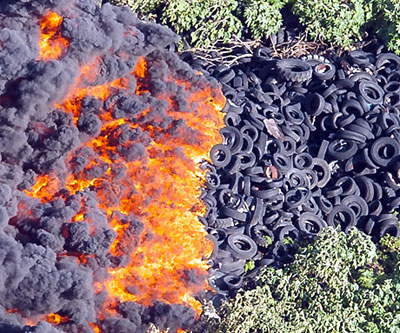
Fourth tender in three years to try to remove tires from landfills

The government has issued another tender for the purchase, processing and removal of tons of discarded tires in the islands’ landfills.
This is the fourth time over the past three years that a tender to remove tires from the overflowing dump site in George Town, as well as those on the Sister Islands, has been issued. Similar invitations to tender were also issued in 2011 and 2012.
Roydell Carter, director of the Department of Environmental Health, said the department had received two submissions to the earlier requests for bids, but there had been no successful bidders.
The renewed effort to find takers to remove the tires comes in the wake of a massive tire-fueled fire that burned for a day at the George Town Landfill last month.
Mr. Carter said it is unknown exactly how many discarded tires are in the George Town Landfill, or at the dumps in Cayman Brac or Little Cayman. To date, none has been removed from any of the islands.
“Over the years, there has not been any shipment of used tires overseas,” said Mr. Carter. “Currently, used tires are separated from other waste and stockpiled at all the Department of Environmental Health landfills.”
Minister of Health Osbourne Bodden estimates there are nearly 2 million discarded tires at the landfill.
He said the removal operation would be carried out by an experienced operator with expertise in this area. The removal of tires from the landfill, and preferably from the island, would be at no cost to government, and would be at an agreed price per ton.
“We would prefer not to keep this volume of tires on hand to wait on a waste-to-energy facility to be built, as they take up space, are a breeding ground for mosquitoes, and are a fire hazard, as recently seen,” said Mr. Bodden. “When we have an up-and-running waste-to-energy plant, the tires can then be used in that process.”
He added, “We trust that a suitable company will come forward and be approved by the Cayman Tenders Committee, a contract signed, and we can get this process started by summer.”
Mr. Carter noted that since the unsuccessful 2012 tendering process, a decision was made to re-tender the removal of used tires in 2014. “An advert has been placed in the Caymanian Compass newspaper which will run for a few weeks,” he said.
Because of the hazards associated with scrap tires, most developed countries regulate their disposal. According to the U.S. Environmental Protection Agency, 38 states ban whole tires from landfills, 35 states allow shredded tires to be placed in landfills, 11 states ban all tires from landfills, 17 states allow processed tires to be placed into monofills (a landfill designated for the disposal of a single material), and eight states have no restrictions on placing scrap tires in landfills.
The EPA says 48 states currently have laws or regulations which specifically deal with scrap tires.
According to the EPA website, the three largest markets for scrap tires are tire-derived fuel, civil engineering applications, and ground rubber applications/rubberized asphalt.
Mr. Carter said the Cayman Islands Government is in the process of examining all aspects of local waste management “and will inform the public about any future plans through the media.”
Tender packages can be picked up at the Department of Environmental Health from 9 a.m. to 4 p.m. Monday to Friday. The return deadline is noon on Feb. 5.
Interested tenders need to meet the following eligibility criteria: “Companies or individual tenders must comply with all applicable local laws including business registrations, health, pensions and any other regulations. Bids should be inclusive of all costs necessary to conduct the project and proof of finances and technical ability to fulfill the contractual obligations must be provided.”


Related Videos













Great, now what about the rest of the dump. During campaign season people said there were viable options on the table so what’s taking so long for the tender.
I think the government should do whatever they have to to get rid of the tires. There must be some foreign company that will do it with no cost to Cayman. Who cares what workers they use. Just get the stuff off the island.
Remember that the CIG has already charged a 2 fee per tyre towards their disposal…
Here’s a few things that are currently done with recycled tires.
About 12 million scrap tires a year are made into rubberized asphalt, which is used to resurface federal interstates and highways in many US states. Studies show that it has a lower life-cycle cost than conventional pavement.
Recycled tires are also used to create eco-friendly, low maintenance decks for homes.
Recycled tire rubber is used for running tracks, basketball courts and outdoor playground surfaces.
Rubber Mulch for landscaping
Rubber roofing tiles
These are all options that are currently being done with discarded tires, one thing I see is that it seems like the CIG is looking for people to buy the tires from them and ship them off island. You have to realize that any recycling company say in the US can easily get tons of tires locally without the added expense of shipping from another nation when Americans wear out about 290 million tires a year. Cayman needs to learn how to recycle their own garbage. Tires are just one part of the problem. I have to ask why hasn’t anyone considered recycling these tires locally for example with so many tires piled up right here there should be tons of home with recycled tire roofing shingles or with all the new roads being built why couldn’t some of these tires have been shredded and used to repave these roads.
Here’s a good article to read about recycling tires, http://auto.howstuffworks.com/recycle-tires.htm Maybe our leaders should try reading and thinking outside the box. If they can’t then we need leaders who can.
Michael, that is an excellent comment but there is a slight practical problem.
We are talking about a facility that apparently cannot even keep basic mechanical equipment serviceable.
Remember when Matrix tried to use the crusher in 2007? It never worked and when the last fire started, both the diggers were out of action. This is simple, fairly low-tech equipment, so how do you think they might cope with something like a tyre shredder? My guess is badly.
The problem with this whole set up is that it is under the control of CIG and as all of us know only too well they are not the most efficient organisation on this planet. In fact I seriously doubt that most of the people employed by DoEH have sufficient understanding of the issues to realise how valid your proposals are.
In the UK, most recycling, and a lot of general garbage disposal, has been successfully contracted out to private companies – there’s a lesson there.
I’m in a related recycling business off island, so I’d be happy to talk with Mr. Carter or Mr. Bodden if they’d like to contact me. That said, here are some thoughts and concerns about the existing tire pile(s):
—The article says: The removal of tires from the landfill, and preferably from the island, would be at no cost to government. I assume the landfill is owned by a gov’t entity, yes? If so, there’s NO WAY the landfill (gov’t?) will break even or make on the removal of these tires. Used scrap tires have a negative value, not positive.
—A very small % of the tires might be grade, or used tires that are resaleable as used driveable tires to destinations like Mexico or India, but that’s doubtful.
—As a ballpark number in the US, unless scrap tires come from a huge account like Wal-Mart, tire shredders commonly charge (not pay) 1.00 to 1.50 USD delivered to their facility per tire.
—The 2 million estimated tires at the landfill represent approximately 1/2 to 2/3 of a year’s feedstock at a reasonable sized tire shredding operation. After that the operation would be out of feedstock.
—Yes, tire shredding operations have a fair amount of mechanical moving parts that take a beating. The equipment isn’t cheap, and it also isn’t cheap to repair. If proper maintenance isn’t done regularly and correctly then major equipment problems will likely occur.
—Setting up a permanent tire shredding business on island makes no sense from a business perspective. It will cost significant to import and install the equipment, and then within one year the site would be out of feedstock (tires).
—Re: the waste-to-energy comment in the article, those facilities are meant to burn trash. Tires are typically culled out of the burn process or incinerated in very minimal amounts. Why? They take a lot longer to burn than traditional trash does, and they’ll typically roll down the oven’s incline and not stay in the burn area nearly long enough for full incineration.
—Regarding another reader’s above comment about shredded tire products, all that information is true, BUT even more equipment (shredders, screens, conveyers, magnets to remove the steel wire, etc) is needed to take the tires down to the small size needed to make the product usable on running tracks, on playgrounds or as garden mulch. And you’d need still more equipment to take the material down to mix with asphalt or make rubber decking or make shingles size…and then a manufacturing facility to produce the latter two products.
—Nope, you can’t landfill whole tires either. By burying them you’d avoid the it’s a mosquito breeding place problem, but they just pop back up out of the landfill over time — yes, that actually happens.
—Likely the least expensive way to get rid of the tire inventory would be to bring a portable shredding company onto the island and pay them to shred the tire inventory down to landfill allowable size / strips, then landfill it. Or make the material smaller and use it as landfill cell liner (although I’m guessing that Cayman’s landfill doesn’t go below ground so that option is probably out).
—Containerizing and paying to remove these tires is also a likely alternative, but it will absolutely cost the landfill to do that too.
Summary: Getting rid of the scrap tire inventory will absolutely cost, even if it’s done perfectly.
Why has it taken so many years, of collecting and burning tires at the land fill for someone to realize that tires are being recycled in other parts of the world? Considering current higher unemployment on Grand Cayman, why does a Caymanian not employ other Caymanians by getting into the tire recycling business and plastic recycling business? Other countries use recycled glass in road asphalt as well. Is recycled glass being used in Cayman? Visit this link for information to get started http://www.wikihow.com/Start-a-Tire-Recycling-Business
Great Info D Matecun. You’d think that people supposedly intelligent enough to run a country or be in charge of the environment would be aware of these types of facts. One big issue it that there’s a long standing misinterpretation that the garbage produced in Cayman is laced in gold and that there are plenty of people willing to pay top dollar for it. I understand the cost factors you mention regarding a huge recycling operation for Cayman’s golden tires but with today’s technology there have to be smaller options. Simple by Googling Tire Shredders on the internet I came across shredding solutions starting as low as under 100K also used ones for less. Some of the links below are from sites I came across. Now I’m not sure how much it will cost to ship the over 2 million scrap tires in the dump off island but if the cost is a little as $1 each, you do the math. Purchasing a shredder would be a plus for use at a new waste management facility as well. I could be wrong but this doesn’t look out of reach to me. It would also create some jobs. I would have to ask why ship it away if you can give jobs to local folks to process and repurpose them here even if it’s only used for Landfill.
http://www.shredderhotline.com/
http://www.alibaba.com/product-gs/755520816/2013_Hot_sale_ZPS_Whole_tyre.html
http://www.komarindustries.com/applications/tire-shredding.php
I own a tire recycling company in the US and we also manufacture low cost recycling equipment (4,000-23,000) and I agree with many of the comments.
For the government to expect to be paid for removal of the tires is completely unrealistic. Used tires cost 1-10 for disposal depending on where they are and condition. The cost alone just to remove them from the island would be millions in USD.
Tire piles like this exist in most countries in the world and processors are still paid even when tires are delivered to the plant.
While there is energy in the tires the equipment to allow them to be burned in safety costs millions and they must be shredded first – and this equipment is also very expensive.
Viable reuse as drivable tires is often under 1% if tires are under 1 year old. Often it is not even financially viable to sort and remove this 1% as the prices for used tires is far too low.
In instances such as this we suggest stripping the tires down and compacting them and then trying to sell or give away only the easily processed sidewalls and rubber crumb (dust) that has value.
By processing the tires in this fashion the equipment cost is far less and if the clean rubber is either mulched or better turned to crumb (dust) it will then have a modest industrial value.
The remainder of the tire can be rolled and packed into an area that is roughly 1/4 of the size of the tire. In this condition it will not hold water so no mosquitoes and will not be as attractive to rats, snakes and other creatures. These can also be used to build retaining walls and containment structures in the dump itself, exported (at cost) buried or re-purposed.
It seems the real solution is for the disposal tax to be levied and actually used for tire disposal.
Expecting companies to be interested in the tires for purchase is completely unrealistic.
Given the cost of the processing, equipment, labor, retirement funds and other personnel and related costs mentioned it’s unrealistic – especially given that they are on the island.
Tire piles like this are saved by many all over the world and in 20 years and millions of tires we have never encountered any tire hoarders that were paid for the tire piles – not once.
What usually happens is the pile keeps being set on fire until it all burns or the people force politics to solve the problem. I suggest solving the problem as there are tire piles of this size that have burned for over a year and cannot be extinguished. The smoke and toxins would have a massive impact on the island tourism, health, air, land and economy. Solving the problem is really the only viable option, and is by far the least expensive.
John Thanks for your insight into this. I must say that I find it unbelievable that our leaders still think someone is going to buy these tires and remove them at their own cost. Even after 3 previous failed tenders to do just that , not to mention that tires have never been shipped off island.
I think it is advantageous for both government and those who filling the tenders. Pile up of discarded tires is indeed awful for environment as well as human health, therefore intense approach is required to tackle this issue soon. Government should also inspect for what purpose these removed tires can be used? There are several organization and firms doing recycling of tires in a dignified manner for example wheels.net who make discarded tires or wheels reusable and sell them at affordable price. Best way to get rid from this tire pile issue in my view!!!