

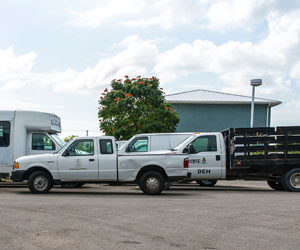

A “growing fleet” of rundown government vehicles has caused a number of Cayman Islands government agencies to choose simply not to use the government department created to maintain and purchase new vehicles.
According to an evaluation done in June by the government’s Internal Audit Unit, this bypassing occurred because the Department of Vehicle and Equipment Services does not measure up, in the estimation of some agencies.
“[This is] evident in the fact that some government agencies do not use the services offered by the Department of Vehicle and Equipment Services … mainly due to concerns of inadequate assurance that the output [work] will not meet their relevant timeliness or quality standards,” the internal audit report states.
In order to provide value for the money taxpayers spend on it, the department should be the “central agency” for vehicle acquisition and maintenance of all government entities, auditors advised. Through the early part of 2013, this is not what occurred. In fact, auditors revealed that government departments routinely bought new cars or engaged in service contracts without even bothering to consult with vehicle services officials.
Auditors were told the department does not keep a routine maintenance schedule for all government vehicles and equipment “owing to the fact that agencies are in charge of vehicles and are not obligated to comply with Department and Vehicle and Equipment Services schedules.”
The department told government auditors that it outsourced repair jobs between July 2011 and November 2012 – at a cost of $1.725 million during the period – because it was simply unable to handle the amount of work required. One reason given was “insufficient mechanics” to handle the sheer number of repair jobs coming in. There were also problems with a lack of updated technology needed to diagnose some of the problems with more modern vehicles.
The audit identified “a growing fleet of dilapidated vehicles, most of which are attributed to the Department of Environmental Health, the Health Services Authority and the Royal Cayman Islands Police Service.”
“These entities’ vehicles consume over 50 percent of the Department of Vehicle and Equipment Services’ time and budget,” the Internal Audit report states.
As an example, the Department of Environmental Health maintained at the time of the audit that 18 of its 27 garbage trucks were more than 10 years old. In addition, 25 of the 27 trucks maintained at the time required “life cycle refurbishment.” Those works were expected to cost a total of $1.5 million, or $60,000 per vehicle.
According to auditors, the average cost of a new garbage truck with a 25-year life span is $225,000.
At one point during 2013, government trash trucks were only visiting certain neighborhoods every nine or ten days because there were only three operational vehicles in the fleet. Newer garbage trucks have been purchased since then and two are expected to arrive on island late this month.
This situation raised another issue with government vehicles, regarding whether purchasing a new vehicle would be more cost-effective than simply repairing old ones over and over again.
For instance, the June 2013 audit cited one example where the government spent $16,000 repairing a 1994 Toyota Coaster in 2011, including providing new paint and body repairs. The car was 17 years old at the time. Another $12,000 was spent for “parts and labor” on a 2005 Hyundai Matrix in 2012, when the purchase of a comparable new model would have cost about $20,000.
“The monies spent may have been better used to offset at least 50 percent of the costs of brand new vehicles of similar characteristics,” the Internal Audit report stated.
Responding to the audit report, the Department of Vehicle and Equipment Services management disagreed with the value-for-money analysis submitted by government auditors.
“The reality is that, in the absence of capital to procure new vehicles, client agencies have required that maintenance and repairs are conducted on their vehicles or equipment to ensure they are operational,” the department’s response stated, adding that – although it will provide advice when asked – it always adheres to the wishes of government agencies it serves.

Related Videos












There were also problems with a lack of updated technology needed to diagnose some of the problems with more modern vehicles.
Modern vehicles are usually the easiest to run a diagnostic. The computer stores codes pointing to most faults. An OBD1 or OBD2 can readily pull up the codes, and they usually cost a few hundred bucks. With the purchasing clout of the department, diagnostic tools should be a on the level of a service manual, a given.
The auditor is asking the right questions, i.e., schedule maintenance, he just seem to be getting poor excuses. Again we see the absence or failure to adhere to policy and procedure. There need to be penalties.
Mr Manderson, it seem that the old contradiction efficiency in government, has raised its ugly head again. The Auditor General may need a repair crew following close behind the audit to insure recommendations are implemented. I sat in on a few budget review boards. During one, a property manager budgeted $2,000 to replace a metal door in my department. After the meeting, I called a vendor and got a quote for $700 installed with a panic bar. Government and large organizations seem to purchase $2,000 toilet seats often.
Evaluate and auction them off.
A good fleet manager, with responsibility and control of a budget can pay for their own salary within the first month. A friend of mine implemented a GPS tracking system (cost equivalent of 50 bucks a month per vehicle) monitored speeding, use of works vehicles without permission over weekends, claims for overtime when in fact the vehicle was back in the yard on time.
If the CIG can’t purchase capital items like new vehicles, then they could lease them from a private sector company so lunacy like fixing 14 year old minibus’s wouldn’t happen – this may seem expensive but private firms do a very good job of identifying the sweet spot between falling residual value vs. rising service costs.
Presumably CIG give themselves a tax exemption when importing vehicles and that would also leave a lot of meat on the bone if for example they bought vehicles tax free and then sold them off after 1 or 2 years at market price – a 20k vehicle could be had for nearer 16 so selling it 2 years later for 15k isn’t a bad trick.