

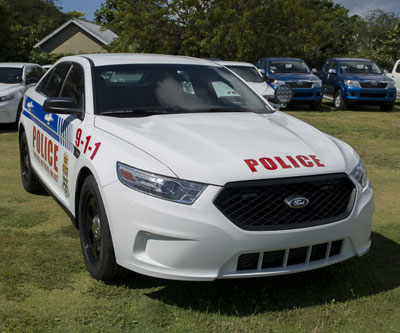

Thirteen brand-new police vehicles that arrived in the Cayman Islands about a month ago had not hit the streets as of Tuesday because they were not released to the department.
However, those new vehicles are just a few leaves in the forest as far as the Royal Cayman Islands Police Service’s overall need for new equipment, according to information sent to the Caymanian Compass.
“The present police fleet consists of 126 vehicles; 65 percent of them have reached their service life, some of the vehicles are as old as 1998,” a statement from the Royal Cayman Islands Police Service said, in response to Compass questions about the police patrol car fleet.
About 20 of the old patrol cars are due to be decommissioned, or placed out of service, according to RCIPS Chief Inspector Raymond Christian.
Some of the remaining patrol vehicles, mostly Chevrolet Impalas, have required major repairs, including new fuel pumps and oxygen sensors, to keep them functioning.
A total of 17 vehicles were purchased in the latest transaction. The 13 vehicles now on island have not been “handed over to the RCIPS yet,” according to Chief Inspector Christian.
“The outfitting of those vehicles with sirens, decals etc., should be completed this week,” Mr. Christian said. “We don’t have a cost of total equipment. We have sought the costing from the ministry, but we have not received it yet.”
The other four patrol vehicles are still en route to the Cayman Islands. “Apparently, the snow storms in the U.S. delayed delivery,” Mr. Christian said.
Mr. Christian acknowledged that there had been rumors about “bad gas” from the government fuel depot being responsible for the loss of some of the police vehicles. “None of the present fleet lost a motor because of bad fuel,” Mr. Christian said.
Replacement police vehicles have not kept up with attrition rates.
Eleven new Dodge Chargers, one of which was totaled in a crash, were received by the department in 2011.
Fleet ‘dilapidated’
The RCIPS has been one of the hardest-hit government departments by what internal auditors described as a fleet of run-down vehicles.
The audit identified “a growing fleet of dilapidated vehicles, most of which are attributed to the Department of Environmental Health, the Health Services Authority and the Royal Cayman Islands Police Service.”
“These entities’ vehicles consume over 50 percent of the Department of Vehicle and Equipment Services’ time and budget,” the Internal Audit report from June 2013 stated.
This situation raised another issue concerning government vehicles – one the police service has often dealt with – that is, whether purchasing a new vehicle would be more cost-effective than repeatedly repairing old models.
For instance, the audit cited one instance where government spent $16,000 repairing a 1994 Toyota Coaster in 2011, including new paint and body repairs. The car was 17 years old at the time. Another $12,000 was spent for parts and labor on a 2005 Hyundai Matrix in 2012, when buying a comparable new model would have cost about $20,000.
“The monies spent may have been better used to offset at least 50 percent of the costs of brand-new vehicles of similar characteristics,” the Internal Audit report stated.

Related Videos













Since when did replacing things like a fuel pump or oxygen sensors become classed as major repairs? On my car these are DiY jobs any home mechanic can do in under an hour.
In fact replacing the sensors (I assume he means lambda sensors) is maintenance rather than a repair because on most vehicles they only have a limited life so, like spark plugs, cambelts and exhausts, are really service items.
Similarly, how on earth did anyone run up a CI16K bill on a 17-year-old Toyota bus or CI12K on Hyundai people carrier and who authorised the payments?
It looks to me as though CIG are simply letting themselves get ripped off here. Could it be that one reason these old, dilapidated vehicles are not being replaced is because the repairers are making too much money out of them?
I think there needs to be a much deeply value-for-money audit into this with emphasis on the detailed repair costs.
Replacing a Fuel Pump or Oxygen sensor is nor more than a routine repair that can be done by even novice auto mechanics. Any repair person that says otherwise needs to be second guessed regarding his qualifications. As far as the other repairs such as spending 16K repairing a 1994 Toyota and 12k on a 2005 Hyundai, I would say both these repairs need to be investigated to see where the money went as well as question why and who approved a repair that cost more than the vehicles were worth. I wonder who’s family owns the repair shop that did the work.
It’s not just the cars, it’s the Commissioner too. LOL. Time for a replacement. You know, like a new fandangled version that is not too concerned with its public perception … which is lower than a bass singer at a soprano rehearsal.
Don’t forget the $1.5 million for the motor in the dump excavator which went to Brazil.
I know these things aren’t cheap but I’ll bet there are complete used excavators for less than that – many countries offer tax breaks for companies investing in new equipment and the old stuff becomes available for a fraction of new price.
Point is, how much is the excavator worth ‘per day’ (ignoring disaster planning like dump fires), so what is the cost of repair in terms of down time?
Can we investigate how these vehicles are cared for by the people that use them on a daily basis?
I have seen a lot of police cars that appear to have broken indicators and seatbelts…either that, or some rules don’t apply to some officers.
Obviously there is someone who is responsible for the care and maintenance of the RCIP fleet of vehicles who needs to answer for this situation. One would think that the replacement of vehicles would be staggered as to not have the bulk of the fleet need replacement at once.
Hopefully the Compass will locate the person responsible for the fleet of vehicles and interview them to get some answers.
Also, why the need for the 11 Chargers and similar? I can only remember a few pursuit stories, and the cars usually back off and wait for the helicopter anyhow.
This is not California Highway Patrol! Most of our incidents tend to be intoxicated ministers crashing, or idiots who can’t drive at the best of times chatting on their phone.
Wonder if the Government is leveraging their buying power?
Buy 1 car – you pay retail.
Buy 25, 50 or 100 and you can negotiate hard and get them direct from the manufacturer at close to wholesale price.
Government then ‘eats the Duty’, keeps them for 30,000 miles or 1 year (whichever is sooner)
and then sells them on to the public for a depreciated RETAIL price (which also reflects that Joe Public actually pays the DUTY) – the kicker is that the actual market value for the cars sold on singly is still at a point similar to what was paid by the CIG, wholesale, in the first place.
End Result – cars for almost no nett expense – but you have to get out of the mindset of running them ’till they drop…