The chairwoman of Transparency International, a global coalition against corruption, highlighted two key areas during an address at UCCI on Wednesday: politicians’ personal and family interests and reform of campaign finance laws.
Huguette Labelle focused on the significance of these issues in the international fight against corruption.
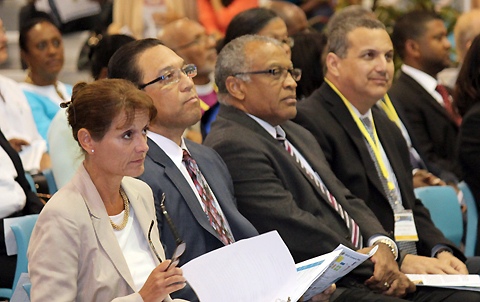
Ms. Labelle, perhaps without realizing it, identified two subjects that have been at the forefront recently in the Cayman Islands public sector during her keynote speech at the college’s three-day conference under the theme “Towards a Corruption-Free Caribbean: Ethics, Values and Morality.”
“It is essential … that parliamentarians have a code of conduct to set the standards to what is permissible and what is not, and that they have, as well, public disclosure of their assets and those of their immediate family,” Ms. Labelle told an audience of hundreds at Sir Vassel Johnson Hall on the UCCI campus. “Family does matter, without any question.”
Ms. Labelle gave examples from different countries, which she did not identify, where questionable financial arrangements existed involving national leaders and close family members.
“The president of [the unnamed] country’s two sons – one 10 and one 12-years-old – each were the owners of a multimillion [dollar] condo in Abu Dhabi,” she said.
In other cases, ministers have placed their financial interests in blind trusts that were directed by spouses or children. “That’s not quite blind in most people’s views,” Ms. Labelle said.
In the Cayman Islands, government recently passed a Standards in Public Life Law requiring a number of disclosures from politicians and senior civil servants by July.
According to section 12 of the law: “In making a declaration required [under the law], a person in public life shall include, in relation to himself and any connected person, details relating to – [subsection 1e] any land, whether beneficial or otherwise.”
The legislation forms part of a wholesale redraft of Cayman’s public standards policies, broadly expanding the areas local politicians and higher-ranking civil servants must make public in the territory’s register of interests.
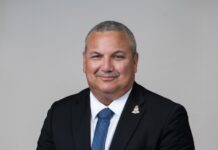
Premier Alden McLaughlin and Works Minister Kurt Tibbetts last week confirmed to the Caymanian Compass that close family members own land in the area of the Mastic Reserve on Grand Cayman. Those areas are located along the path of a planned road that is slated to service the proposed Ironwood golf and resort development in the center of the island.
Mr. McLaughlin told the anti-corruption conference Wednesday that change would eventually come on how corruption is viewed in the Caribbean and in the world, but that the change would be slow and would require massive effort to overcome current social norms.
“We’ve been at such a point for so long that all politicians are expected to be corrupt,” Mr. McLaughlin said. “You reach the conclusion that a good politician … is someone who ‘teefs’ (sic) and shares with other people. It is what so many people believe.”
Ms. Labelle said one of the largest contributors to distrust among the public and political parties is in the area of campaign finance.
“All expenses should be made public during the election,” she said.
Some countries, including Ms. Labelle’s native Canada, have abolished contributions to political parties from private businesses or labor unions, among other organizations. The Canadian limit on political party contributions from individuals is $1,200, with some proposals to raise that to $1,500 per person.
“I’m not suggesting it has to be like this everywhere, but it does, I think, create some greater trust,” she said.
In the Cayman Islands, political contributions are recorded only within the final six weeks of a general election campaign – from nomination day to election day. Anything spent outside that period is not recorded. Also, political contributions are only ever made public after an election, never before.
Transparency matters
Ngozi Okonjo-Iweala, Nigeria’s finance minister and former World Bank managing director, picked up on the transparency theme in her keynote address at Thursday’s conference session.
She said transparency was the most important tool in fighting corruption and the biggest lesson Cayman could learn from her country’s experience.
She said every level of the Nigerian state now made its monthly revenues available to the public. The country also has one of the most detailed budgets in the world, down to the level of enumerating the amount spent on cutlery by the first family, Ms. Okonjo-Iweala said
“The fundamental bedrock of fighting corruption is transparency – the minute you don’t have transparent accounts, transparent companies, you have problems,” she said.
“You should know the beneficial owners of your accounts, you should know your customer. It shouldn’t be easy for banks to just get away with just taking money – once you lay that bedrock, that’s the biggest lesson that helps a lot.”

Related Videos