

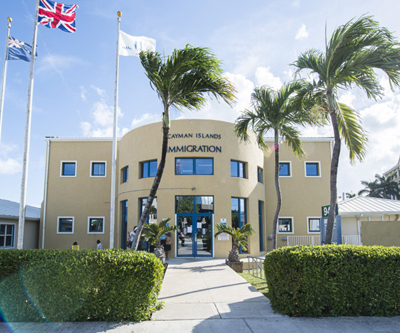

Even North Side MLA Ezzard Miller is finding himself confused by Cayman Islands Immigration Laws these days.
Mr. Miller recently filed an application for his wife, a Cuban national, to obtain Caymanian status following her marriage to him and seven years of legal residence in the country, by way of a Residency and Employment Rights Certificate.
The lawmaker sought advice from two sources, one advised him he had to file his wife’s status application prior to the expiry of the employment rights certificate, the other said the status application had to be filed after the certificate expired.
“So, I prepared two applications, one that I turned in three weeks ago,” Mr. Miller told the Legislative Assembly on Friday. “The other I still have in the study at home, to be turned in the day after [the employment rights certificate] expires.”
Mr. Miller’s comments came after several lawmakers told stories of confusion and frustration concerning Caymanian constituents attempting to get status for their spouses, and then British Overseas Territories citizenship following the approval of their Caymanian status applications.
“Four of my constituents [have been] in that situation,” said East End MLA Arden McLean. “The inequity not only comes at the stage of being naturalized [receiving citizenship], but getting to that stage is now causing extreme difficulties for Caymanian spouses. The Immigration Department [is] sending mixed messages.”
A motion filed by Bodden Town MLA Anthony Eden seeking to change the Immigration Law with regard to Caymanians’ non-Caymanian spouses receiving Caymanian status was approved unanimously by Legislative Assembly members late Friday. Mr. Eden and Bodden Town MLA Alva Suckoo said they hoped proposed changes would make navigating the immigration labyrinth easier for legal spouses of Caymanians.
Mr. Eden pointed out that non-Caymanian spouses of permanent residents, who do not have Caymanian status, have a much quicker path to citizenship under the current law.
“The foreign spouse of a Caymanian should not have lesser rights than the spouse of a permanent resident when applying for citizenship,” Mr. Eden said. “This motion seeks to create a level playing field.”
Under current Immigration Law, a non-Caymanian who receives permanent residence can have their spouse apply as a dependent on that grant of residence, essentially obtaining permanent residence themselves during the currency of the marriage. One year after that residency status is granted, the spouse is eligible to apply for British Overseas Territories citizenship. Citizenship status allows the holder to carry a Cayman Islands passport and is the tantamount step to receiving Caymanian status.
The non-Caymanian spouse of a Caymanian must wait seven years before applying for the right to be Caymanian. The spouse can also seek British Overseas Territories citizenship at that time, but that would occur seven years later.
Precisely how this issue should be addressed is not set out in the motion before the Legislative Assembly.
“We want the government to fix the anomaly one way or the other,” Mr. Suckoo said. “We would prefer that Caymanians are topped up in terms of their rights and benefits. Either move everybody to seven years or move everybody to one year.”
Premier Alden McLaughlin said this issue with the Immigration Law is not a simple legislative fix.
“This is a matter which has exercised the government’s minds,” Mr. McLaughlin said. “We’ve had discussions with the deputy governor and we do believe there is a way forward.” The Cayman Islands Immigration Law operates on a system of graduated rights for non-Caymanian residents, who make up roughly half of the islands’ 55,000 to 60,000 residents.
Any non-Caymanian employed in the islands’ private sector must obtain a work permit to take up residence here, and that permit can only be renewed for up to nine consecutive years before the non-Caymanian must take a one year “break in stay” from their residence.
Permanent residence can be obtained in a number of ways. Typically, a Caymanian citizen’s spouse can be granted the equivalent of permanent residence as long as the marriage remains intact. Also, a non-Caymanian worker who has stayed in Cayman for at least eight consecutive years can apply for permanent residence.
Once permanent residence is granted, applicants can apply for citizenship and obtain a British Overseas Territories passport. British Overseas Territories citizenship is not the same as a grant of Caymanian status, which confers the right to be Caymanian. Non-Caymanians can apply for the right to be Caymanian if they have remained resident in Cayman for at least 15 years or, have been married to a Caymanian for at least seven years.

Related Videos







Yes there are some mis-understandings in the law concerning Caymanians and their non Caymanian Spouse.
I think is a mind bender for the Government because they have to ensure that the right decisions are being made. I believe public education and input is necessary. My thoughts also are that the Immigration should require the Non Caymanian Spouse to have their passports stamped every six months, paying 300.00 stamp fee. That is only fifty dollars a month. This hopefully will encourage the non Caymanian partner to work and show responsibility. Its not an easy job but someone has to do it.
This is quite funny. I really wanted to see how many disagrees I would get.
Ok let me be a little more explicit. If I am not correct please correct me. If an expatriate spouse apply for a PR or R with R to work. they are required to pay 1000.00 up front correct. Beside that they have to wait 7 years on a permit.
Would it not be easier to find 300.00 every six months and then the person granted PR after two years providing they are living with their spouse. Mind you we have some very good expat. spouses, however we got scoundrels too.
Correct me if I’m wrong Twyla, but you appear to be saying that the non-working wife of, say, an ex-pat attorney should be effectively fined 600 Dollars a year for NOT working.
Does this get refunded if they work free of charge as a volunteer at a local charity?
Norman, what I am trying to talk about is the fee required. Not a fine. This fee has to be paid one way or the other, however would it not be easer how I have suggested it.
The non working wife would be expected to pay for the PR correct. Or the husband would have to pay it.
An attorney of course can afford to have a non working wife. Volunteer Charity, but what about those persons who cannot afford this.
Check out all the charity volunteers and see who they are. Are you aware that there are non Caymanian spouses making five dollars an hour who cannot afford 1000.00 up front. Also if crab don’t walk about he will never get fat.
Twyla:
Many foreigners are perfectly happy to work here for a few years and then move on having gained some useful experience.Therefore they will never apply to become permanent residents and thus will never have to pay any fee to apply for it.
Why then should their non-working wives have to pay an extra fee just to live with their husbands?
I’m sure you are aware that children of foreigners are not allowed to go to government schools, even though their work permits fees pay for them.
Another reason why foreigners with families cannot afford to live here unless they have very high-paying jobs.