

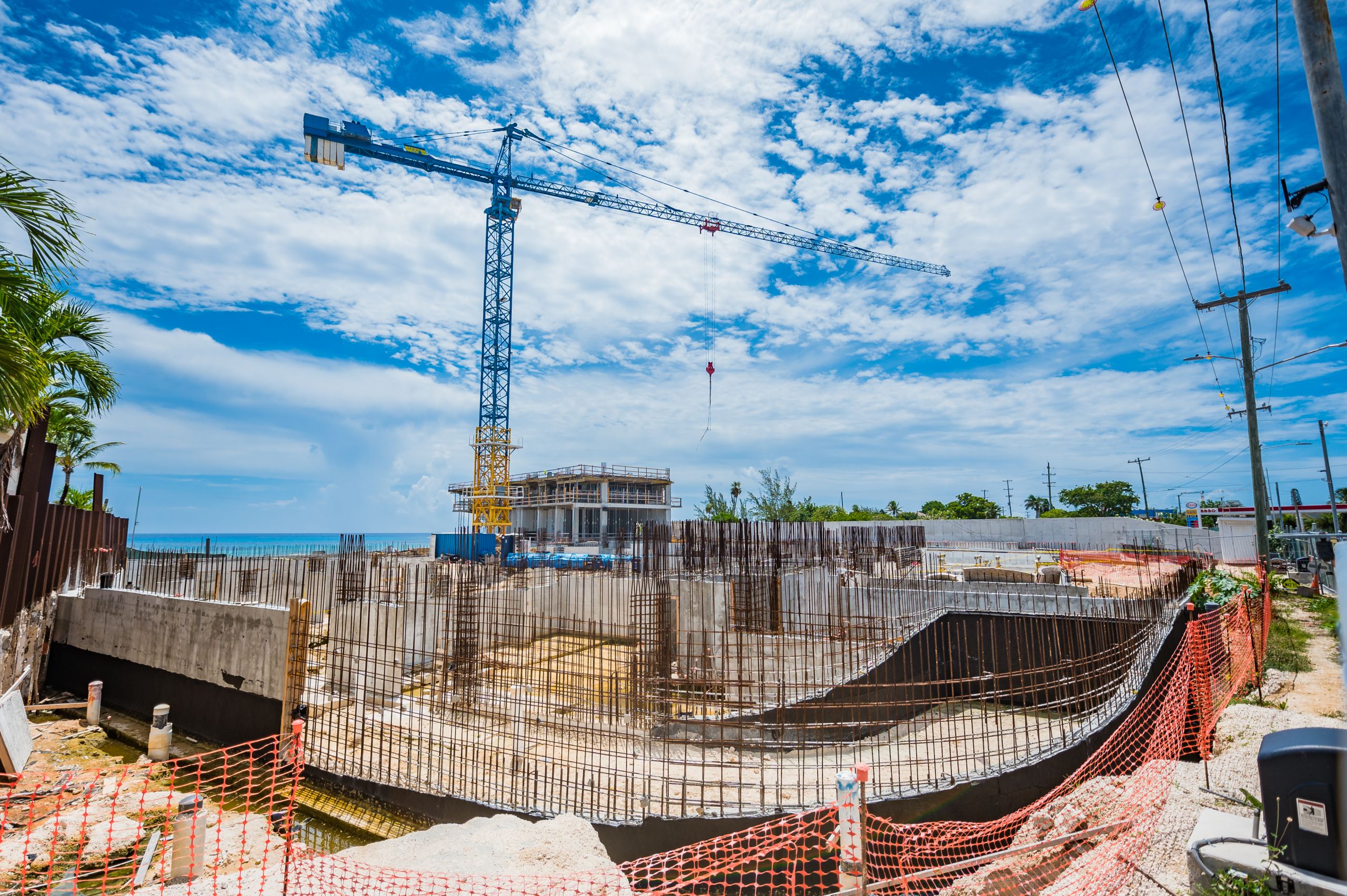
Government expects to rake in significant income from property taxes over the next two years with Cayman’s development boom showing little sign of slowing down.
A record figure of almost $100 million came from stamp duty on land transfers in 2021 – double what was originally forecast.
And the PACT government’s first budget anticipates almost $140 million in income from that source over the next two years.
The revenue is linked to both an increase in property values and volume of sales, associated with a string of new developments.
Premier Wayne Panton told the Cayman Compass that the budget projection is not out of step with his government’s plans for a more sustainable approach.
He said increased stamp duty revenue does not necessarily reflect an expected surge in construction, although he acknowledged that continued growth is anticipated in the sector over the next four years.
Panton said a new Development Plan and a national sustainability strategy are priorities for his government.
But he said these could take several years to implement.
He added that a sustainable approach to Cayman’s future does not necessarily mean substantially less physical development.
“Significantly slowing or stopping development would not automatically make the Cayman Islands a more sustainable country,” he said in an emailed response to questions from the Compass.
“Indeed, some level of physical development will be required to ensure we can address other issues facing our community, such as ensuring we can affordably house our people in dignified conditions, safely treat our solid waste and wastewater, and meet our national renewable energy targets.”
While much of the commentary on sustainability in Cayman has focussed on the tension between development and the environment, Panton said the concept, as defined by the United Nations, is much broader than that.
He said sustainable solutions tap into the the links between the economy, society and environment and maximise benefits across this “triple bottom line”.
Review of Development Plan
The review of the Development Plan – which regulates land use across the Cayman Islands and has not been updated since 1997 – will be a collaborative effort between Panton’s new Ministry of Sustainability and Climate Resilience and the Ministry of Planning.
Panton said a broad aim of the plan would be to prioritise development that contributes to “safe, inclusive and resilient” communities.
He said initial discussions had taken place and momentum would increase on the project soon. But he acknowledged this was a “medium term objective” that could take up to to three years and may need to be carried out in stages.
Development continues
Meanwhile development continues apace. Government pulled in more than double its original stamp duty forecast in 2021.
The number reflects the levy on all property sales – not just new development.
A high sales volume and some record value home and condo sales, in the post-COVID property boom, contributed to the unusually high total.
Re/Max broker Kim Lund said the sales volume, price and related government revenue were also linked to development cycles. He said Cayman had been through a boom in construction and property sales that would continue to provide revenue for government as those purchases are completed, and stamp duty becomes payable, over the next 12 months.
The longer term future is less clear, says Lund.
He said developers and contractors had been “maxed out” over the past few years completing a slew of new projects and he anticipates some contraction.
“We have to see what happens but ebb and flow is part of the normal market dynamics,” he said.
Lund said property development typically responds to market demand and he believes it will be difficult to reduce construction without creating other issues.
Sustainability ‘more than just development’
While revenue from stamp duty is a significant income stream for government, netting around 7% of its projected annual income, Panton points out that it is dwarfed by financial services (approx 39%) and import duties (23%).
He said these sectors of the economy also have impacts on the community and natural environment. Panton said his ministry had been set up to help set in motion a “paradigm shift” that would embed sustainable practices across multiple industries and sectors – not just development and planning.
“A transformational shift toward sustainability will require us to develop and agree on a national strategy as an organising framework for current and future sustainability initiatives,” he added.
Related Videos












It would be interesting to learn how much our realtors have earned during this boom period. It is high time their commission rates which can be as high as 7% and never below 5%, are substantially reduced to bring them more into line with other countries.
It’s possible to help solve local housing affordability and provide the government with an ongoing income stream.
Allow all Caymanians to pay their Stamp Duty bill over a period of time at a slightly higher rate.
For example rather than needing to come up with, say, $50,000 cash at closing let people pay $5,100 per year for 10 years. The unpaid Stamp Duty would be a second charge on the property till repaid.
Anyone who thinks that development and financial services are not interlinked, are not fully considering our place in the world. Development of homes, commercial centers, infrastructure and roads are what makes Cayman competitive and livable to those in the financial services industry, who frankly have other options for residence and operations. Cayman’s financial sector would have a long slunk away to Dubai, Singapore, London, Abu Dahbi etc under the weight of FATCA and other restrictions imposed by the OECD, were it not for the fact that this place has become such a desirable one to hold a meeting, live and move people. The development of the past 20 years such as Camana Bay have inspired other developers and newcomers to our financial services sector to follow in Dart’s wake. This has created a virtuous cycle. I find it unsettling to hear government intimate “sustainable” (slowing) development while at the same time cheerleading financial services, because those two pillars are interlinked. We cannot sustain our financial services industry without helping this place evolve, remain desirable and welcoming to the people who will support and grow Financial services. Memories are short and it has been a generation since our last major recession. It’s easy to take comfort in the spillover benefits rained on this country through Ken Dart’s incredible vision, but it is unhealthy to become over-reliant on an artificial wave, or kid yourself into believing that a gusher will never end. Who will build the homes to house the next 3000 bankers who expect a standard akin to London? I would encourage everyone not to get complacent that the money comes out of the air. The OECD/US could impose a regulation tomorrow that scares financial services away. We need to have enough of a nucleus through development, that those in the financial services industry will work together to adapt rather than run. Development is the quiet engine putting food on everyone’s table and inspiring newcomers. Wish it away at your peril.
Great post Frank. You nailed it. People forget how the financial services industry, and the incredible amounts of stamp duty collected have allowed us to live COVID free for so long, while supporting our tourism workers with a stipend. This luxury was not available to other islands. It is time to understand that Ken Dart putting a world class private school at Camana Bay has helped families move here comfortably, and for the very long term. We must continue to develop, while protecting our valuable environment to the best of our ability against climate change. Responsible development and the growth engine it creates will take Cayman to greater heights, and allow a small island to tackle any challenge that lays ahead whether it be financial services regulation, climate change, or the next pandemic.
The infusion of funds from such over-developing will be spent long before their demand on public services and infrastructure is met. Why are the CIG not considering something like an ad valorem property tax of $1 or each $100k of value over $1M starting five years after development?