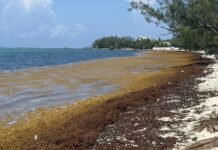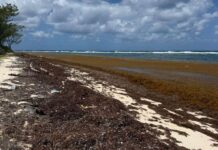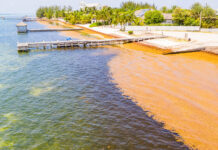
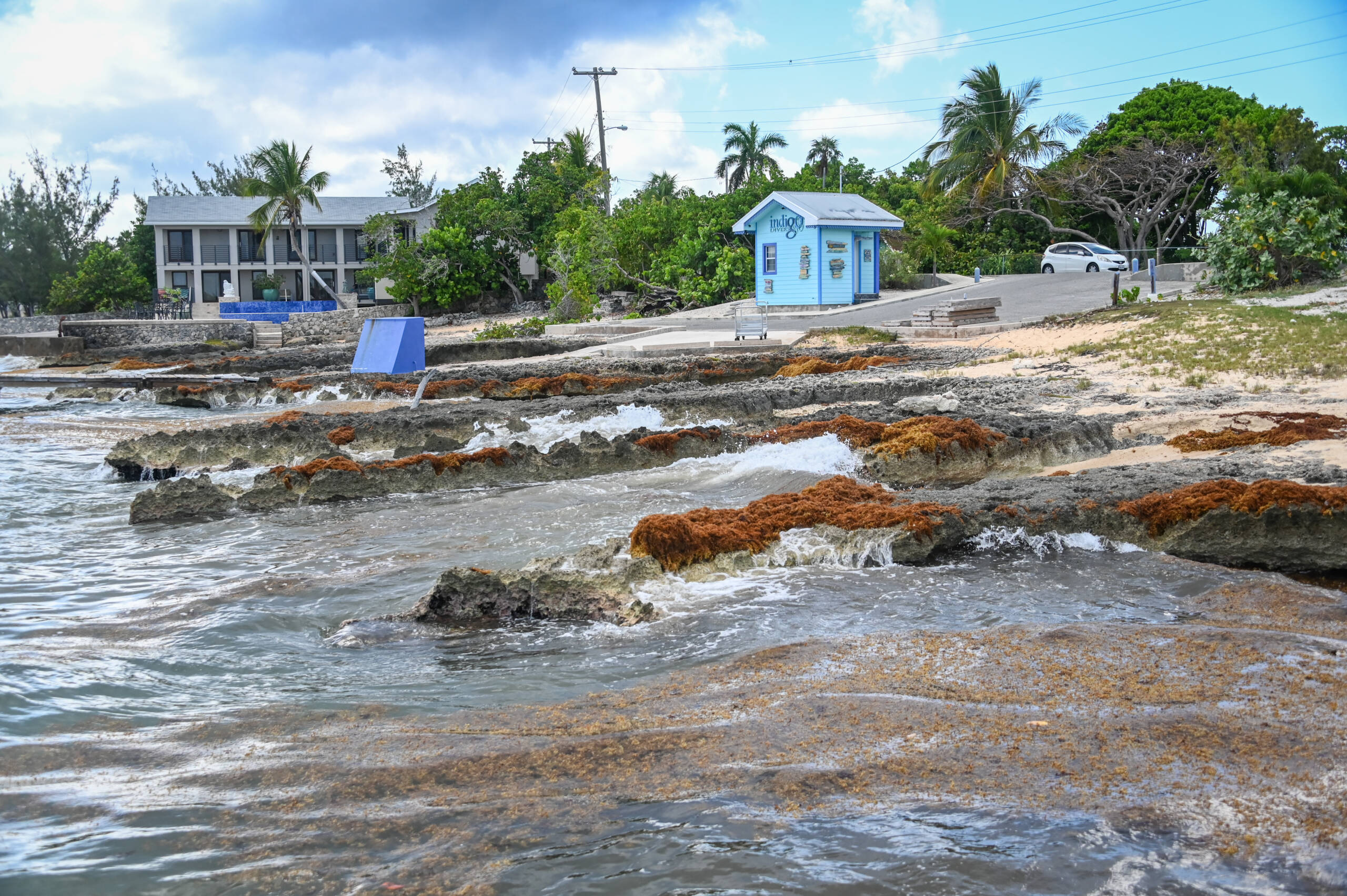
For the past decade, Vince Ramgeet and his two Public Works Department field officers have been locked in a constant struggle to clear Grand Cayman’s public boat ramps and their adjoining shorelines from an unending onslaught of sargassum seaweed.
As 2022 continues to shape up to be a record-breaking year of bloom for the sea-surface algae, it seems the men’s efforts are shaping up to be nothing short of futile.
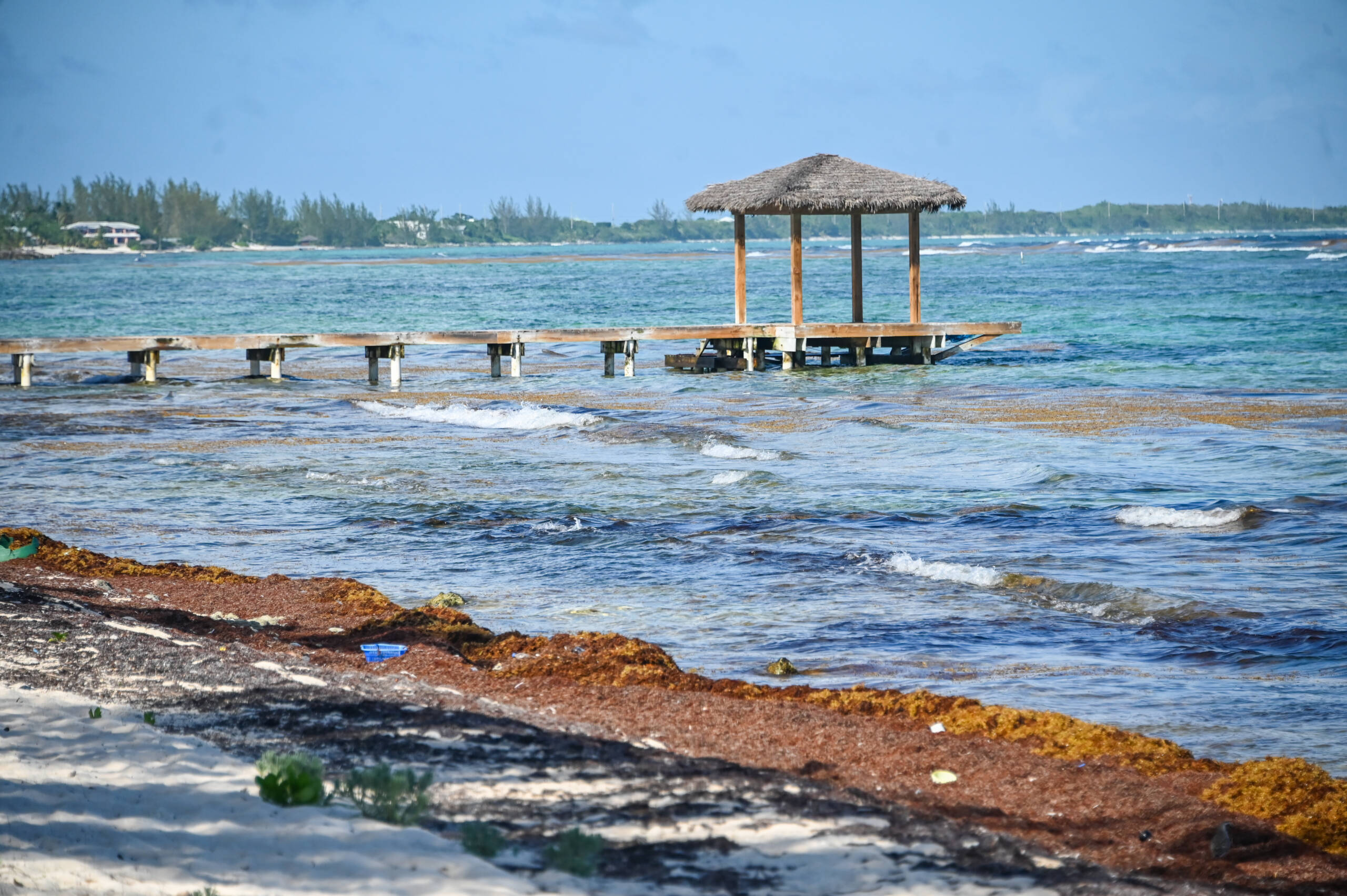
“Some days it feels like a never-ending battle,” said Ramgeet. “We are up before the crack of dawn and on a day like today, we have driven out to the eastern side of the island to clear this dock in Frank Sound. As soon as we leave, it will be like we were never even here.”
Before 2012, their greatest obstacle was clearing boat ramps which were often left clogged with hundreds of pounds of sand in the wake of a passing nor’wester, tropical storm or the occasional hurricane.
“Clearing the sand can be a bit difficult at times, with the debris that washes ashore, but it is manageable because it doesn’t happen that often,” Ramgeet said.
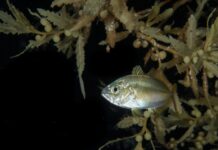
However, changing conditions in the Atlantic Ocean and the Caribbean Sea have left the men fighting a more menacing foe in the form of sargassum seaweed.
On a recent trip to the Brac, the Compass observed the same challenges afflicting the Sister Islands, too.
Record-breaking bloom expected for 2022
In the past six months, researchers at the University of South Florida, in collaboration with NASA, have observed record-breaking growth in the amount of sargassum across the Caribbean and the southwestern Atlantic Ocean.
In its May 2022 ‘Sargassum Seaweed Bulletin’, USF researchers reported rapid growth in seaweed for the fifth consecutive month – with the months of April and May recording the largest ever individual month’s growth in history.
“In all regions combined, the total Sargassum amount increased from [approximately] 14.0 million tons in April 2022 to [approximately] 18.8 million tons in May 2022,” states the bulletin.
The largest recorded growth was noted in Nov. 2020 when researchers observed approximately 20 million tons of the seaweed.
“It’s scary to think that much seaweed is out there, because we are just a team of three, so we are going to need more resources if we are going to be able to continue to clean it up,” said Ramgeet.
According to USF figures, the current bloom is forecast to continue to increase into June and July, before an expected reduction in the fall months.






Challenges clearing the sargassum
For Ramgeet and his officers, the clearing process, in theory, is simple.
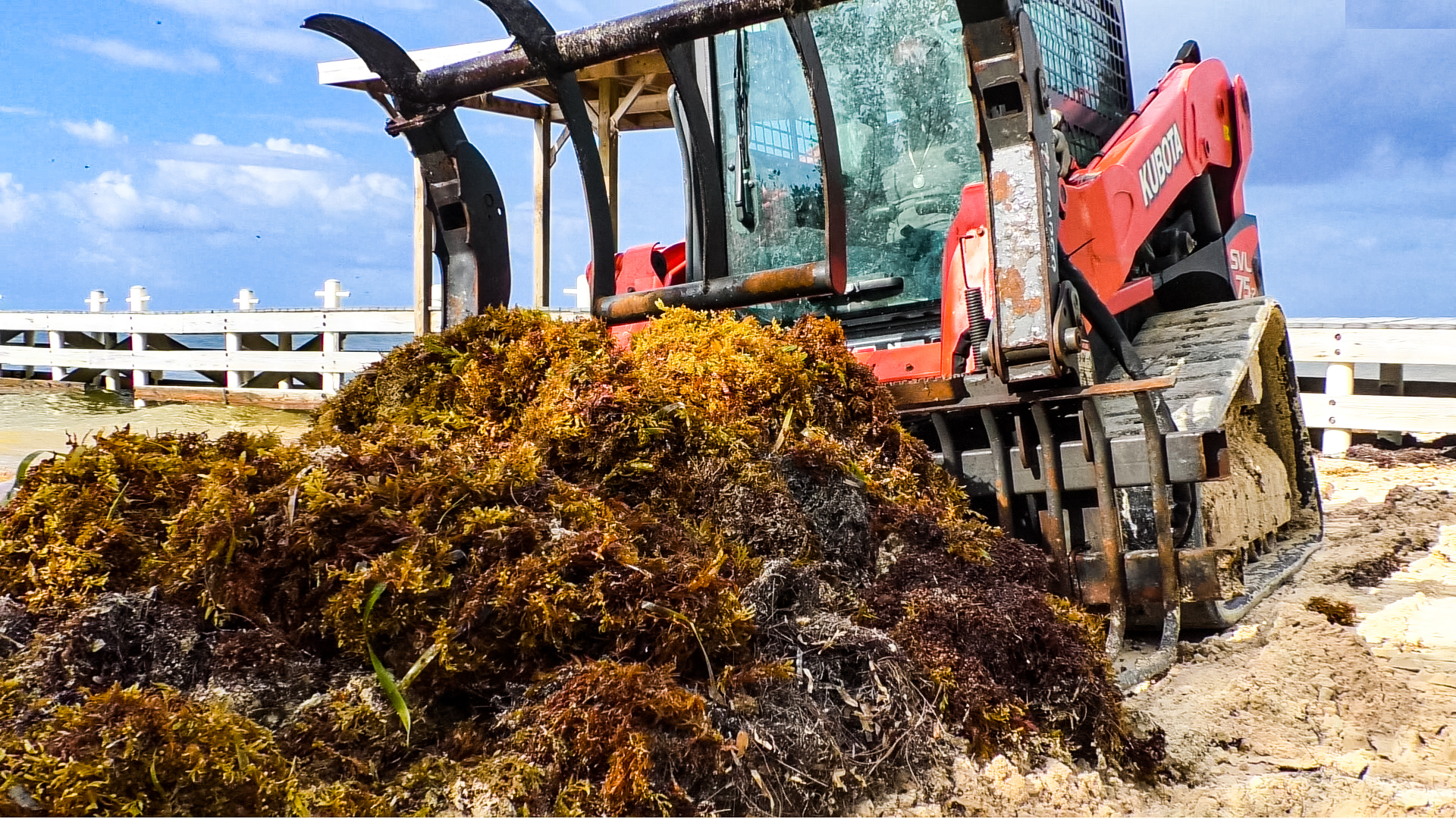
One of the men uses a relatively small front-end loader to grab chunks of seaweed from the water’s edge of the ramp and the nearby shoreline. The large grill-like clamp of the machine allows water and sand to fall free, while the seaweed is loaded into the back of a nearby dump truck and taken to a site to be mulched by the Department of Agriculture.
However, in reality, the process is more complicated.
“We are not allowed to take seaweed that has not washed ashore,” said Ramgeet. “So that means sometimes we are only allowed to take a small fraction of the large clumps of seaweed that we can see in front of us.”
The problem is made more complex during turtle nesting season, which coincides with the height of the sargassum bloom. The Department of Environment has restricted the use of heavy equipment on active turtle nesting beaches.

‘We need more resources’
Across the region, governments have deployed a wide range of strategies to help combat the sargassum seaweed, as it jeopardises a fragile tourism industry, struggling to recover in the wake of the pandemic.
Some of these strategies include floating buoy lines which act as artificial coastlines and trap the seaweed before it can make landfall; large teams of heavily equipped beach cleaners who clean and harvest the bountiful algae; and the repurposing of the seaweed for human consumption or mulch for livestock and fertiliser.
While a few of these strategies have been employed in Cayman, nothing has been done on a large enough scale to make a dent in the ever-growing sargassum problem.
“I think the best way forward is more resources,” Ragmeet said. “If we could have a few more people who are properly equipped, then we could actually clean it up better and have multiple teams working at the same time.”
He added, “What we are doing is helping, but there is only so much that we can do with what we have.”
Related Videos