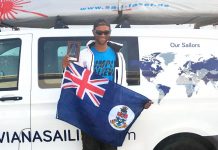
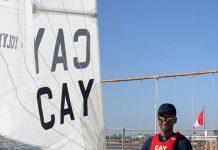
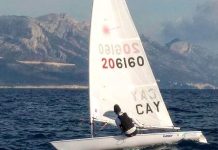
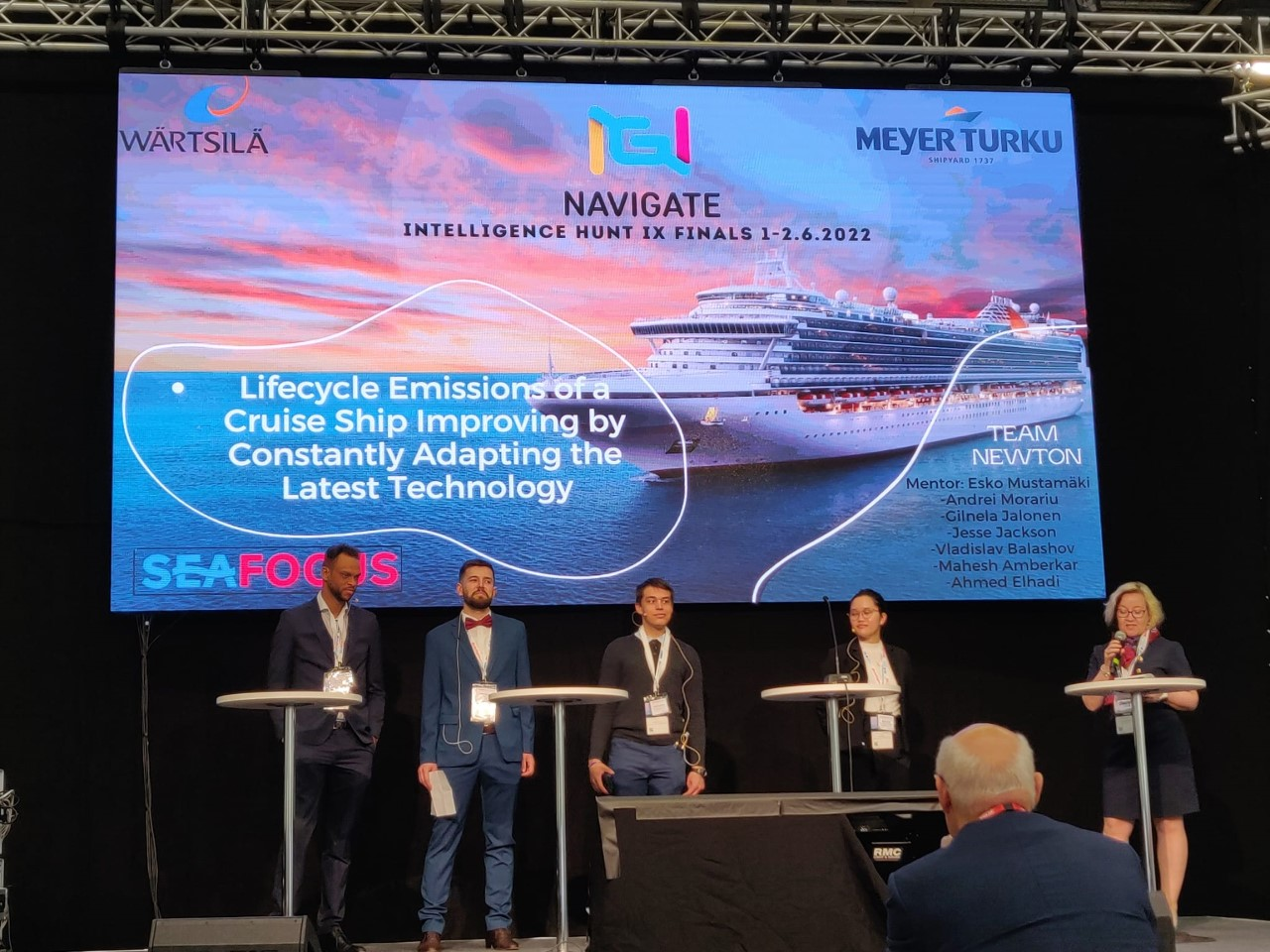
Caymanian student Jesse Jackson is riding a wave of success after his team clenched the top prize at the Seafocus 9th Intelligence Hunt project competition in Turku, Finland, earlier this month.
The contest was held in conjunction with the Navigate 2022 Maritime Trade Exhibition in early June. The Seafocus Intelligence Hunt project that students in the maritime field an opportunity to showcase their talents while advancing the industry with innovative ideas.
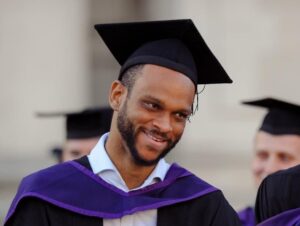
Jackson, speaking with the Cayman Compass via Zoom about the win, said it was very special opportunity for him and his team.
“I was quite excited to get this topic,” Jackson said, as it was “right up my alleyway”.
Jackson’s Team Newton consisted of maritime university students from across Europe. They were given the assignment ‘Lifecycle Emissions of a Cruise Ship – Improving by Constantly Adapting the Latest Technology’ by the case companies Meyer Turku and Wärtsilä Voyage. The team has to complete a confidential part of the project, then present a final report to the companies by the end of June.
He said the task of finding solutions to address cruise ship emissions was important, as it directly impacted the Cayman Islands, which saw 1.83 million cruise visitors arrive in 2019.
A project that hit home
The 23-year-old Savannah resident is currently studying for his master’s degree in Advanced Naval Architecture at the University of Strathclyde in Scotland.
His team won a prize of 500 euros and an invaluable opportunity to intern with Wärtsilä Voyage, one of the world’s largest ship engine manufacturers, and career counselling.
“[They] basically gave us networking [opportunities], that was a big thing they were focussed on – trying to network you and get you into the industry so that, if you want to go into the industry, then you already have connections. I got several good connections. Especially [as] I am finishing my master’s in September, [I] could potentially work with some of those companies,” he said.
He said participants were assigned topics for the competition and had to present their strategies at Navigate 2022 Maritime Trade Exhibition before global leaders in the shipping industry.
The subject of cruise ships was perfect for the him, he said, “because before COVID, we used to have anywhere from two to five in the harbour [in a day]. That brings a lot of tourism. These things are huge and there’s potential to save energy and just be more efficient,” he said.
Jackson said his team was required to research cruise ship designs, their lifecycle and how they could be enhanced to make them energy efficient and environmentally friendly.
He was one of two Caribbean students participating in the contest – the other was from St. Lucia, and the only member of his team who had been on board a cruise ship.
Watch the video of Jackson’s team’s presentation:
He said the team’s ideas were well received and included recommendations that can be implemented at the design stage, as well as retrofitting current in-service fleets.
One of the ideas that was well received was alternatives to fuel.
“If they’re not green… nobody wants to really go on anything that’s damaging the environment anymore, so that’s a big concept,” he said.
The team discussed ships changing from using fossil fuel to electric power, as well as using more efficient destination routes.
Their idea of ships using bio fuel was well received, he said.
“A cruise ship has a lot of waste. If you’ve ever been on there, there’s human waste, first of all, and then there’s a lot of food waste. That was the first thing… you build a mini plant and you just throw all the waste and you burn [bio] fuel,” he said.
The team also suggested that slower speeds for the ships would also reduce fuel use.
“If you slow down by four or five knots, you can save a large amount of fuel, and with gas prices going up, the company was even more happy for us to take this topic on,” he added.
Urge to return to seafaring culture, ship building
It was Jackson’s love of the sea and Cayman’s seafaring culture that propelled him to pursue his shipbuilding studies. That, and his passion for fishing.
“I was happy to go fishing, catch my fish, sell every day and start my company or start a charter fishing company, get some boats and do commercial. My mom was, like, ‘No, you have to get a degree to set up yourself and then, after you get your bachelor’s, you can do whatever you want,'” he said.
Jackson said he did not want to do typical degrees so he picked yacht design, which had piqued his interest.
His dream, ultimately, is to return to Cayman and start a maritime design school, possibly in partnership with the University of Strathclyde, as he wants to help rekindle an interest in seafaring among young Caymanians.
“Because it’s all about banking these days and tourism, I feel like this will give us a great opportunity… because I know there are a lot of young Caymanian that don’t want to go to university and study the typical [degrees], but they’re very good at hands-on things, very good at designing, very good at building,” he said.
Related Videos