Auditors raised red flags about suspicious loan transactions for US$1.2 million when they examined the Cayman Islands Football Association’s books.
Two identical loan agreements from two apparently unrelated companies each signed by the same person at the same address in Panama, raised concerns among auditors at Rankin Berkower, the Grand Court heard this week.
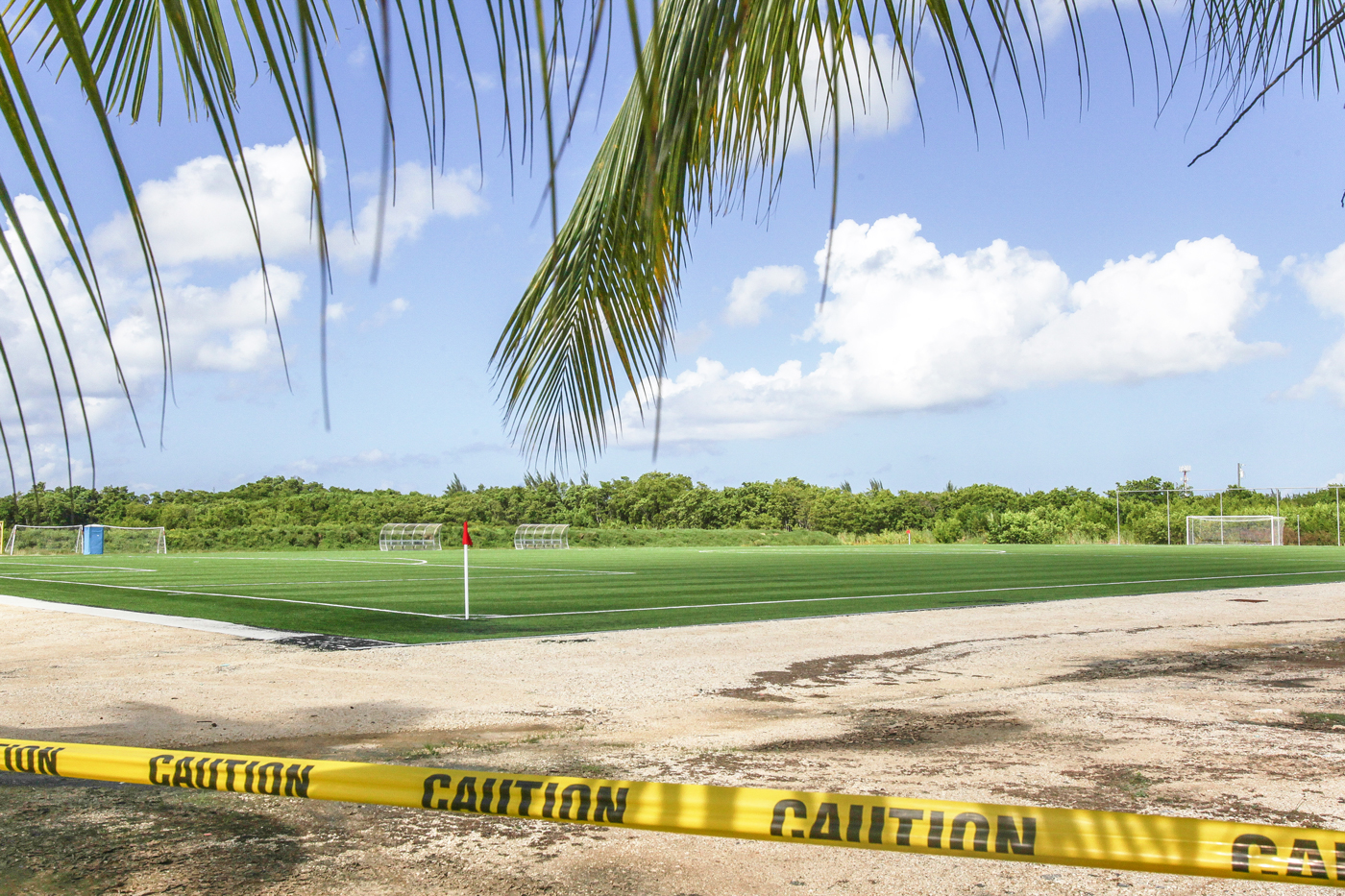
Matthew Adam who audited CIFA’s accounts for 2014 said the two US$600,000 loans were listed as an injection of funds into the national training centre.
Adam said he and fellow auditor Philip Rankin flagged a number of questions about the transactions. When they did not get satisfactory answers, he said, they had ended their audit and notified the authorities.
False accounting charges
Adam was testifying in the ongoing fraud trial of former CIFA executives Canover Watson and Bruce Blake. Both men have denied a string of offences relating to their dealings as football administrators in Cayman and the wider Caribbean region.
The Crown alleges that some criminal proceeds, from three false invoices sent by Watson to regional football body CONCACAF for sporting goods that were never delivered, were ultimately transferred to CIFA.
To explain the origin of the large cash amount, used to pay down the football association’s loan with Fidelity bank, it is alleged that Watson and Blake created fake loan agreements.
Watson, a former treasurer of the Cayman Islands Football Association (CIFA) and former member of the finance committee of regional football governing body CONCACAF, is charged with receiving secret commissions, transferring criminal property and false accounting.
Blake, also a former CONCACAF and CIFA executive, is facing money laundering-related and false accounting charges.
Both have pleaded not guilty.
Red flags
Giving evidence this week, Adam said neither of the loans were secured, meaning there was no property or other guarantee that the lender could collect on, if repayment was not made. The loan agreements were both signed by Blake, then CIFA’s vice president, with no evidence of any other signatory on behalf of the association or board agreement.
He said there was also no indication that scheduled repayments had been made by the association in accordance with a repayment plan, attached to the loan agreements.
The funds ostensibly came from two companies based in Panama – Cartan International and Forward Sports.
Adam said the auditors had asked the association for more information about these agreements – and an explanation for why they had not been repaid.
The auditor said CIFA had later indicated that the loans were reclassified as sponsorship and provided a letter from Cartan indicating that the association did not owe the company any money.
He added that the auditors had begun their own ‘open source’ investigation.
He said their inquiries revealed that Cartan was a sports ticketing and travel company based in the US and that Forward Sports was a Pakistan-based sports equipment manufacturer, with a sales arm in Germany.
He contacted representatives of those companies.
David Elmore, on behalf of Cartan, replied by email through an attorney, that the company had made a ‘charitable donation’ of $600,000 to CIFA in 2013. In the same email, the company indicated that there was never any loan and that the US-based business had no Panama affiliate.
Shakeel Khawaja, on behalf of Forward Sports, said the company had not loaned any money to CIFA.
Adam said he had advised both Blake and Watson at a series of meetings in August 2015 of his concerns about the loans.
He said, at that point, the firm had decided they could not complete the audit and had alerted the authorities.
Under cross-examination, he acknowledged that ‘open source’ investigations had largely involved Googling the two companies.
Shown numerous documents by Watson’s lawyer Dapinder Singh, QC, which appeared to be company incorporation documents detailing links between the Panama companies and both Cartan and Forward Sports, he acknowledged he had not been privy to those files at the time of the audit.
He also acknowledged that it was common practice in some jurisdictions, including both Panama and Cayman, for professional services companies to act as nominee directors for various firms. In that context, he agreed it was possible for the same person to be listed as a director for two firms.
‘Loans did not seem kosher’
Adam’s fellow auditor, Philip Rankin, said it was an article in the Cayman Compass mentioning the arrest of CONCACAF and CIFA president Jeffrey Webb and a reference to Capital Bank in Panama that prompted him to report his concerns about two loan agreements produced by CIFA to justify the receipt of two US$600,000 payments.
He said it was the same Panamanian bank that CIFA had received some of the money from.
In addition, the loans were not the standard agreements with terms he was accustomed to, Rankin said. The loans were apparently unsecured, did not make reference to any collateral, and did not contain any contact details for the lenders.
“The two loan agreements did not seem ‘kosher’ to me,” Rankin said.
Both loans, from apparently unrelated companies, were dated 31 Dec. 2013, but the two US$600,000 payments had been made earlier, in October and November 2013.
The auditors also did not receive the documents until August 2014, despite numerous requests for them to be produced, he said.
Considering the material amounts involved, Rankin said, under corporate procedure he would normally have expected to find a written resolution by the executive members of CIFA approving Blake to sign the agreements on behalf of the association. “There were no such resolutions that were presented to us.”
At a later meeting with Watson and Blake, Rankin said, Watson promised to work on having the Forward Sports loan converted to a sponsorship, while Blake said he had already spoken to Daniel Gamba at Cartan and it would be no problem to have that company’s loan converted to a donation.
However, the wording of a letter from Cartan, and the fact that it had not been sent to them directly but via CIFA, did not satisfy the auditors.
They contacted Elmore at Cartan and Khawaja at Forward Sport directly.
When they denied the existence of any loans, Rankin said, we ascertained that the loans presented by CIFA were not in fact loans, but in his view, “they were false accounting”.
At a subsequent meeting on 28 August 2014 with Blake and Watson, “we told them that the confirmations that we received were contrary to what they had told us,” Rankin said.
“I told them that I had my doubts about the reliability of the documents they had given us and we were unable to complete the audit.”
Rankin said he also cautioned Blake that his signature was on both loan agreements and there was nothing else to support those agreements.
Rankin further told Watson and Blake that the auditors had to report their concerns to the authorities.
While Watson was calm and said, “You must do what you have to do”, Blake appeared upset as if he wanted to cry, the auditor said.
Watson admits ownership of Panama companies
Later that day, Watson returned with incorporation documents and admitted to Rankin that he was the beneficial owner of Green Day Trust, which in turn was the owner of the two companies featured in the loan agreements: Forward Sports International Management Inc and Cartan International Management Inc.
Rankin said he asked Watson “Why all the deception regarding Forward Sports International Management Inc?”, but he received no reply.
The auditor suggested Watson could have presented the loan as legitimate on the books of CIFA, had he declared it as a related-party transaction backed by a resolution of the association’s executive committee.
By that point the auditors had already expressed their concerns to the Anti-Corruption Commission and also handed over the documents showing Watson’s ownership of the Panama companies to investigators.
Cayman Compass journalist Michael Klein contributed to this article.
Related Videos