For more than a decade, police have feverishly scoured Cayman in hope of retrieving a 9mm handgun that has passed through the hands of multiple criminals on all sides of the islands’ gang divide.
During that time, the weapon has been used to commit multiple murders, attempted murders, robberies and other violent crimes during which shots were fired.
The range of criminality suggests it is being indiscriminately rented out to a disparate variety of thugs needing a ‘gun for hire’.
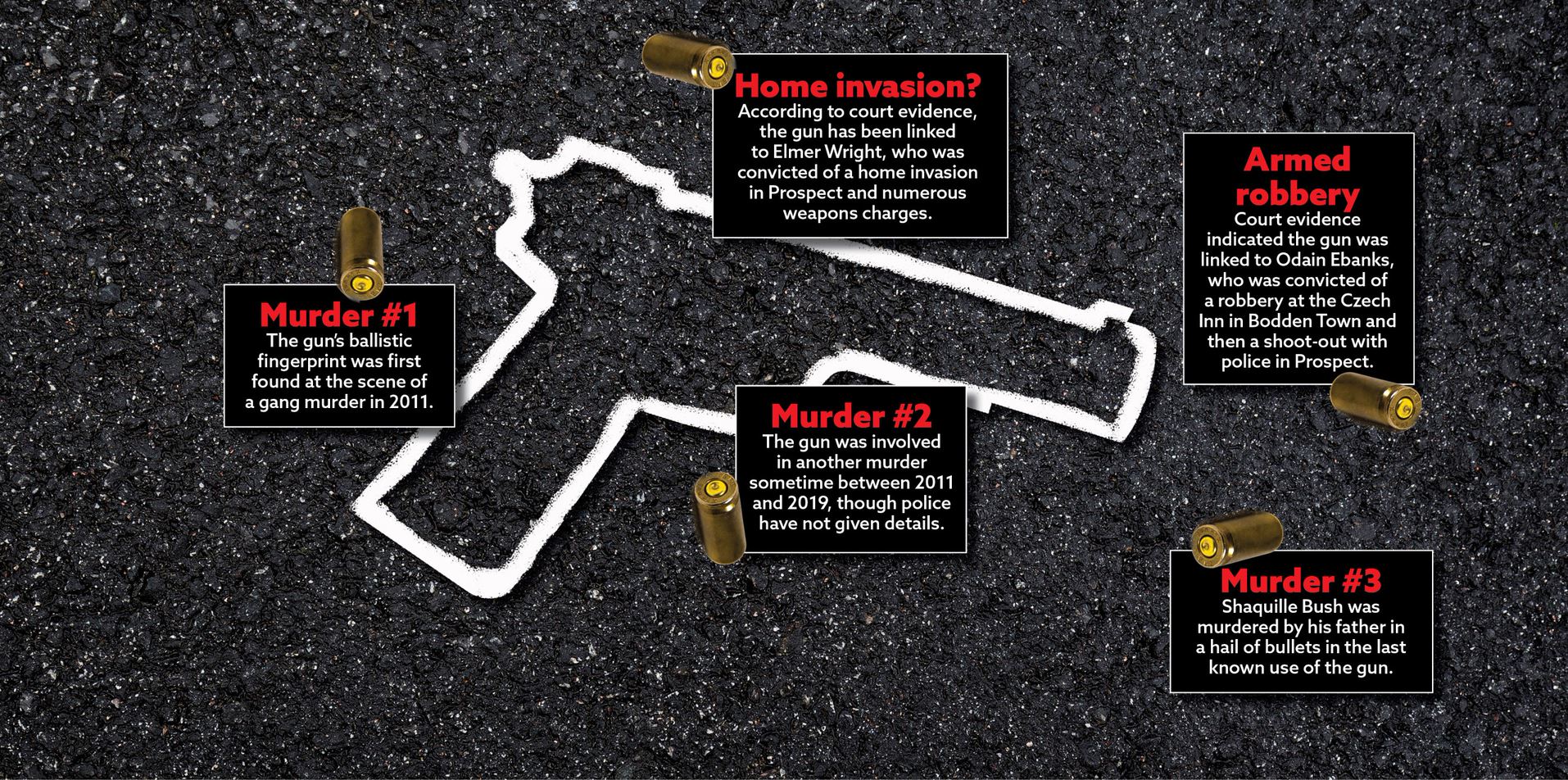
The mystery weapon – a smoking gun that could help solve a string of violent crimes – first blipped on the radar in 2011, when it was used in a homicide, one of several gang killings late that year.
Its unique ballistic fingerprint was discovered again at the scene of another grisly murder almost a decade later.
Between those crimes, it has left a trail of carnage in its wake. Getting it off the streets could help prevent future violence and solve past crimes.
But despite their best efforts, the Royal Cayman Islands Police Service have, so far, turned up nothing.
 Details of the gun’s history came into the public domain during the murder trial of Roger Davard Bush, who was convicted of killing his son, Shaquille Bush, in what the prosecution described as a “hail of bullets”.
The apparent motive for the crime was a rumour of an affair between the younger man and his father’s then-girlfriend.
Police firearms experts testified and submitted evidence in that case of how the same weapon had been identified in at least nine other crimes.
The gun’s precise history, including details of the exact incidents, was attached in the evidence bundle for the judge-alone trial but was not formally admitted as an exhibit – apparently because of police concerns about its sensitive nature.
Cayman Compass efforts to obtain the document, which have been ongoing since June, have been resisted by both the courts and the police.
Justice Marlene Carter, who presided over the trial, through her personal assistant told the Compass she would make a ruling on whether to release those details to this publication. However, no ruling had been given to the Compass by the judge’s stated deadline of 12 Oct. and subsequent follow-up emails have not been answered.
The Compass also requested an interview with the RCIPS to discuss the gun and its links to crime in Cayman over the last 11 years. Police declined, stating the information “has potential to jeopardise our ongoing police work to locate the weapon”.
“We will not be releasing this information, either via interview or via FOI as it is part of an active investigation,” said a spokesperson for the RCIPS.
The unknown gun
What authorities know about the gun has been pieced together from bullet casings found at various crime scenes.
When a gun is fired, the bullet and the spent-shell is imprinted with a unique microscopic pattern unique to that gun – similar to a human fingerprint.
Over the years, police have gathered numerous bullets and casings and scanned them using laser-point accuracy.
The data is then saved in their ballistics hub, which cross-references each new entry with its database.
By doing this, police have been able to conclusively say which guns were used in crimes that involved shots being fired.
According to evidence extracted from an RCIPS ballistics report, which was admitted as evidence in the Bush murder trial and given to the Compass by the court, police recovered 15 spent 9mm Luger bullet casings from the scene on Miss Daisy Lane.
The report revealed that all the bullets were more than likely fired from the same gun.
According to data from the RCIPS ballistics hub, the gun used to kill Shaquille Bush was also used in numerous other crimes, including one of the tit-for-tat gang killings in West Bay in September 2011 and another unidentified murder.
Little else is known about the weapon.
The make and model of the gun, how it came to be in Cayman, and its rightful owner are still a mystery to police.
The type of bullet and the quantity of ammunition discharged during the murders also puts forward two different theories on the type of gun. Either it is a revolver, which was reloaded by the shooter multiple times during the incidents or, more likely, a semi-automatic handgun capable of housing a minimum of 16 bullets.
What is clear, however, is that those with criminal connections throughout Cayman have been able to come by the gun in question quite easily.
A history of violence
Without the assistance of the police, it is difficult – but still possible – to piece together a partial history of the weapon from the evidence that was aired in open court at the Bush trial.
His lawyer, Oliver Blunt, KC, summed up the trail of destruction.
“These were serious incidents involving attempted murder, shots being discharged, armed robbery, murder, more armed robbery and more murder,” he said.
Blunt sought to suggest the weapon was in the joint ownership of the Birch Tree Hill Gang. But prosecutors alleged it was a “gun for hire” available to anyone in the know for the right price.
Sources affiliated with Cayman’s gun and gang culture spoke to the Compass under the condition of anonymity.
“I know the gun, I had initially wanted to buy it for 15 bills but they said it belongs to [OMITTED] and it was going for that price because it had two duppies on it,” said the source.
When asked where the gun was now, the source said they didn’t know.
A gun for hire
If the prosecution’s theory of the gun is correct, and the weapon is indeed a communal gun, it would put it in line with international trends.
As far back as 2012, police tasked with combatting inner-city gun crime in places like New York City found that criminals are sharing what have now been termed “community guns”.
“They don’t want to keep the weapons on them but want to have access to them,” said Manhattan District Attorney Cy Vance during a press conference at the time. “It poses challenges in terms of prosecution, to the police on the street. It [also] puts the weapon in the hands of a larger number of people.”
In his closing speech in the Bush trial, defence lawyer Blunt name-checked a slew of dangerous criminals, who he said were likely to have been connected with the weapon – giving further credence to the concept of a community gun here in Cayman.
Referencing evidence from a police firearms specialist, Blunt also listed Elmer Wright and Odain Ebanks – not believed to be directly affiliated with any gang – as criminals convicted in cases involving the same firearm.
However, without the police list, which the RCIPS has refused to disclose, the Compass cannot be sure precisely which crimes the gun was used in.
Publicly-accessible court records indicate the likely candidates, in addition to the murders, could include an armed robbery at a Bodden Town restaurant and a home invasion in Prospect; for which Odain Ebanks is serving a 14-year sentence and Elmer Wright is serving a double life sentence.
Gun crime in Cayman
Gun crime remains relatively rare in the Cayman Islands, especially in comparison to others in the region.
Between 2011 and 2019, when the gun was being lethally used, there were 24 killings, three of which were linked to the mystery gun, making it responsible for 12.5% of the fatal shootings during that time.
According to the RCIPS crime report for 2021, police recorded 57 “Firearms Enabled Crimes” in 2021 compared to 30 in 2020.
The last shot
Based on the evidence used to convict Roger Bush, the weapon may have already claimed its last victim.
According to the prosecution’s star witness, Nikkieta Ebanks, who is also the estranged partner of Roger Bush, the gun was disposed of by Bush’s nephew after it was last used in the murder on Miss Daisy Lane.
Since that fatal shooting, the weapon has not been forensically matched to any subsequent firearms case.
But the history of the gun suggests it might not have been destroyed, but simply taken out of use for a period of time.
Related Videos