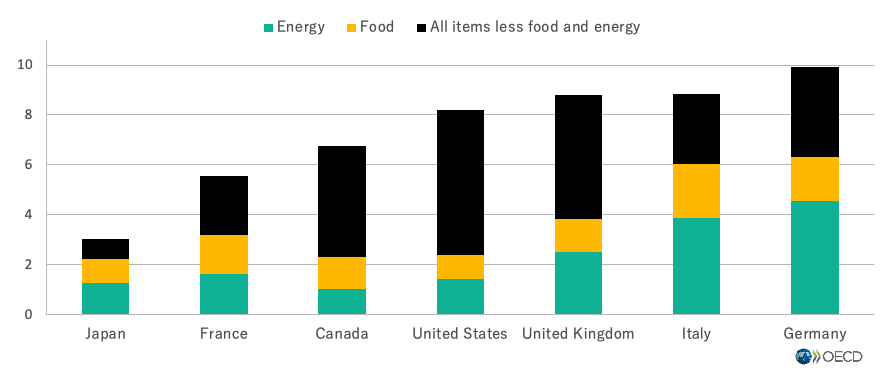
Core inflation is on the rise internationally.
While double-digit inflation rates in OECD countries are predominantly caused by the high cost of energy, consumer prices excluding food and energy continued to increase in September.
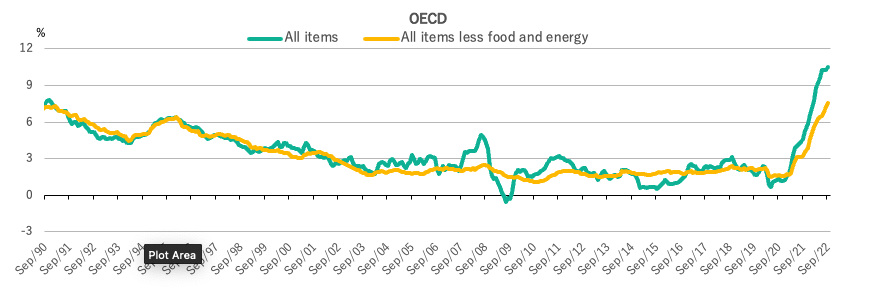
Overall, the consumer price index across OECD countries rose to 10.5% from 10.3% in August. Half of 38 OECD countries are experiencing double-digit annualised inflation rates.
Meanwhile, core inflation reached 7.6% as price hikes for services accelerated in most countries.
Despite a fall in energy prices in most OECD markets, energy inflation remains high at 28.8%.
In the euro area, consumer prices rose from 9.1% to 9.9% in September.
A Eurostat flash estimate for the euro area in October 2022 shows a further increase in year-on-year inflation to 10.7%, reflecting essentially a resurgence of higher energy prices.
In the United States, consumer prices were up 8.2% year-on-year in September but dropping more slowly than expected. Core inflation in the US continued to rise to 6.6% during the month.
The Cayman Islands saw record inflation of 12.1% in the second quarter. Although the Economics and Statistics Office has not yet provided an updated core CPI figure, it is likely to be higher than the 5.8% in 2021.
Real household income declines
Not surprisingly, higher prices have depressed the level of household incomes when inflation is taken into account.
Real household income per capita fell by 0.5% in the OECD in the second quarter of 2022, marking the third consecutive quarter it has dropped.
In the UK, this declining trend held firm for the last four quarters, while households in the US have seen diminishing income for five consecutive quarters, reflecting both the reduction in pandemic-related government assistance and higher prices.
Unemployment rates stable
The OECD unemployment rate was only marginally higher in August 2022 at 4.9%, up from 4.8% in July but at the same level as in June.
Overall, the unemployment rate was below or equal to the pre-pandemic rate in 80% of OECD countries.
This comes at a time when the OECD’s labour force participation rate of 73.2% in the second quarter reached its highest level since it was first recorded in 2008.
Related Videos