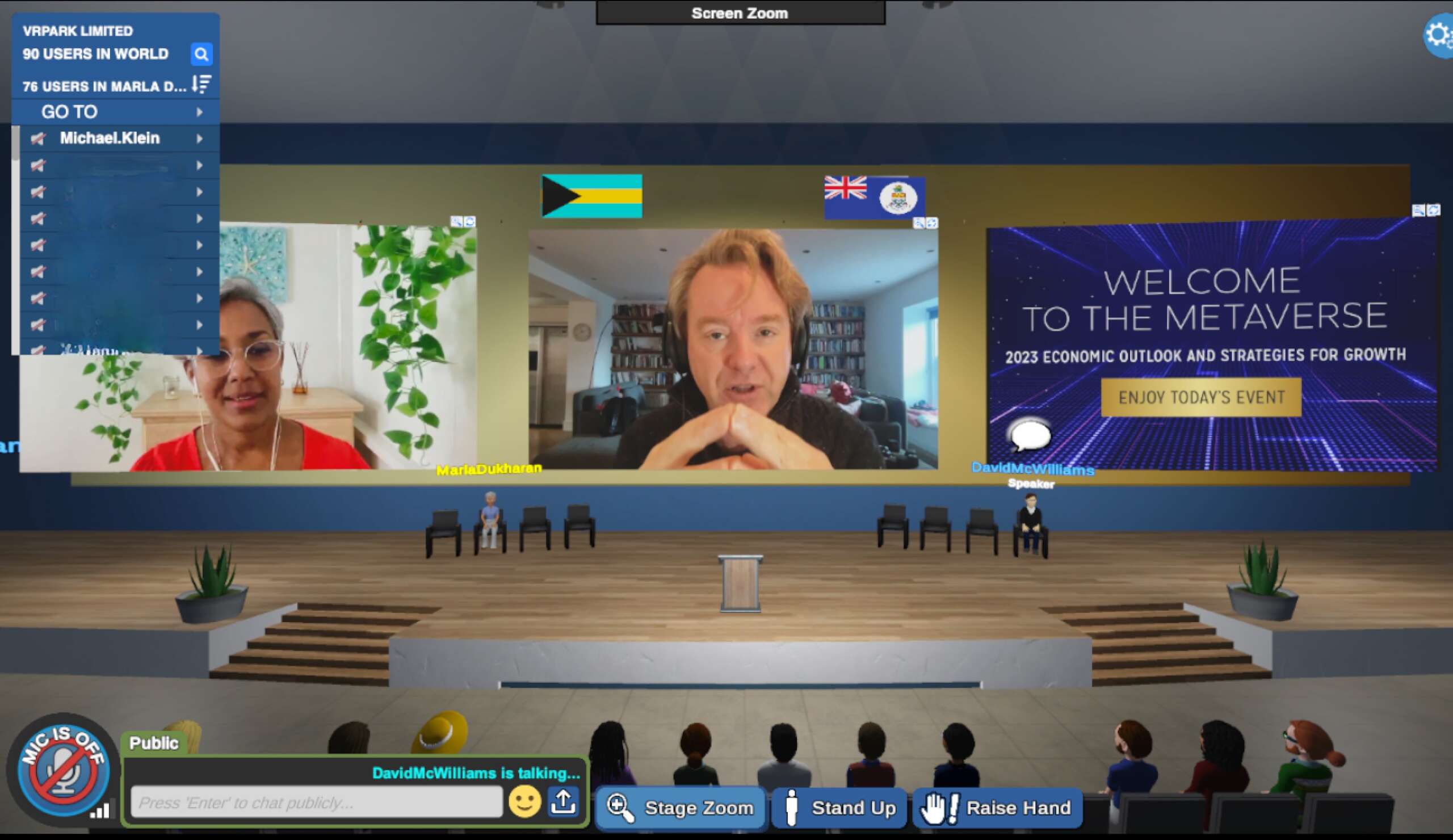
Economists at the virtual conference ‘Into the Metaverse’ painted a gloomy picture of a watershed moment for the global and regional economy, as mounting geopolitical and social problems are dimming the economic outlook for next year.
Economist David McWilliams argued that the world is reaching the end of an economic supercycle, a sustained period of economic expansion.
He described the current cycle as the tail end of a 40-year period that started with Ronald Reagan and Margaret Thatcher. It entails the opening up of China, the fall of the Iron Curtain and the end of communism, as well as the emergence of new technologies.
It is a general cycle of disinflation and the globalisation of supply chains.
It also is, the Irish economist said, the end of a period of naivety and the presumption that everyone is going to turn into “nice Europeans or nice Americans” and that there is only going to be one ideology that would emanate from monetarism.
The world is now getting a reality check, in terms of the naivety that the United States and China are always going to be friends, that Russia is not the enemy of Europe, that technology is only a force for good, that there is always going to be cheap money, cheap energy and cheap labour, and that inflation will remain low.
It is the kind of tipping point that repeats in history, McWilliams said, comparing it to a period in the 1920s after the Spanish flu, and adding that it has been “experienced by our parents and grandparents”.
“The issue is, how do we deal with it? How do we deal with all this incoming, economic, social, political problems?”
Shrinking away from the challenge will only lead to emergence of bad actors, he said.
McWilliams estimates that the potential for recession in the United States “is enormous”, despite very low levels of unemployment.
He believes the US “will take it much slower than people imagined”, while for Europe the big issue going forward will be Russia and its war in Ukraine.
Weaker global growth
Against this backdrop of heightened uncertainty and a more complicated geopolitical picture, conference host Marla Dukharan noted that countries in the Caribbean will have to contend with much weaker global growth for the foreseeable future.
The economist from Trinidad, who is based in Barbados, said “things are going to be difficult” for economies that are heavily reliant on trade, remittance flows, tourism and foreign direct investment.
“All of those countries are slowing down,” she said. “We’re really not going to see the kind of growth that we saw in the run-up to the pandemic, not for a few years.”
Unlike other Caribbean countries, the Cayman Islands only saw a relatively moderate contraction during the pandemic, due to its reliance on financial services, and the economy has been growing positively since last year, she noted.
For the first quarter of this year, Cayman’s economy grew 3.8%, with projected growth for this year around 3.4%. The total labour force increased in the first half of 2022 by about 12%.
The Economics and Statistics Office forecasts 3% growth for 2023, Dukharan added.
Related Videos