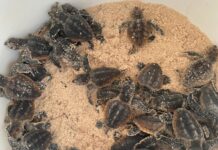
Researchers at the Cayman Islands Department of Environment and the University of Exeter have teamed up on a project on how to protect local turtles from the multiple threats caused by climate change.
The project, ‘Mitigating the impacts of climate change on sea turtle populations’, a DoE statement said, will assess the “impacts of rising temperatures, increased storminess and sea-level rise, and devise ways to protect turtles”.
Premier and Minister for Sustainability and Climate Resiliency Wayne Panton welcomed the collaborative project.
“It is a concern that turtle nesting beaches in the Cayman Islands are already being impacted by rising temperatures and increased storminess, and further sea-level rise will lead to loss of this critical habitat. We are hopeful this project will identify ways to mitigate these threats to sea turtles,” Panton said in the statement.
The project has received a grant of almost £400,000 from the UK government’s Darwin Plus scheme, the DoE said.
“Darwin Plus is a UK government grants scheme that funds projects that aim to protect the unique biodiversity and improve resilience to climate change within the UK Overseas Territories,” it explained.
Threats to turtle population
The DoE said that local sea turtles are recovering from over-harvesting, “but climate change is causing habitat loss, [and] an increasingly female population (the sex of turtle hatchlings is determined by temperature) and has the potential to reduce egg-hatching success”.
In 2022, a record 858 turtle nests were recorded, the highest total since the DoE starting logging statistics in 1998.
The previous high of 689 nests was recorded in 2017. Last year’s numbers represented a 54% increase over the overall total in 2021.
While green sea turtles recorded the sharpest increase last year, with 528 nests compared to 180 in 2021, loggerhead nests had a slight decrease on the 350 recorded last year.
Cayman suffered lost nests due to storm wave action as well as coastal erosion.
The DoE said using turtles as a “flagship” species, the team will also develop local capacity and outreach to improve management of coastal areas.
Professor Annette Broderick, of the Centre for Ecology and Conservation on Exeter’s Penryn Campus in Cornwall, said the UK team of researchers is “delighted to be continuing our long-term collaboration with the Cayman Islands Department of Environment, with whom we have been working for over 25 years”.
She added, “The impacts of climate change on marine species are far reaching, and for species such as sea turtles, that come on to land to lay their eggs, protecting nesting beaches is critical for their future survival.”
Jane Hardwick, marine research officer and manager of the DoE Sea Turtle Programme, said the team was “thrilled to be partnered with Exeter University on this important project”.
“This research aims to explore how sea turtle hatchling feminisation, due to climate warming, could impact future populations, and whether this can be mitigated with non-invasive techniques such as nest shading. Data will also be used to model nesting beach erosion from storms and impacts of predicted sea level rise, to determine the most vulnerable nesting beaches, so that better coastal protection can be applied,” she added.
Related Videos