


A Grand Court judge has issued a temporary stay on government regulations banning the feeding of stray animals and their release back into the wild after spaying and neutering.
The controversial National Conservation (Alien Species) Regulations were passed by Cabinet in December last year in a bid to implement control measures on feral animals that threatened local endemic species, such as seabirds, and blue and rock iguanas.
The regulations were met with much criticism from local animal charities and residents, who say they were not consulted on the plan to implement them, and that they were too heavy-handed.
Animal charity Feline Friends, which runs a spay-neuter-release programme for stray cats, has now succeeded in its application to seek leave to bring a judicial review of the regulations.
Justice Marlene Carter, an acting judge of the Grand Court, in a ruling dated 4 April, said she was satisfied that Feline Friends had met the required threshold on the application for leave, as the grounds of its challenge “are not obviously vexatious or frivolous”, and the charity had a legitimate interest in the matter.
She said there was an “arguable case” based on three of the four grounds raised by Feline Friends.
The judge dismissed one of the four grounds, saying she did not agree with the applicant that the enactment of regulations was “procedurally unfair”. Feline Friends had argued that it was unfair due to the government’s lack of consultation with the public and relevant stakeholders.
Feline Friends pointed out to the court that it has provided free community trap-neuter-and-release, healthcare and feeding programmes on Grand Cayman for stray and feral cats since 2011, and therefore was “severely impacted” by the enactment of the regulations which criminalised those practices.
The charity noted that the regulations refer to “domestic cat” and provide that if it is living in the wild, defined as any area which is not under active management and control of any person, it may be destroyed “in a manner which does not cause unnecessary suffering”.
It also noted that the regulations make it is an offence to feed such a cat, and that a person who contravenes the regulations is liable to “manifestly disproportionate” penalties, under Section 38 of National Conservation Act, of a maximum fine of $500,000 or a four-year prison term, or both.
The Department of Environment has previously noted that such a penalty is extremely unlikely, as it is the maximum outlined in the law, and would only be used for much more serious offences.
In its submissions about the case, the attorney general, arguing on behalf of Cabinet as the respondent and the National Conservation Council as an interested party, said the court should not grant leave to apply for a judicial review because Feline Friends had not complied with a protocol that “sets out a code of good practice and contains the steps which parties should generally follow before making an application for judicial review”.
However, the judge ruled that while the court endorses full compliance with the protocol and encourages parties to explore alternative methods to litigation to resolve matters, “non-compliance with the protocol is not determinative of an application for leave”.
Exceeded scope of legislation
Feline Friends, represented by Jackson Law, argued in one of its grounds that the regulations were unlawful because they exceeded the scope of the National Conservation Act by “creating definitions for terms … [that] effectively alter the spirit and intent of the NCA”, and by authorising the killing of feral animals, which is the remit of the Department of Agriculture and its director under the Animals Act.
On another of its grounds, the charity argued that the enactment of the regulations was “irrational” as neither Cabinet nor the National Conservation Council possessed the “necessary independent scientific information/data to make a reasonable determination as to the need for and/or effect of the regulations”.
It added that it was unreasonable to authorise private persons to kill a feral animal, and that the effects of the ban of feeding and releasing animals were “counterintuitive and counterproductive”.
The charity also said it was “manifestly unreasonable” to apply the regulations in the same way across all three islands as “different considerations apply to the different islands and even within particular areas within Grand Cayman”.
The charity argued that the regulations are also incompatible with the Constitution as they “threaten the unlawful interference with personal property rights protected by Section 15 of the Constitution, including the personal rights to an animal and the personal rights to the enjoyment of property by feeding and/or providing water” to that animal.
It further stated that the regulations breached Section 19 of the Constitution as they were “not lawful, rational, proportionate and/or procedurally fair”.
Justice Carter stressed that the court was not at this time concerned with the merits of the claim.
“It is no part of my consideration at this stage to determine the issues raised by the affidavit of the Applicant,” she said. “I am satisfied that the Applicant has met the required threshold on the application for leave.”
Sammy Jackson, representing Feline Friends, told the Compass his firm has been instructed to “file an originating motion and move forward to have the court determine the issues on which we have been given leave to proceed”.
No date has yet been set for the hearing.
Related Videos
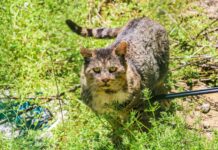
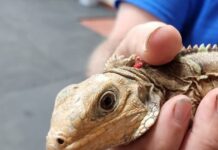
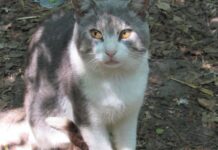
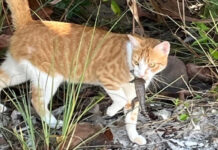








Stray cats are highly destructive of native species, including endemic birds and lizards, and they have no local predators.
Spaying and releasing them to carry on killing is not a solution.