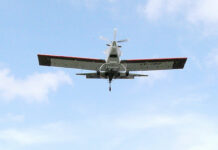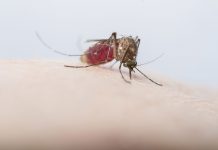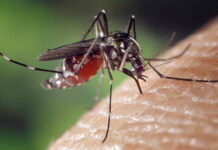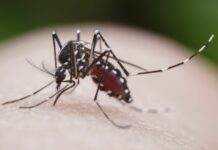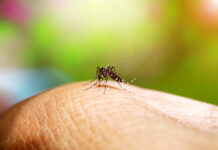
The Health Ministry has confirmed that both of its aerial spraying planes are currently out of commission and that the surge of mosquitoes is expected to increase over the next few days.
The ministry, in response to Cayman Compass queries, said it has been unable to conduct any aerial operations since 14 April due to a “necessary repair” that was discovered during weekly inspection of one of its aircraft.
“The necessary technical expertise has been sourced and will be on island this week to make the repairs. It is expected that the aircraft should return to service by next week. The other aircraft is currently undergoing its required annual inspection and not available until this is completed in about one month’s time,” the ministry told the Compass in an emailed response.
However, it said that ground ultra low volume (ULV) fogging operations will continue to be conducted at full capacity until the current mosquito problem has been resolved.
High tide increases mosquito population
The Mosquito Research and Control Unit said it has received six complaints about a high abundance of mosquitoes over the last three weeks.
“This represents a slight increase over what would typically be received at this time of the year and indicates a mosquito emergence. MRCU encourages the community to submit concerns to 949-2557 as this form of community engagement is important,” the MRCU told the Compass.
So far in 2023, according to the MRCU, there have been three large mosquito emergences with the most significant occurring on 20 Feb. when there was an average trap catch of 277 mosquitoes.
However, the MRCU said, in the emergence on 27 March there was an average of 214 mosquitoes per trap; the current emergence has to date peaked at an average catch of 132.
“It is expected to increase further over the next few days as more mosquitoes emerge,” the unit cautioned.

Although there has been some heavy rainfall in April, the primary cause of the current mosquito emergence is high tides, the MRCU said.
“Any tide that is above 30cm will cause flooding of the mangrove areas. On 6 April, the tide rose above this level and increased gradually until it reached a peak of 64cm on the 19 April. This is the highest-ever tide recorded by MRCU. The result of this extended high tide has been to hatch mosquito eggs that have remained dormant for many years,” the MRCU said.
The MRCU said it does not conduct spray operations on a schedule as all insecticide applications are conducted based on a daily evaluation of the mosquito situation.
Since the onset of the current mosquito emergence on 13 April, the MRCU said it has conducted 40 separate ground ULV control missions across Grand Cayman and treated a total of 68,143 acres.
The unit said it has enough insecticide to deal with the current as well as future mosquito emergences.
“The problem is the lack of aircraft to apply the products aerially. Ground application still continues,” it said.
Even as it awaits the return of the planes, the Health Ministry said there is only one pilot to conduct the aerial spraying.
It said it is recruiting a second pilot to ensure that aerial operations are properly resourced.
Filling the post requires an experienced pilot, the ministry said, so “recruiting the person with the necessary skills takes time”.
No mosquito borne-diseases
Public Health has confirmed that there have been no cases of mosquito-borne illnesses reported in 2023.
“We continue to monitor for cases of mosquito related illnesses which include malaria, dengue, zika, and chikungunya,” it said, adding that mosquito-borne viral disease “is not considered to be endemic to the Cayman Islands as historically there has been no sustained transmission of the disease”.
Public Health is encouraging residents to take precautions when outside during peak mosquito hours (sunrise and sunset).
“This includes wearing long sleeve clothing and utilizing your mosquito repellent while outdoors,” the department said. “Mosquito repellent containing 50% DEET can also be used when outside during peak hours for added protection. Additionally, please ensure that you drain any still water in receptacles in the yard (tyres, plastic containers ) to prevent mosquito breeding, and ensure your doors and windows remain closed if they are not screened.”
Related Videos